If you’re stuck between print on demand vs. dropshipping, you’re not alone. One path feels like the “easy start” route: find a product, run ads, and let a supplier handle fulfillment.
The other feels like the “creative brand” route: design something original, build a following, and grow something that lasts.
That tension creates real analysis paralysis, because this print on demand vs dropshipping decision isn’t just about which model is simpler. It’s about which model fits how you actually win.
Why the print on demand vs dropshipping decision changed in 2026
| Critical difference | Dropshipping | Print on demand |
| 1. Customization and brand control: the design moat | Limited product control, so differentiation is mostly marketing-led. | White label by nature, so differentiation is design-led and brand-led. |
| 2. Profit margins and pricing power | Commodity pricing pressure can squeeze margins as CAC rises. | Design-driven perceived value can support premium pricing and healthier margins. |
| 3. Inventory and financial risk | Low inventory risk, higher exposure to supplier variance, refunds, and support load. | Zero inventory risk, and risk shifts to design-market fit and product selection. |
| 4. Speed to market: validation | Fast to list, but testing often depends on ad cycles and trend timing. | Fast to create and test because design, mockups, and listings can be iterated quickly. |
| 5. Shipping times and customer satisfaction | Shipping experience varies by supplier and fulfillment centers, which can increase uncertainty. | More predictable timelines when orders route through regional fulfillment centers and published production windows. |
| 6. Competition and saturation | Easier to replicate because competitors can source the same product and mirror ads. | Harder to replicate because designs are tied to intellectual property and brand consistency. |
| 7. Long-term asset value: exit strategy | Often valued as a cash-flow engine tied to suppliers and paid traffic. | More likely to build brand equity through a design library, repeat buyers, and owned channels. |
In 2026, ecommerce isn’t mainly a product-access game anymore. It’s an attention game, and attention keeps getting pricier.
- Digital channels account for 72.7% of worldwide ad investment, with online ad spend exceeding $790 billion in 2024.
- Global advertising revenue passed the $1 trillion milestone in 2024 and was forecast to reach $1.1 trillion in 2025, reinforcing how competitive paid visibility has become.
- For many new sellers, that cost shows up as customer acquisition cost: one benchmark report puts average CAC at $66 for fashion/apparel ecommerce.
- Even at the top of the funnel, “just getting seen” can be costly: one US benchmark report puts typical Meta CPM ranges around $10–15 on average.
That’s why “easy to start” can quietly become “hard to sustain” if your only lever is paid traffic.
What is dropshipping?

Dropshipping is a retail fulfillment method where you sell products online without holding inventory. When a customer places an order, you forward it to a third-party supplier, and that supplier stores, packs, and ships the product directly to your customer.
Where products come from varies, but many sellers source from supplier directories and marketplaces such as AliExpress, and similar networks that connect retailers with manufacturers and agents.
Think of dropshipping as running a storefront for products you didn’t invent. You’re the middleman who connects demand to a supplier.
Also the curator who picks a tight set of items and packages them into a niche that feels intentional. And of course, the trend hunter who moves fast when something starts selling.
Your real craft is in the offer, the positioning, and the marketing that gets the click, because the product itself is usually the same one that other stores can source too.
You do not own the product design; you own the marketing and the customer relationship. That means your edge comes from positioning, creative, and traffic, while the supplier controls the underlying product, packaging options, and fulfillment consistency.
What is print on demand?

Print on demand is a white-label dropshipping model where products start “blank,” and your design is added only after a customer places an order. A print partner then produces and ships the item for you, which means you can sell physical products without holding inventory.
Think of print on demand as building a real label without renting a warehouse.
You’re creating what the customer is buying. The “product” becomes your taste, your point of view, and the identity your designs help someone wear, gift, or display. The fulfillment partner handles production and shipping, but the brand is yours to shape.
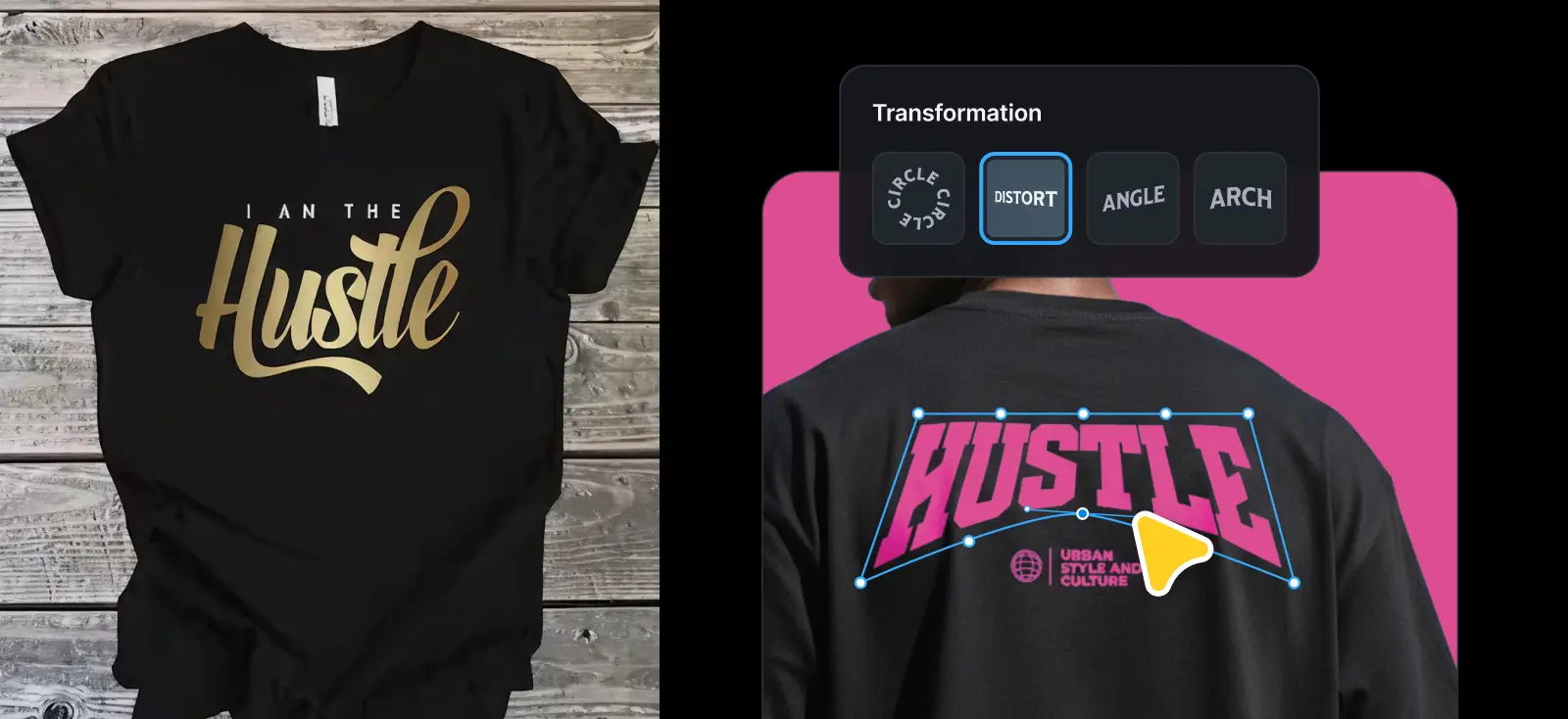
You own the IP and the brand. In practice, that means you control the original artwork and the customer-facing identity. Then, a print provider supplies the base product and fulfills orders. The biggest weakness beginners face in POD is amateur-looking design. Kittl removes this barrier. With thousands of premium-quality templates and an AI Image Generator, you can launch studio-quality designs in under 5 minutes, building a ‘Design Moat’ without hiring an expensive graphic designer.
Print on demand vs dropshipping: the 7 critical differences
If you’re asking what is the difference between dropshipping and print on demand, it’s this:
Dropshipping wins when you can out-market everyone else on the same product, while POD wins when you can out-design everyone else with something customers can’t get anywhere else.
In the real world, POD vs dropshipping comes down to how much control you want over the product, the customer experience, and the long-term value of what you’re building.
1. Customization and brand control: the design moat

- Dropshipping: Low control, marketing-led differentiation. Dropshipping is a retail fulfillment method where you sell without holding inventory and a supplier ships orders directly to customers, which means you typically have less control over product quality, consistency, and the brand experience.
- Print on demand: White label by nature, design-led differentiation. POD products start blank until your design is applied, so your brand can feel more distinct and more relational. You can add white label touches like custom inside labels and branded pack-ins to make the unboxing feel like your brand. The biggest weakness beginners face in POD is amateur-looking design, and that’s where Kittl reduces friction with premium templates and AI tools that help you ship polished, studio-quality visuals faster.
2. Profit margins and pricing power: dropshipping vs print on demand

- Dropshipping: Low control, high squeeze. When many stores can source the same product, price competition is common and profitability gets vulnerable to customer acquisition cost (CAC). A common “math reality” is roughly a 20% margin paired with roughly a 2% conversion rate, and then advertising and support costs eat into what’s left.
- Print on demand: High perceived value, stronger pricing power. POD costs more per unit, but uniqueness can justify premium pricing because customers are buying identity, not a generic listing. A widely used benchmark for POD is that a “good” profit margin often sits around 20% to 40% to cover platform fees, shipping, and marketing while still leaving profit.
3. Inventory and financial risk: who holds the risk when things break

- Dropshipping: Low inventory risk, higher fulfillment risk. You don’t buy stock upfront, but you absorb operational risk when supplier quality varies, shipments slip, or the customer experience breaks, because you still own the customer relationship.
- Print on demand: Zero inventory risk, standardized production expectations. Orders are produced only after purchase, so unsold stock risk stays at zero. Established providers often publish production standards and timelines, such as the note that most products are produced within 2–5 business days.
Made-to-order production can reduce overproduction, which matters in a world where UNEP reports 92 million tonnes of textile waste are produced each year globally.
4. Speed to market and validation: why POD can be faster in 2026

- Dropshipping: Fast to list, slower to validate. You can import a supplier product quickly, but validation often becomes the real time sink as you iterate creatives, angles, and offers until something sticks.
- Print on demand: Faster iteration with templates, AI, and mockups. In 2026, design time is less of a bottleneck when you can generate directions and refine quickly. Kittl helps creators move faster by using better prompts and structure from this AI design prompt guide, then turning concepts into listing-ready visuals using the mockup generator.
5. Shipping times and customer satisfaction: the delivery date factor

- Dropshipping: Cross-border delays can create anxiety. When products ship from overseas, delivery can be slower and less predictable. With ePacket, many orders arrive within seven to 15 days, which can increase customer worry if expectations aren’t clear.
- Print on demand: Regional fulfillment centers and clearer timelines. POD isn’t instant because items are produced, but major providers publish expectations like 2–5 business day production and can route orders through regional fulfillment centers. Printify also supports geo-routing through Global Fulfillment, fulfilling eligible products locally in the US, Canada, the UK, Australia, and the EU.
- Clarity beats speed for conversions. Baymard’s checkout research recommends showing delivery dates rather than shipping speeds because dates remove guesswork and reduce friction.
6. Competition and saturation: copy-paste pressure vs defensible creativity

- Dropshipping: Easier to copy, faster competition. Low barriers to entry can create intense competition, especially when marketing costs stack up against thin margins. Competitor monitoring is also easier now, because anyone can look up ads by advertiser using the Google Ads Transparency Center.
- Print on demand: More defensible through intellectual property. POD is still competitive, but copying your “product” requires copying your creative. That ties directly to intellectual property, and staying original is both a brand advantage and a risk-management move.
7. Long-term asset value and exit strategy: what you can sell later
- Dropshipping: Often valued as a cash-flow engine. Dropshipping stores can be profitable, but if the engine relies heavily on paid traffic and unowned differentiation, it can feel less durable to a buyer. A common valuation method is average net profit multiplied by a multiple, and that multiple is heavily influenced by risk and transferability.
- Print on demand: Brand equity builds transferable value. POD aligns more naturally with building brand equity through a repeatable visual identity, returning customers, owned channels, and a design library that functions like product IP. The compounding advantage is that you can keep launching new SKUs from the same brand system, instead of restarting every time a single trend fades. For inspiration on what that looks like in practice, see these successful POD store examples.
Why is design the winner in 2026?
In print on demand vs dropshipping, design is the advantage that compounds. Products are easier than ever to source, but attention is harder than ever to earn, and “generic” is easier than ever to scroll past.
1. The shift to hyper-personalization
Personalization is no longer a nice-to-have. In a global BCG survey of 23,000 consumers, four-fifths said they’re comfortable with personalized experiences, and most expect companies to personalize.
What that looks like in the real world is micro-niche identity: items that feel like they were made for “my people.” A simple example is an inside-joke shirt concept, like the niche angles in Kittl’s guide to designing and selling DIY funny shirts, where humor, relatability, and “only we get it” references turn a basic t-shirt into a personal signal.
Etsy and similar e-commerce websites are seeing the same demand pattern in gifting, highlighting trends driven by personal expression and products that “tell a story.”
Top 3 niches for POD in 2026 vs dropshipping
- Personalized gifts
Demand is measurable: the U.S. personalized gifts market was valued at $9.69 billion in 2024. A reliable way to play this niche is to turn identity pride into giftable designs, like personalized pride merch with customizable flag colors, where the design is the emotional hook. Use Kittl’s text-effects feature to create unique name-based typography. - Local pride
Local pride works because it’s instant identity: neighborhoods, slang, landmarks, and “if you know, you know” references. POD tends to outperform generic dropshipping here because the design is the product, and a consistent visual style makes the store feel like a real local brand rather than a generic catalog. Tools like Kittl provides vintage and retro logo assets that are perfect for city or locally themed designs. - Hobby-specific apparel
Hobbies reward specificity, not broad appeal. McKinsey’s 2025 consumer research notes that people are spending more time alone, with the biggest increases including time spent enjoying hobbies or relaxing independently. That’s fertile ground for POD because communities buy designs that reflect their identity and inside language, not just a functional item. Leverage Kittl AI to generate niche illustrations like ‘Cyberpunk gamer cat’ within seconds.
2. The technology shift
POD used to be “slower” because design was the bottleneck. In 2026, that bottleneck has shifted. With Kittl, you can start from a strong base using design templates and iterate quickly using Kittl AI tools, which means you don’t need to be a Photoshop pro to create retail-ready designs at speed.
Why bad design kills POD, and how Kittl removes that friction
In POD, the design is the product. If it looks amateur, customers don’t just skip the shirt; they skip the brand.
Two reasons this matters:
- People can form stable judgments of visual appeal extremely fast, with research showing impressions can be made within 50 milliseconds.
- When evaluating credibility, “design look” is a dominant signal: Stanford’s research found it appeared in 46.1% of credibility-related comments.
Kittl’s value is reducing “design risk” through repeatability.
Templates help you avoid rookie composition mistakes, AI helps you generate and refine assets faster, and consistent styling helps your products look like a cohesive brand, not random one-off designs. Over time, that consistency builds brand equity, which is the relational advantage that’s hardest to copy.
Finally, on sustainability, POD’s made-to-order model often aligns better with sustainable fashion principles because it avoids overproduction, which matters in a world where UNEP reports 92 million tonnes of textile waste are produced globally.
The hybrid model: can you do both?

Yes, but the safest version for creators is a two-phase hybrid, not a forever-mix.
It’s true that both models rely on third-party suppliers for fulfillment, and Shopify even groups them as closely related approaches that shift stock and fulfillment to suppliers. That’s why combining them can feel natural at first.
But running dropshipping and POD products together in one store can create a customer experience trap: items may ship from different factories at different times, arriving in separate packages with separate tracking and delivery windows.
Shopify documents how orders can involve split shipping from different locations or profiles, which is where confusion (and support tickets) tends to spike. Use dropshipping as market research, then transition fully into POD to lock in brand equity.
A solution-oriented warning: why “mixed catalogs” can hurt customer experience
A mixed dropshipping + POD store can work, but it’s riskier than most beginners expect because it can create:
- Split deliveries that feel like “missing items,” even when nothing is wrong.
- Multiple tracking numbers and different arrival dates, which increases anxiety and support load.
- Inconsistent packaging and presentation, which weakens trust and makes the brand feel less cohesive.
If your goal is long-term brand building, a cleaner path is a staged hybrid: test with dropshipping, then move fully into POD once the niche is proven.
The testing ground strategy: use dropshipping to validate, then switch the store to POD
If you’re unsure what to design, dropshipping can act like a low-commitment testing layer.
You list a small set of niche products, learn what people actually click and buy, then build your POD collection around the language and identity that’s already converting.
- Pick a niche with repeat-buy behavior and accessory intent, like dog accessories.
- Launch a tight dropshipping set and track which items drive the most add-to-carts and purchases.
- Identify the identity hook behind the clicks, like “dog mom,” breed pride, rescue humor, or training culture.
- Transition your store into POD-first (or POD-only) using cohesive designs that make the niche feel like a brand, not a catalog.
When the niche signal is clear, you can translate it into a cohesive design system quickly in Kittl using the prompt structure and vocabulary from this guide to AI design prompts and better results.
You can also borrow positioning patterns from these successful POD store examples and expand your catalog using these easy design business ideas you can start from home.
Cross-selling: keep it, but avoid split-shipment chaos
If you still want cross-selling, the creator-friendly way is to do it after you’ve transitioned into POD, and only add products that won’t fracture the delivery experience.
- Keep the hero product POD (shirt, hoodie, tote, mug) so the brand stays relational and design-led.
- Add only accessories that can ship with similar delivery expectations, or clearly label delivery windows per item.
- Use checkout and product page messaging that makes the shipping experience feel intentional, not accidental.
If you do mix shipping origins, know that Shopify’s split shipping behavior can apply when items ship from different locations or profiles, so clarity becomes part of your product experience.
Print on demand vs dropshipping: Which path should you choose

Choose dropshipping if:
- You’re data-driven and want to win through testing, offers, and ad iteration.
- You’re comfortable with a more transactional model where differentiation is mostly marketing-led and CAC can be a main constraint.
- You want to validate broad product demand quickly before investing time in creating a brand system.
Choose print on demand if:
- You want to build a brand that compounds through brand equity, not just short-term cash flow.
- You have a creative vision and want to own your intellectual property and product identity.
- You want a more relational model where customers buy because the design feels made for them, not because it’s the cheapest option.
- You want to create faster without needing advanced software by using Kittl templates and AI tools.
Don’t just start a store, start a brand. You can start designing for free on Kittl and build your first product concept in minutes, then refine it into a repeatable design system.