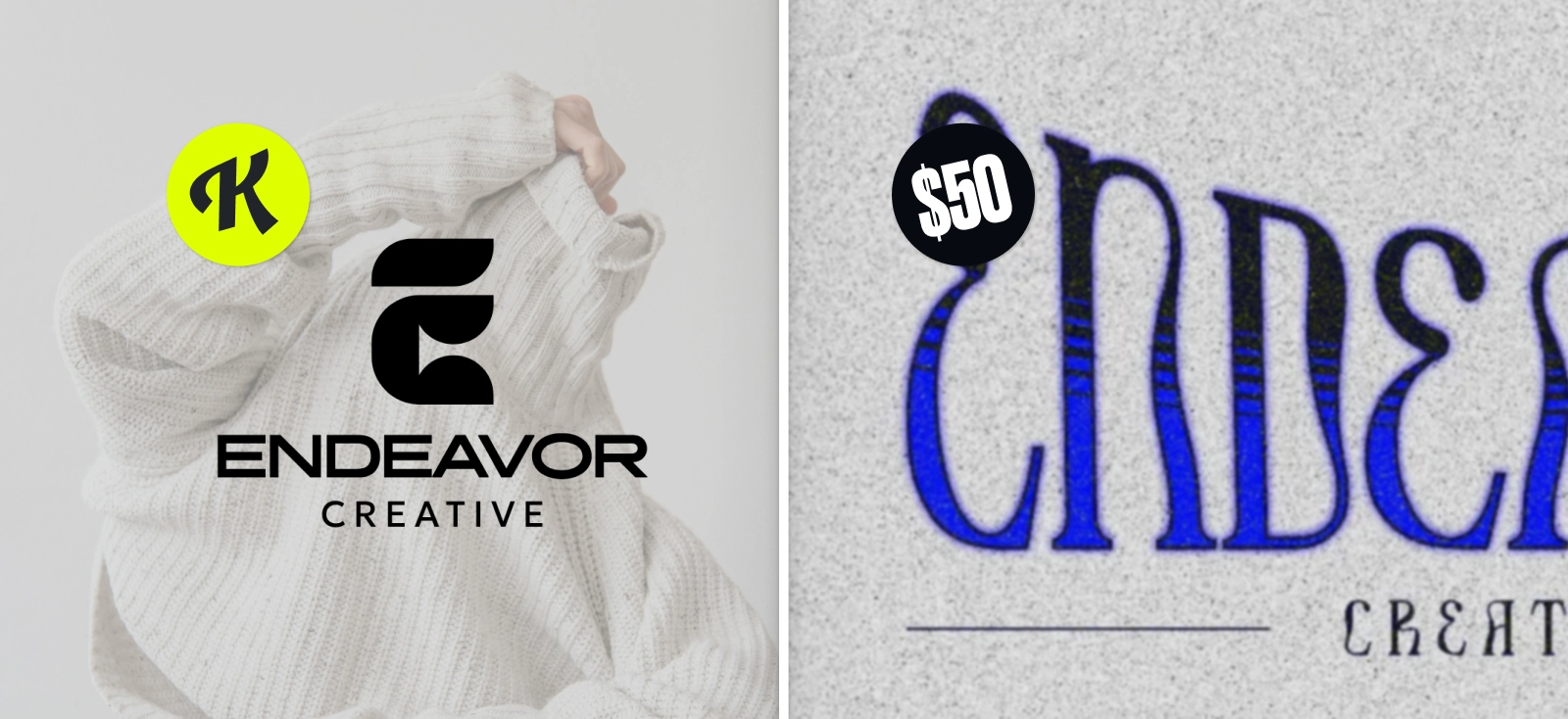
Your logo is the face of your business. So it’s fair to ask: does a $50 logo really look 100x worse than a $5,000 one? Sometimes yes, sometimes no.
The difference usually isn’t “how pretty it looks” on day one. It’s what you’re actually buying: originality, brand thinking, usable deliverables, and scalability so the mark still works when you print packaging, add signage, or build a visual identity system.
The confusing part is that logo design cost can range from free tools to agency projects, and many small businesses land somewhere in the middle.
Common pricing bands and notes that a typical “professional” range often sits around $300 to $2,500, depending on what’s included and who you hire.
That range is also where the most “value-to-risk” mistakes happen, because buyers pay for a logo but do not get the files and rights needed to use it confidently.
In 2026, the old gap between “DIY” and “pro” is smaller than ever because advanced tools can produce high-quality results fast. The catch is knowing what matters.
For example, PNG/JPEG are generally best for digital use, while PDF/SVG are better for printing, which is exactly why vectorization is often the hidden line item that turns a cheap logo design price into an expensive redo later. Our export guidance explains this in our download settings.
In this article, we’ll break down 7 pricing tiers, reveal the hidden costs (especially vectors/SVG, revisions, and licensing), and help you choose the right path for your stage of business so you protect brand equity without taking on unnecessary financial risk.
Why logo design cost change in 2026
If logo design costs feel more confusing than it used to, it’s because the market has changed. The gap between “DIY” and “pro” collapsed, but the gap between “looks fine” and “actually usable for a business” did not.
Three shifts are driving it:
- Logos now have more jobs. A modern logo has to work as an app icon, social avatar, website header, product label, and sometimes signage. That raises the importance of deliverables (especially vector formats), scalability, and building a starter visual identity system instead of a single one-off graphic.
- Tools became good enough to create a new middle tier. It’s no longer just templates versus agencies. Advanced creator tools make it possible to design, iterate, and refine marks with custom typography and precise edits, so early-stage founders can get “pro” results without paying for full agency process. This is the “smart middle” most pricing guides skip.
- Risk shifted from aesthetics to ownership. The real risk is not whether the logo looks trendy today. It’s whether it’s original, whether you can safely use it commercially, and whether you have clear intellectual property transfer when you hire someone. That’s the difference between building brand equity and building future rework.
Next, we’ll break down the four factors that dictate price so “how much does a logo cost” becomes a decision you can control.
The “why” behind the logo design cost: 4 factors that dictate price

Value-based pricing is when the logo design price is set by the business value it creates for the client, not the hours it takes to design it.
That’s why brand agencies can charge five figures when a logo is tied to high-stakes outcomes like repositioning, rollout risk, and a larger identity system, as many cost guides note when they separate simple DIY logos from premium professional work that includes broader branding scope.
But if you’re a small business asking “how much does a logo cost” or “how much does a logo design cost,” paying corporate value-based premiums is usually overkill.
You often need a credible, scalable mark with the right deliverables (especially vector files) so it works across your visual identity system without forcing a costly redo.
That’s where the smart middle wins: pro-DIY tools like Kittl’s AI logo generator help you create high-quality assets without being forced into enterprise pricing just to get something you can actually use.
So, here’s a breakdown of what value-based pricing typically looks like in practice.
1) Process vs product (and why “value-based pricing” exists)
The biggest reason logo design price varies is simple: some options sell you a finished mark, while others sell you the thinking behind it.
- Agency-level work often includes discovery, research, positioning, and alignment with your broader brand architecture and future visual identity system. That’s not billed like “hours on a task.”
It’s often value-based pricing, where the fee reflects the business impact and risk reduction for the client (not just time spent). That’s why a large company might pay five figures for a logo that helps protect or grow revenue at scale. - Pivot for small businesses: if you’re a founder or local brand, paying corporate value-based premiums is often overkill. You usually need “credible + scalable” first, then deeper strategy later.
Are you buying a launch-ready logo, or a long-term brand system that needs stakeholder alignment and rollout?
2) Deliverables (the “vector factor”)
A logo can look fine on your website and still be unusable in real life. The difference is usually not the design itself; it’s the deliverables.
- Raster files (JPG/PNG) can blur when scaled and often break in print.
- Vector files (SVG/EPS/PDF) are built for scalability, clean printing, and consistent reproduction, which is why “owning the vector” becomes the hidden upgrade fee.
What is a vector logo? A vector logo is built from points and curves (math), not pixels. That means it stays sharp at any size, from a tiny favicon to a storefront sign, and it’s easy to edit later.
This is where advanced tools collapse the DIY versus pro gap. With Kittl, you can generate vectors directly using the Vector Generator, which helps you avoid the “JPEG problem” before it shows up on labels, signage, or packaging.
Will you receive an SVG or print-ready PDF (not just a PNG)? If not, that “low logo design cost” often becomes a rework bill later.
3) Ownership and copyright (the hidden trap at the low end)
When people ask “how much does a logo design cost,” they usually mean the upfront price. But the more expensive mistake is paying for a logo you can’t safely use.
Two risks show up most often in ultra-cheap gigs:
- Originality risk: Recycled concepts or copied icons that put your brand equity at risk later.
- Rights confusion: You may get files, but there’s no clear intellectual property transfer or commercial usage clarity.
Platforms themselves acknowledge IP enforcement as a real issue. Fiverr, for example, has explicit rules around intellectual property and non-original work
Beginner-safe rule:
- Can I use this logo commercially everywhere I need to?
- Is it original work?
- Are the rights transferred to my business?
If you’re building with Kittl, link out to Kittl’s commercial licensing for a plain-English explanation of what’s covered.
4) Revisions and support (time becomes money)
Revisions are the most predictable reason a quote balloons. The more people involved, the less clear the brief, the more revision cycles you buy.
- Unlimited revisions usually cost a premium (or it’s a red flag at low prices).
- Capped revisions lower the price but require faster decisions.
- Support and handholding change the quote because you’re paying for guidance, not just files.
How many revision rounds are included, and who is approving (you vs a committee)?
5) Timeline and urgency (rush fees)
This is the missing cost driver most buyers don’t budget for: When you need a logo in 24–48 hours, you’re not just paying for design, you’re paying for schedule disruption.
Rush work often costs more because it forces a freelancer or studio to drop other commitments, work overtime, or rearrange production.
A common benchmark is a 25% to 100% premium depending on urgency (especially for 24–48 hour turnaround).
This is also where the “smart middle” becomes a practical hack: if you can generate and refine a professional logo yourself quickly (and still get vector deliverables), you can often bypass rush fees entirely and stay in control of timeline risk.
Is your deadline a real urgency, or is it avoidable pressure that will inflate your logo design price?
The 7 pricing tiers of logo design (from $0 to $10,000+)
When people ask “how much does a logo cost?”, they are usually trying to map logo design cost to confidence.
Will this logo scale as your business grows, protect your brand equity, and come with the deliverables you need to use it everywhere?
These seven tiers explain the real spectrum of logo design price, from quick starters to full brand architecture.
| Tier | Typical logo design cost | Typical turnaround time | Best for | Deliverables you should expect |
| 1. DIY generators | $0 to $50 | Instant (about 1–2 hours) | Hobby projects, proof of concept | Usually PNG or JPG, limited customization |
| 2. Advanced creator tools / Pro-DIY | $10 to $30 per month | Instant (minutes to same-day) | Early-stage businesses that still want pro polish | Vector-ready outputs (SVG/PDF), clean typography, consistent variants |
| 3. Gig economy freelancer | $50 to $300 | 3–7 days (beginner freelancer timeline) | Fast, disposable needs | Varies wildly, often raster-only unless requested |
| 4. Experienced freelancer | $300 to $1,500 | 1–2 weeks | Serious small businesses | Vector files, variations, light strategy |
| 5. Design contests | $500 to $1,500 | About 7 days (sometimes longer with handover) | Exploring many directions quickly | Multiple concepts, winner files depend on the platform |
| 6. Boutique design studios | $2,500 to $10,000 | 2–4 weeks (studio timeline) | Growing brands that need a visual identity system | Logo suite, guidelines, applications |
| 7. Strategic branding agencies | $10,000 to $50,000+ | 4–8+ weeks | Enterprises, rebrands, complex portfolios | Research, brand architecture, full identity |
1. The DIY generators ($0 to $50)

This tier exists because you need something fast. Basic, template-first logo makers can get you a usable mark in minutes, which is fine for a short-lived project or a pre-launch placeholder.
The trade-off is predictability and risk. The designs tend to look “safe” and familiar, and the deliverables often stop at web-ready PNG/JPG files. That’s where the hidden cost sneaks in: once you need crisp printing (labels, signage, packaging), you’re forced into vectorization or a full redo.
A vector-first workflow is the easiest way to avoid this, which is why tools like Kittl’s Vector Generator matter even at the low end.
Here’s the bigger red flag your budget should care about: ownership. Many free template tools and “instant logo” generators don’t clearly give you full commercial usage rights, may require attribution, and often don’t give you trademark-safe exclusivity because the underlying template elements are non-exclusive.
Kittl is unusually direct about this distinction, including what’s allowed on free vs paid plans and what “commercial use” means in plain language on its commercial licensing page (and it also calls out attribution requirements for free usage on its logo maker page).
If you’re building a real business brand, that clarity is the difference between a “cheap logo” and a logo that can safely grow into brand equity.
- Choose this if: You need a temporary logo for a side project, internal demo, or early validation. Example: A weekend pop-up bakery needs a quick logo for Instagram and a simple menu board.
- Avoid this if: You plan to print anything, want a brand that looks distinct in a competitive niche, or need confident commercial ownership from day one. For a safer starting point, begin with editable, brand-ready assets you can actually refine, like Kittl logo templates, backed by clear licensing terms.
2. The advanced creator tools / pro-DIY ($10 to $30/mo)

Advanced creator tools are professional-grade design engines that let a business owner build a logo with agency-level aesthetics, without paying agency-level rates.
You’re paying for the tool, speed, and a higher ceiling on quality.
The biggest difference here is deliverables and control. A pro-DIY workflow can give you the assets that make a logo usable long-term: vector export, print-ready formats, and the ability to iterate cleanly across variants.
For example, Kittl’s Vector Generator helps you avoid the “JPEG problem” from day one, so your mark stays crisp on packaging, signage, and merch.
What makes it ideal for pro-DIYers is what comes next: you can vectorize a sketch or raster logo, then refine it with precise edits, adjust shapes and spacing, and customize typography so it looks owned, not templated.
You can also build a consistent set of logo versions in one workflow (primary, icon, black-and-white), which is how real brands protect consistency as they scale.
- Choose this if: You want the best value-to-risk ratio, you care about scalability, and you want pro polish on a founder budget. Example: An Etsy candle seller needs a logo that stays crisp on small labels, shipping inserts, and a Shopify header.
- Avoid this if: You want someone else to lead strategy and make decisions for you.
3. The “gig economy” freelancer ($50 to $300)

This tier is what most people mean when they say they found a logo “cheap.”
Marketplaces like Fiverr or entry-level listings on Upwork can produce quick results, and sometimes you get a decent mark if you find the right person.
The trade-off is risk. At this price, the business model rewards speed, which increases the odds of recycled concepts, stock-icon dependency, and unclear ownership. If you cannot confidently say you own the result and can use it commercially, the low logo design cost can turn into a high “future headache” cost.
If you want a beginner-safe way to sanity-check usage rights, point to a clear policy source like Kittl’s commercial licensing and mirror that clarity in your freelancer agreement with plain language.
- Choose this if: You need something fast for a limited campaign or a short-term project. Example: A one-time event (5K run or community fundraiser) needs a “good enough” logo for a t-shirt and landing page.
- Avoid this if: You are building a long-term brand and want to protect brand equity from originality issues.
4. The experienced freelancer ($300 to $1,500)

This is often the best “hire a human” tier for serious small businesses. These designers typically have credible portfolios on Dribbble or Behance and can deliver a more unique mark with a basic strategy baked in.
The trade-off is that your outcome depends heavily on your brief and your decision-making. You are not just buying a logo design price point; you are buying collaboration. If you provide clear context like audience, competitors, tone, and where the logo must live, you get better work.
This tier is also where you should start expecting professional deliverables: a vector file, color and monochrome versions, and usage-ready exports that support scalability.
- Choose this if: You want a unique logo and a light strategic layer, but you are not ready for a full identity system. Example: A local skincare brand launching 6 products needs a unique wordmark and icon that can scale to packaging and ads.
- Avoid this if: You cannot invest time into feedback, approvals, and clear direction.
5. Design contests ($500 to $1,500)

Contest platforms like 99designs give you variety fast. You write a brief, dozens of designers submit directions, and you pick a winner.
The trade-off is coherence. Contests optimize for options, not for a cohesive visual identity system or long-term brand architecture. You also pay in management time: reviewing submissions, giving feedback, and keeping your brief consistent. Even strong contest outputs often need extra work to become a scalable system of deliverables.
Main risk (value-to-risk reality): originality + trademark safety.
When a contest pulls in a high volume of fast submissions (often 30–50+ concepts in a week, depending on the project), the incentive is speed, and the risk of recycled ideas, lookalike concepts, or questionable icon usage goes up.
Platforms have rules like an Originality Policy and guidance on how to check that work is 100% original, which is useful, but it also signals that “trust but verify” is part of the contest model.
And even if you receive rights at handover, paying $500 for a contest does not automatically mean your logo is trademark-safe.
Trademark clearance is a separate step, so if you plan to protect the mark, start with the official databases like the USPTO trademark search (and for broader coverage, WIPO’s Global Brand Database).
- Choose this if: You need breadth of concepts quickly, and you are willing to manage the process. Example: A new coffee brand isn’t sure what style fits yet and wants 30+ directions before committing to one.
- Avoid this if: You need a guided strategy process or you want lower ownership risk from day one. If licensing clarity is your priority, compare this route against workflows with centralized commercial terms like Kittl’s commercial licensing.
6. Boutique design studios ($2,500 to $10,000)

Boutique studios are small teams that deliver a sharper mix of strategy and execution. This is where a logo becomes part of a broader visual identity system with guardrails.
Instead of a single mark, you are buying a usable toolkit: logo suite, typography rules, color logic, and real-world applications that protect consistency.
The trade-off is financial timing.
This tier is best when you are ready to roll the identity out across multiple touchpoints right away, such as packaging, a website redesign, retail, pitch decks, and brand assets. If you do not have those rollout needs yet, it can be overbuying.
- Choose this if: You are scaling and need a distinct identity that looks intentional everywhere. Example: A DTC snack brand going into retail needs a logo suite plus basic guidelines for packaging, trade show signage, and social.
- Avoid this if: You only need a launch-ready mark and do not have rollout plans.
7. Strategic branding agencies ($10,000 to $50,000+)

At the top end, agencies are not just designing a logo.
They are designing a strategic system that supports long-term growth: research, positioning, competitive analysis, and brand architecture that can support multiple product lines, regions, or sub-brands.
The trade-off is that it is an enterprise-level investment.
For most small businesses, the value is real, but the timing is wrong. It often makes more sense to start with a scalable logo and strong deliverables now, then invest in a deeper strategy and a full identity system once you have product-market fit.
- Choose this if: You are rebranding at scale, managing multiple stakeholders, or launching into high-stakes markets. Example: A multi-location healthcare group needs a rebrand that works across departments, signage, sub-brands, and internal teams.
- Avoid this if: You are pre-scale and primarily need credibility, consistency, and usability today.
Hidden logo design costs: What nobody tells you on the price tag
When you’re budgeting logo design cost, the upfront quote rarely reflects the total cost of ownership.
The hidden fees usually show up later, right when you need scalability for print, packaging, or a growing visual identity system.
If you’ve been wondering how much does a logo cost (or how much does a logo design cost) in the real world, these are the line items that quietly inflate the final logo design price.
1. The “source file” ransom (aka paying extra to make your logo usable)

Many buyers assume a logo comes with everything needed to use and edit it forever. In practice, some designers charge extra to release the editable working files like .AI or .EPS (the files you need for future edits, vendor handoffs, or clean scaling).
Even pricing guides call out that formats like EPS/SVG are sometimes treated as paid add-ons instead of standard deliverables (see “cost to vectorize” in this logo cost guide).
The real sting is the follow-on bill: if you only receive a PNG or JPG, you will eventually pay a file conversion fee just to make the logo printable or embroidery-ready. Many guides estimate vectorization at $10–$50 on average, but that number climbs fast when the logo is detailed, low-quality, or urgent (and some vendors charge professional service rates just to prep files, like $100/hour for vectorizing pixel graphics in this engraving/vectorization service example.
What this means for brand equity: a “cheap” logo can become a recurring expense because you keep paying to retrofit scalability later.
This is why pro-DIY workflows can be the smarter middle ground. If you generate your mark as a vector from the start using Kittl’s Vector Generator, you skip the conversion tax entirely and keep your logo future-proof as your business grows.
Ask for a vector deliverable (SVG, EPS, or print-ready PDF), not just “a logo file.”
2. Font licensing fees (the cost you didn’t know you agreed to)

Fonts are one of the most common hidden costs because licensing rules are fragmented. You might “buy the logo,” but the font used in that wordmark can have separate permissions for web, desktop, and logo usage.
Kittl’s own font licensing guide explains how foundry font licenses can add meaningful cost and complexity, especially when logo usage is treated as its own scope.
The pro-DIY advantage here is simplicity. Kittl also explains that a single subscription includes commercial licensing across its font library, which removes the usual “did we license this properly?” anxiety for early-stage brands
If your logo is typography-led, font licensing is part of your brand’s long-term IP hygiene, not a small detail.
3. Ownership, copyright, and the “commercial use” trap

Low-cost gigs often look like a bargain until you ask the ownership question. What you want is clarity on commercial use and, when appropriate, intellectual property transfer. The Graphic Artists Guild notes that for corporate identity work, a full transfer of rights can be appropriate because the company needs broad usage across products and merchandise.
If you’re hiring from a marketplace, never assume the rights are clean or complete.
Keep it beginner-simple: Get commercial-use clarity in writing, and avoid anything that feels recycled or suspiciously fast.
If you’re building with Kittl instead, you can point to Kittl’s commercial licensing for plain-language coverage of what’s permitted on the platform.
4. Trademark search (the “make sure you’re not buying a lawsuit” step)

Even a cheap logo can become expensive if it collides with an existing mark.
A basic search helps you avoid building brand equity on something you may not be able to protect. The USPTO provides an official starting point to search the trademark database before you invest heavily in a name or logo.
You do not need to overcomplicate this early. A simple approach is:
- Do a quick database search for similar names in your category
- Look for obviously similar logos or icons
- If you’re investing in packaging, signage, or expansion, consider a professional clearance step
The Guild also explains that trademark issues often come down to whether consumers could be confused by similar marks.
1. Deliverables: “Will I receive vector files (SVG/EPS/PDF) plus web-ready PNGs?”Fonts: “Is the font usage covered for my logo and commercial use?”
2. Ownership: “Do I have clear commercial rights, and is IP transfer included if I’m hiring a designer?”
How to choose your logo design cost path
The best way to decide logo design cost is not by picking a number. It’s by matching the investment to your stage, your risk tolerance, and how soon you need your logo to scale into a real visual identity system.
Use this matrix to turn “how much does a logo cost” into a clear next step, without overbuying strategy or underbuying usability.
| Your situation | Best path | Why it fits | Non-negotiables to ask for (deliverables) | Biggest risk to avoid |
| Bootstrapped / side hustle | Pro-DIY with Kittl | Fastest path to “pro” without high logo design price | Vector exports, versions (icon + wordmark), print-ready files | Launching with a JPG that can’t scale |
| Funded startup | Experienced freelancer or boutique studio | You’re building a defensible brand asset | Vector source files, usage rights clarity, basic guidelines | Unclear IP ownership or weak positioning |
| Legacy rebrand | Strategic agency | Brand equity risk is high; alignment matters | Research outputs, brand architecture, full identity system | Getting the story wrong across stakeholders |
Scenario A: Bootstrapped or side hustle
If you’re bootstrapped, the smartest move is usually minimizing financial risk while still building something you can grow with.
Let’s say, a solo print-on-demand seller needs a logo that works for store headers, product mockups, and embroidery-ready merch without a big bill.
That’s where pro-DIY wins.
You need speed, a low monthly cost, and a look that signals “credible” on day one.
Use Kittl when your goal is to produce professional deliverables yourself. The most important thing is avoiding the “looks fine online, fails in print” trap.
Starting with vectors means you’re not forced into future vectorization work just to print labels or signage. Kittl’s Vector Generator helps you build marks that stay crisp as you scale them.
Choose this when your biggest constraint is budget and time, but you still want scalability and consistent outputs that protect your brand equity.
Scenario B: Funded startup
If you’re funded, you’re not just buying a logo. You’re buying a brand asset that needs to hold up under scrutiny, attract talent, and support a product roadmap.
A good example would be a funded SaaS startup preparing for PR and partnerships, which needs a distinct identity and defensible IP before scaling paid acquisition.
This is where hiring an experienced freelancer or boutique studio makes sense, because you need a story, a visual logic, and a mark you can defend.
The key is to treat the deliverables like a business asset.
Ask for the right outputs up front: Vector files, clear usage permissions, and a lightweight identity starter kit (colors, typography rules, logo lockups). When you hire, don’t gloss over ownership.
Make sure you have clear commercial rights and, where appropriate, intellectual property transfer. If you want a plain-English reference point for what “commercial use” clarity looks like, use Kittl’s commercial licensing as a baseline for the kind of clarity you should expect in writing.
Choose this when your brand equity and market position matter immediately, and you can invest time into briefing and feedback.
Scenario C: Rebranding a legacy company
If you’re rebranding an established business, like “A 30-year regional construction company rebranding after a merger needs stakeholder alignment, signage updates, and consistent brand architecture,” the cost question changes.
The risk of getting it wrong is usually higher than the logo design cost itself, because a legacy rebrand touches stakeholders, customer trust, and internal alignment.
In this scenario, agencies earn their fees by managing complexity: Research, positioning, rollout planning, and building a full brand architecture that supports multiple departments, products, or regions.
This is also where you need a complete visual identity system, not just a logo. That means guidelines, governance, and a rollout plan that keeps the brand consistent across channels and teams.
Choose this when the downside risk of inconsistency is high, and you need the process led for you.
Logo design cost red flags to watch for

When people search for logo design cost, they’re usually trying to avoid one thing: paying twice.
The lowest logo design price options can work for throwaway projects, but for a real business, the risk is rarely the design itself. It’s the hidden damage to your brand equity when your logo can’t scale, can’t be used commercially, or isn’t truly original.
Here are the red flags that signal “cheap now, expensive later” for anyone asking how much does a logo cost.
1. “Unlimited revisions” for $50
If someone promises unlimited revisions at an ultra-low price, the math does not work. In most cases, it means one of three things:
- They are reusing templates and swapping colors or icons
- They will drag the process out until you give up (For example: A new pet-grooming business gets 12 “revisions” that are just the same template with different icons and colors)
- They will deliver something that looks fine on screen but lacks professional deliverables (like vectors)
What to ask instead (simple and fair):
- “How many revision rounds are included?”
- “What counts as a revision versus a new direction?”
- “Will I receive vector files (SVG/EPS/PDF) and print-ready exports?”
If your end goal is a logo that supports scalability (packaging, signage, embroidery), make “vector output” the non-negotiable.
A common failure mode is ending up with a JPG that looks okay online but falls apart in print. Starting with a vector-first workflow using Kittl’s Vector Generator helps you avoid that trap.
2. No portfolio, or a portfolio that feels inconsistent
A credible designer should have a portfolio that shows consistent quality and range. A missing portfolio, or one that looks like five different people made it, is a risk signal.
The other giveaway is work that looks suspiciously “too perfect” across unrelated industries, like the same style repeated for a dentist, a crypto token, and a pet brand.
For example, A freelancer sends a “custom” fox icon logo, but a reverse image search shows the same mark on multiple Etsy shops.
Quick checks that take 2 minutes:
- Ask for 2–3 relevant examples in your niche (or close). A “POD streetwear mark” and a “local café wordmark” should not look like the same template with a new name.
- Request one process artifact: a moodboard, 3 directions, or rough sketches. If they cannot show any thinking, you are likely buying a recycled product.
Reverse image searching can help spot copied icons or lifted designs. It’s not perfect, but it’s a practical way to reduce originality risk before you invest in building brand equity around the mark.
3. Vague contracts and unclear ownership language
Let’s say a food truck owner pays for a logo, then a packaging printer asks for rights confirmation, and the designer says commercial use “costs extra.”
This is the most expensive red flag because it turns your logo into a liability. If the agreement does not clearly say you can use the logo commercially, you may not actually own what you paid for.
To avoid the extra cost, always confirm these in plain language:
- Confirmation that you have full commercial usage rights
- Clarity on whether there is intellectual property transfer (often described as “work made for hire” or an assignment of rights)
- A list of the deliverables you receive (including vector files)
The Graphic Artists Guild explains the difference between licensing and transferring rights, and why identity work often requires broader rights than a one-off design.
If you want an easy benchmark for “what good commercial clarity looks like,” you can reference Kittl’s commercial licensing as a plain-English standard.
You don’t need to overwhelm yourself with legal detail. You just need to avoid paying a low logo design cost for something you cannot confidently use on products, packaging, ads, and storefronts.
4. Skipping the discovery phase
If you’re paying $500 to $1,500+ and the designer doesn’t ask deep questions about your target audience, competitors, positioning, and where the logo must live (packaging, signage, app icon), that’s a major red flag.
A real discovery phase protects brand equity because it connects the logo to your brand architecture, future visual identity system, and the actual deliverables you need for scalability.
If you’re paying $1,000 but doing all the strategic thinking yourself anyway, you’re wasting money. In that case, you’re often better off acting as your own strategist and executing the design directly in Kittl, where you can iterate quickly, create consistent logo versions, and keep the outputs usable long-term.
Example: A funded SaaS founder pays $1,200 for a logo, but the designer never asks who the product is for or what competitors they’re replacing, then delivers a generic mark that needs a redo when the company starts running paid ads and updating the website.
5. Bonus red flag: “You’ll only need a PNG!”
If a seller insists you only need a PNG, they are optimizing for speed, not for your business.
A real brand needs assets that can live across your visual identity system, from tiny app icons to large-format printing. Without vector files, you are usually one growth step away from rework, paid vectorization, or a full redesign.
Rule of thumb: If you plan to print anything, insist on vector deliverables now. Your future self will thank you.
Key takeaway: The logo design cost is relative to value

At the end of the day, logo design cost only matters in relation to what you’re building. A logo is a lever for trust.
If your mark can’t scale, can’t be used confidently, or doesn’t come with the right deliverables, the cheapest logo design price becomes the most expensive choice because you pay again in reprints, redesigns, and lost brand equity.
So when you’re asking “How much does a logo design cost?”, don’t obsess over saving $100 on the upfront quote.
Obsess over owning something you can actually use: a logo that supports scalability, protects consistency across your visual identity system, and grows with your brand instead of breaking the moment you print a label or launch a new product line.
If you want a logo that looks like it cost $5,000 without taking on agency-level financial risk, start with Kittl’s AI Logo Generator and build from professional templates you can refine into your own.