Look, successful POD brands are not built on guesswork. They are built on a fast-growing market and clear buyer demand.
According to Grand View Research, the global print-on-demand market was valued at over 6 billion USD in 2022 and is projected to grow at a compound annual growth rate of more than 25 percent through 2030.
Etsy itself reports over 90 million active buyers worldwide, making it one of the most important marketplaces for print-on-demand sellers targeting the US market. Despite this growth, most content about print-on-demand focuses on tools, suppliers, and beginner tutorials.
Very few articles analyze successful POD brands themselves, including who their target market is, what design styles they rely on, when they started, and how many products they sell. Without real examples, new sellers are left guessing what realistic success actually looks like.
By looking closely at these brands, clear patterns emerge around target audience selection, design simplicity, and scalable product systems. Some brands succeed with meme-driven typography, others with personalization, digital products, or strong brand identity.
The goal of this article is to surface those patterns and show how creators can apply them today.
We will also explore how tools like Kittl support these workflows by helping sellers build repeatable design systems rather than one-off designs.
What makes these print-on-demand store examples “successful”?
Not every online shop with a few thousand sales is truly successful in the long term.
Sustainable POD brands show repeatable performance, clear positioning, and systems that allow them to grow without burning out.
- They don’t rely on one design. Even brand-led shops rely on a recognizable system rather than a single bestseller, while high-volume sellers multiply variations across phrases, roles, or formats.
- They build repeatable systems. Whether it’s typography-based layouts, personalization workflows, or digital templates, successful brands reduce creative decision-making by reusing the same underlying structure.
- Product count matches the business model. Humor and identity-driven brands tend to scale with hundreds of SKUs, personalization-led brands operate with fewer listings, and digital sellers expand through bundles rather than individual products.
- Design complexity is usually low. Most successful POD brands favor clarity and readability over intricate visuals, allowing designs to be produced, tested, and expanded quickly.
- Speed and consistency matter more than originality. Long-term performance comes from publishing regularly, staying visually consistent, and meeting buyer expectations rather than chasing novel or artistic breakthroughs.
- They make a deliberate choice between physical and digital products. Physical POD trades higher operational effort for tangibility and emotional value, while digital products benefit from instant delivery, near-zero marginal cost, and easier global scale.
- They align closely with the platform search behavior. Winning brands design for how people search, using familiar phrases, roles, occasions, and formats that buyers already understand.
But how do we know all these? In the next section, we analyze real POD brands using publicly available shop data to explain why their approaches work in practice.
On Etsy, typical POD shirt production costs are around $8.50–$13 per shirt, and the real determinant of profitability is design cost. If you are aiming for a roughly 39% margin, keep design costs low by using typography systems, reusable templates, or DIY tools like Kittl, which allow them to keep margins positive even at sub-$20 sale prices.
How 6 successful print-on-demand store examples made their way into the “Top Sellers” category
To understand what actually works, we analyzed 6 real successful print-on-demand businesses with publicly visible storefront data.
This includes total sales, product catalogs, pricing ranges, and how long each shop has been active.
1. Utopia Vibes: Meme-driven POD at scale

Utopia Vibes is an Etsy print-on-demand brand focused on humor-driven, text-first T-shirts. Active since 2022, the shop has generated over 23,000 sales, showing consistent demand rather than short-term trend spikes.
The brand succeeds by turning simple jokes into a scalable product system.
- Target market: Adults who resonate with internet humor, sarcasm, and crude or self-aware jokes, often tied to everyday identities like dads, husbands, hobbyists, or pop-culture fans. While the products are frequently bought as gifts, the core appeal comes from humor recognition and relatability rather than a specific gifting occasion.
- Design style: Meme-driven typography combined with light illustration and references to familiar cultural symbols or famous logos, reinterpreted through parody and humorous phrasing. The designs prioritize instant comprehension and punchline delivery, allowing one visual structure to support hundreds of joke variations without losing clarity.
- Catalog size: Hundreds of active listings spanning themes like pop culture meme, movies, hobbies, and lifestyle jokes, typically priced between $10 and $14 USD. This large catalog functions as a humor library, increasing the chance that buyers find a phrase that feels personally relevant while keeping production and design workflows simple.
Why does this model work?
- Humor performs well because gift buyers are often looking for an emotional reaction, not a utilitarian product. That makes humorous phrases easier to discover, remember, and purchase, and research on humor and consumer behavior, such as the Journal of Consumer Research, shows that humor enhances consumer engagement and positive emotional responses, which support recall and liking in the context of purchasing.
- Simple typography enables fast variation without creative bottlenecks
- High SKU count increases surface area for discovery while keeping production straightforward. It also compensates for low per-unit margin (if you want to keep the cost low)
2. Theresa Comforts: Identity-based POD with rapid SKU expansion

Theresa Comforts is a print-on-demand brand built around identity and role-based apparel, primarily T-shirts and candles.
Active for approximately six months, the shop has already generated over 4,100 sales, signaling unusually fast traction for a new POD store. The brand scales by multiplying simple identity concepts into a large, searchable product catalog.
- Target market: Adults expressing personal identity through interests and affiliations, including hobbyists, students, professionals, and people aligned with specific beliefs or social movements. Buyers are often selecting products that reflect who they are or what they support, such as school majors, occupations, faith-based messages, feminist or pro-choice statements, and crude or humorous self-identifiers.
- Design style: Text-first typography centered on short statements, catch phrases, and slogans, with minimal decoration to keep the message direct and readable. The designs prioritize clarity and flexibility so the same layout system can be reused across jokes, beliefs, professions, and lifestyle identifiers without visual complexity.
- Catalog size: Approximately 784 active listings across T-shirts and scented candles, typically priced between $10.70 and $19 USD for apparel. The large catalog functions as an identity library, increasing relevance across many niches while keeping design and production overhead low.
Why does this model work?
Aside from similarities with Utopia Vibes, such as simple typography and a high SKU count, Theresa Comforts follows a different conversion logic.
Research in consumer psychology shows that identity and gift-giving are deeply intertwined in consumption decisions.
For example, the broader research on identity-based consumer behavior in the Journal of Consumer Research demonstrates that consumers are more likely to choose products that reinforce their self-concept or social roles (for example: “Best coach ever!” or “Mama’s favorite child,” “In my bride’s maid era.”)
This explains why role-based products also work as symbols that affirm important identities, making them emotionally relevant purchases.
3. ModPaws US: Personalized pet products at an emotional scale

ModPaws US is a print-on-demand brand centered on personalized pet products, including custom portraits and decor.
Active since around 2020, the shop has generated over 347,000 sales across several years, placing it among the highest-volume personalized sellers on Etsy. The brand scales by systemizing customization rather than multiplying static designs.
- Target market: Pet owners buying gifts or memorial products, often tied to strong emotional moments such as celebrating a beloved pet or commemorating one that has passed. The brand focuses on a single buyer context and expands across pet types, styles, and occasions rather than roles or humor.
- Design style: Custom pet portraits and personalized decor based on customer-submitted photos, with consistent visual formats that allow variation without redesigning from scratch. The emotional value of personalization replaces the need for complex illustration or messaging.
- Catalog size: A medium-sized catalog with fewer static listings compared to typography-based POD brands, priced across a wider range depending on product type. Scale comes from repeat personalization workflows rather than high SKU counts.
Why does this model work?
ModPaws benefits from offering customers meaningful choice through customization, allowing buyers to select styles, formats, and how their pet is represented.
Research in consumer psychology, such as the “IKEA effect” in the Journal of Consumer Psychology, shows that people tend to value products more when they participate in designing or creating them, increasing satisfaction and willingness to pay.
While studies in human–animal interaction research indicate that companion animals are linked with positive psychological well-being and emotional support for owners, underscoring why pet-centric products resonate so deeply with buyers.
4. Love Suna: Personalized gifts built for life milestones

Love Suna is a print-on-demand and handmade hybrid brand focused on personalized gifts for major life events.
They sell custom pet photo blankets, ornaments, apparel, and bridal gifts. Active since 2021, the shop has generated over 328,000 sales in roughly five years.
The brand scales by applying the same customization logic across multiple gifting occasions rather than concentrating on a single niche.
- Target market: Gift buyers shopping for emotional milestones such as weddings, anniversaries, holidays, and pet-related moments. Love Suna expands across couples, families, bridesmaids, and pet owners, using personalization to serve different relationships and events.
- Design style: Typography-driven designs with minimal decoration, occasionally supported by light illustration. Personalization is text-based, such as names and dates, allowing the same layouts to scale across products and occasions with minimal redesign.
- Catalog size: A relatively compact catalog with dozens of core products rather than hundreds of static listings, priced roughly between $9 and $27 USD. Scale comes from high-order volume and repeat gifting use cases rather than aggressive SKU expansion.
Why does this model work?
Compared to ModPaws, Love Suna relies less on deep attachment to a single identity and more on the frequency of gifting occasions. Gift buying is not a one-time event, it repeats across life milestones and relationship roles.
Similar to both Utopia Vibes and Theresa Comforts, Luna Suna also maintains relevance by covering a wide range of humor for specific cultures, social roles, and life milestones through its catalog, allowing the same product formats to remain useful across weddings, holidays, births, graduations, and family events year after year.
Rather than depending on deep customization for every order, the brand benefits from having the right products available whenever a recurring gifting occasion arises, which supports consistent demand over time.
By keeping prices accessible and products broadly giftable, the brand reduces friction while still benefiting from the higher perceived value that customization creates.
5. Dark Cycle Clothing: Brand-led POD built on a recognizable visual signature

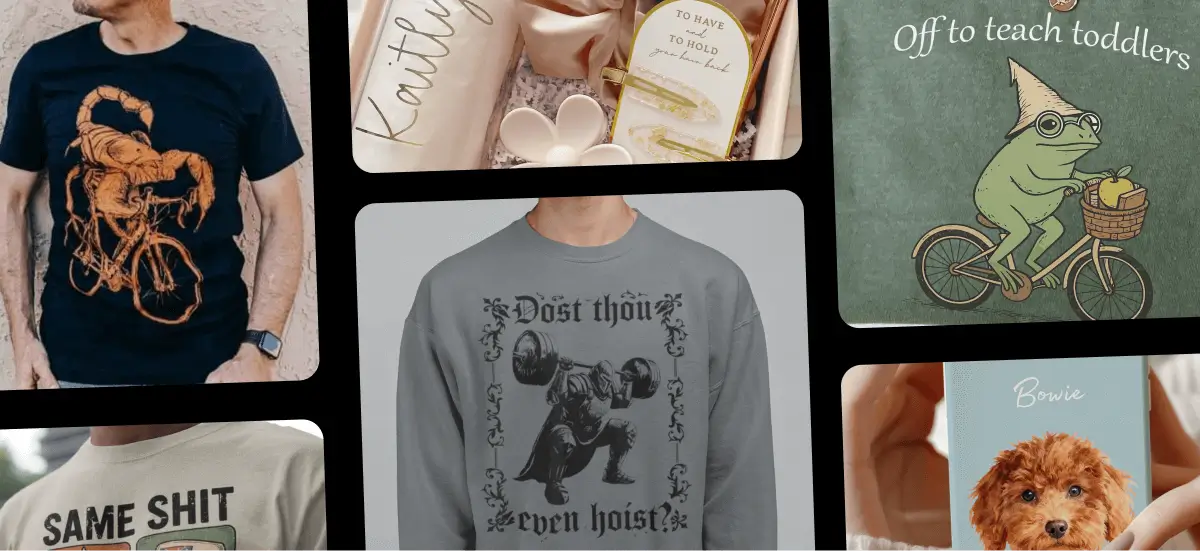
Dark Cycle Clothing is an apparel brand defined by a single, highly recognizable visual system: hand-drawn animals riding bicycles.
The brand began offline before and later moved online, where it has generated over 74,000 sales over many years. Rather than scaling through variation or personalization, the brand compounds value by repeating a distinctive visual idea that becomes immediately identifiable over time.
- Target market: Adults connected to cycling culture, punk and DIY communities, and buyers who value originality and craft. Purchases are often self-driven rather than gift-led, with customers buying because they identify with the aesthetic and lifestyle the brand represents.
- Design style: Hand-drawn animal illustrations consistently depicted on bicycles, functioning as a visual signature rather than a flexible template. Designs are intentionally minimal in execution, typically using only two colors, the shirt color and a single ink color for the illustration. This constraint reinforces recognizability, keeps production efficient, and makes the artwork difficult to imitate without being obviously derivative.
- Catalog size: A small and stable catalog compared to high-SKU POD brands, supported by low-cost vinyl stickers as entry products. Core apparel designs remain active for years, relying on long-term recognition rather than frequent releases or seasonal refreshes.
Why does this model work?
Research in branding and consumer psychology shows that repeated, distinctive visual elements can function as informal brand identifiers over time.
Studies on distinctive brand assets published in the Journal of Advertising Research demonstrate that consistent visual cues improve recognition and make brands easier to identify, even without logos or text.
Plus, repeating the same visual system across many animals introduces a collectible dynamic.
When customers already like the artist’s hand-drawn style and signature motif, each new animal becomes a variation within a recognizable set rather than a completely new product.
Research on collecting behavior in consumer psychology shows that people are motivated by completion and set building, where ownership feels incomplete until additional variants are acquired.
6. Phenix Digital: Reusable digital planners built for tablet handwriting

Phenix Digital is a shop specializing in digital planners and digital notebooks designed for handwriting on tablets.
Active since 2020, the store has generated over 91,900 sales, reflecting steady demand as more people adopt tablets with stylus pens for planning, journaling, and note-taking.
The brand scales by selling templates that customers can reuse repeatedly rather than products that need frequent replacement.
- Target market: Tablet users, including students, professionals, parents, and planners, who prefer handwriting with a stylus but want the convenience of a lightweight, all-in-one digital system. Buyers are typically looking for long-term organizational tools rather than seasonal or one-time-use products.
- Design style: Clean, digital, functional layouts optimized for writing, flexibility, and reuse. Products include digital Bible study templates, income and expense trackers, vision boards, weekly planners, to-do lists, kids’ chore charts, daily split journals, and meal planners. The designs intentionally leave space for users to write anything they want, making each purchase a one-time investment that can be reused year after year.
- Catalog size: A focused digital catalog built around planner and notebook templates, each bundled with coordinating digital stickers. All products are designed to be compatible with GoodNotes and Notability, reinforcing usability within established tablet workflows.
Why does this model work?
Phenix Digital benefits from the structural advantages of selling digital products rather than physical goods.
There is no inventory, no shipping, no fulfillment delay, and no geographic limitation, which removes many of the operational constraints that physical POD brands face. Each sale has near-zero marginal cost andcan be delivered instantly, allowing the business to scale without additional labor or logistics.
In addition, digital planners function as high-perceived-value, one-time purchases.
Customers can reuse the same templates repeatedly for different purposes and across multiple years, making the purchase feel worthwhile even at a higher upfront price.
By testing compatibility with widely used handwriting apps like GoodNotes, Notability, Zinnia, Noteshelf, and Xodo, and including video tutorials, the brand reduces friction and support overhead while increasing trust and usability.
Comparison of successful POD store examples
| Brand | Core Product Type | Buyer Motivation | Design System | Catalog Strategy | Operational Complexity | Scalability Lever |
| Utopia Vibes | Physical apparel (T-shirts) | Humor, relatability, and identity expression | Typography + meme phrasing | Very high SKU count with phrase variations | Low–medium (physical POD) | Speed, humor variation, search coverage |
| Theresa Comforts | Physical apparel & candles | Identity signaling, beliefs, hobbies, roles | Text-only slogans and catch phrases | Very high SKU count across niches | Low–medium (physical POD) | Horizontal expansion across identities |
| ModPaws US | Personalized physical products | Emotional attachment to pets | Customization workflows | Medium catalog with deep personalization | Medium–high (custom orders) | Emotional value, personalization depth |
| Love Suna | Physical personalized gifts | Life milestones and recurring occasions | Typography-driven layouts | Medium catalog covering many roles/events | Medium (physical + light customization) | Occasion frequency and catalog coverage |
| Dark Cycle Clothing | Physical apparel & stickers | Brand identity, lifestyle alignment | Hand-drawn illustration with strict visual rules | Small, stable catalog | Medium (screen printing) | Visual ownership and brand loyalty |
| Phenix Digital | Digital planners & notebooks | Productivity, handwriting convenience | Reusable digital templates | Focused catalog reused across years | Very low (digital only) | Near-zero marginal cost, instant delivery |
5 common successful POD product models
Looking across these POD online store success stories, clear patterns emerge around what types of products actually sell at scale.
The differences are less about creativity and more about what is being sold, how often it’s searched for, and how easily it can be repeated.

- Meme and humor POD
Primarily text-based apparel built around jokes, cultural references, and recognizable phrases. These products scale through volume, speed, and variation rather than visual depth. - Identity-based typography
Products centered on roles, beliefs, interests, and affiliations, such as professions, hobbies, or values. Scale comes from expanding the same layout across many identities and niches. - Personalized products
Items that allow buyers to customize names, dates, or representations. These products typically have fewer listings but higher perceived value per order. - Brand-led illustration
Illustration-driven apparel or merchandise built around a consistent visual motif or art style. Growth is slower but more durable, as recognition compounds over time. - Digital POD
Reusable digital products such as planners, notebooks, and templates that expand based on function rather than design. Common functions include Bible study, income and expense tracking, weekly planning, to-do lists, meal planning, kids’ chore charts, vision boards, and daily journaling. These products benefit from instant delivery, near-zero marginal cost, and long-term reuse, allowing sellers to scale by covering more use cases instead of creating entirely new designs.
Each model reflects a different trade-off between volume, effort, and longevity. The data shows that successful POD businesses choose products that match how they want to scale, not just what they want to design. A dedicated eCommerce developer can help support the store’s technical needs as it grows.
How to build successful POD businesses
- Choose one target market: Start with a single, clearly defined audience or use case. Focus on one group or need instead of trying to cover multiple niches at once.
- Choose one design system and art style: Commit to a single layout structure and visual style that can be reused. This helps build recognition and dramatically reduces the time needed to create new products.
- Create 10 core designs: Build a small foundation of designs that all follow the same rules. Tools like Kittl make this easier by handling typography, layout consistency, and brand elements in one place.
- Expand into 30 to 50 variations: Scale by changing copy, format, or application, not by redesigning everything. Leveraging Kittl AI features like Kittl Flows for layout and variation generation can speed this up without breaking consistency.
- Publish, track, and refine: Launch your listings, watch what gets traction, and iterate based on real data.
How Kittl helps you build successful POD store brands

Across all the POD models analyzed, the differentiator is not the idea itself but how efficiently it can be turned into a consistent, repeatable design system.
Kittl is built to handle the design side of POD at scale, so sellers can concentrate on copy, messaging, or product strategy.
- Typography as a first-class design tool
Kittl is built on a strong typographic foundation, with professional-grade fonts that include multiple masters and styles. This allows precise control over balance, spacing, and hierarchy, ensuring text-based designs look intentional and visually refined rather than improvised. For POD product listings where the message carries the value, this makes it easier to produce designs that feel finished and cohesive. - Reusable layouts, brand kits, and infinite canvas
Kittl allows sellers to define layouts, colors, and type styles once and reuse them consistently. Brand Kits help lock in visual rules, while the infinite canvas makes it possible to manage multiple variations or products within a single project. Together, these features support consistent design systems even as catalogs grow. - Fast iteration with Kittl AI and Kittl Flows
Kittl AI and Kittl Flows accelerate the design process by helping generate layout variations and build new designs based on an existing visual style. This reduces repetitive work and makes it easier to expand or adapt designs without breaking consistency. - Mockups for zero-inventory listings
Built-in mockups let sellers place designs on realistic product visuals before printing. This supports a zero-inventory workflow where designs can be listed, tested, and refined before any fulfillment happens. - POD-ready exports
Designs can be exported in formats suitable for print-on-demand production, reducing file preparation time and keeping output consistent across large catalogs. - Custom font uploads for Pro and Business users
Sellers on Pro and Business plans can upload their own fonts, making it possible to maintain a distinctive typographic voice while still benefiting from Kittl’s system-first workflow.
Kittl covers the design execution layer. Once a seller knows what they want to say, the platform makes it easier to say it consistently, at scale, and without rebuilding designs from scratch.
Key takeaways from successful print-on-demand store examples
Across all examples, successful POD brands are built around repeatable systems rather than individual ideas.
- They sell systems, not one-off designs. Products are designed to expand through reuse and variation.
- Design consistency beats complexity. Simple layouts scale better than intricate visuals.
- Product count matches the model. High-SKU catalogs, personalization, brand-led art, and digital products each scale differently.
- Speed and iteration matter more than originality. Publishing, testing, and refining quickly is a recurring advantage.
- The right tools enable scale. Without reusable design systems, growth becomes manual and unsustainable.
Once you know what you want to sell, the real challenge is turning ideas into products quickly and consistently. Kittl makes this easier by supporting reusable layouts, strong typography, and fast variation creation with Kittl Flows.
Start creating in Kittl and turn one idea into a scalable POD system!