Lo and behold, Gen Z is reclaiming looks that millennials loved. The Gen Z fashion trends are no longer just a style conversation. The cultural tension between millennials and Gen Z fashion choices in 2026 is no longer just a style conversation. Younger consumers are projected to account for 40% of fashion spending by 2035, and they are already reshaping how trends spread, shop, and scale.
That shift is happening fast, which helps explain why aesthetics now splinter into smaller, faster-moving signals instead of following the old seasonal retail cycle. That speed is colliding with a more cautious consumer mindset. More than 80% of Gen Z say money-related concerns are causing stress. Yet many still expect brands to reflect their values. That tension matters. It means Gen Z style is being shaped by two forces at once: budget pressure and value-driven buying.
30 Gen Z fashion trends to watch and capitalize on
To understand Gen-Z fashion in 2026, it helps to look at the forces shaping it. These 30 trends are grouped by the cultural and commercial shifts behind them, starting with one of the strongest drivers of current Gen Z fashion trends.
A. The 2000s & 2010s Nostalgia Wave
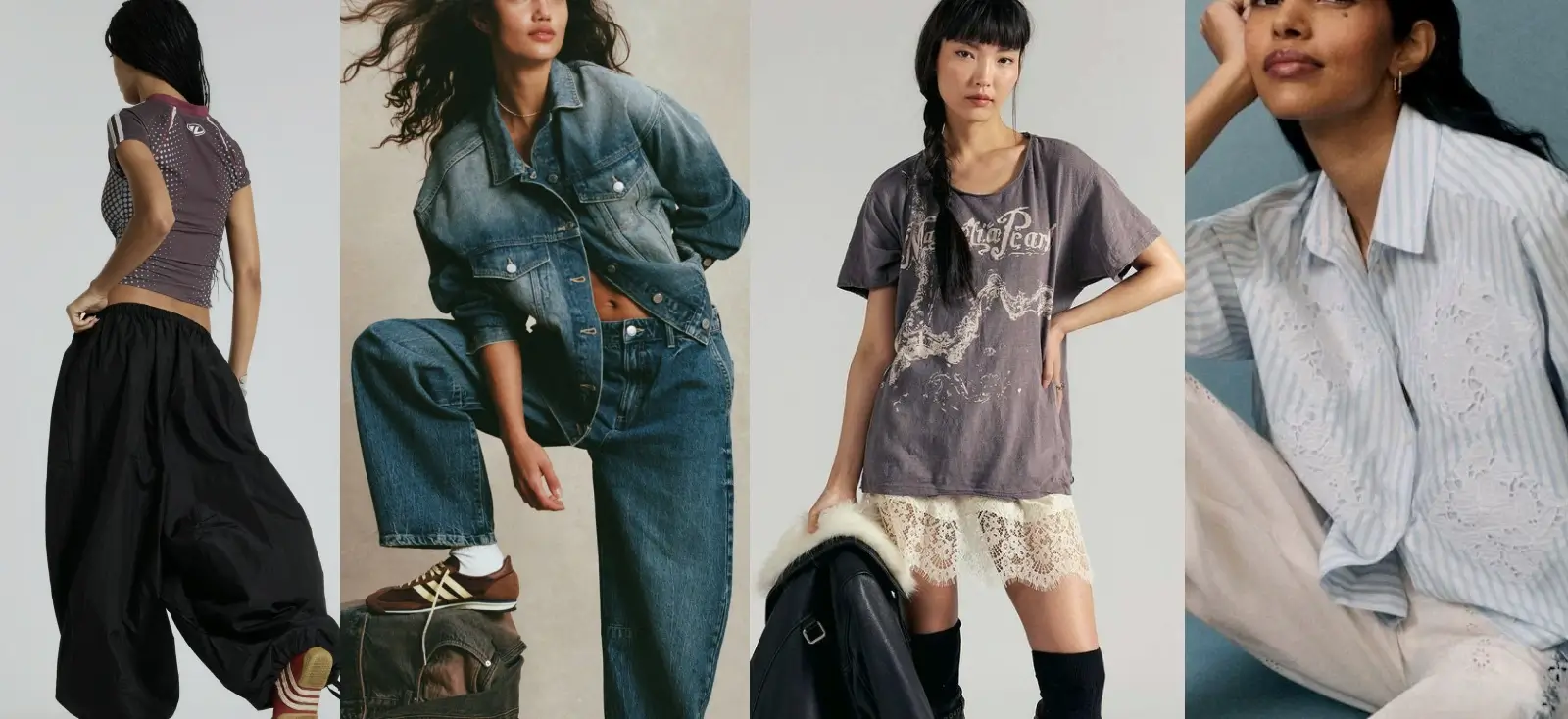
The first major wave inside Gen-Z fashion is a return to recent decades: double denim at Paris Fashion Week, the small-top/big-bottom ratio showing up across Resort 2026, and a growing obsession with archival bags and resale-era icons.
What makes this wave commercially useful is that it comes with built-in recognition. These are not obscure references. They are instantly legible style codes that brands can rework into something fresh.
Still, the signal is visible in the rise of the analogue bag and in resale reporting, showing Gen Z buying more 1990s and noughties pieces.
1. Slouchy double denim (Y2K revival)

You can already see this filtering into youth retail through PacSun and Abrand, where low-rise baggy jeans in rigid washes are being sold as the new default rather than a niche throwback.
Execution angle:
- Source rigid, heavyweight denim instead of soft stretch blends.
- Build matching sets in washed indigo, dirty mid-blue, and faded black.
- Use distressing, sanding, or worn-in finishes to avoid a too-clean look.
- Style denim-on-denim with cropped tops or slim layers to keep the silhouette balanced.
2. The 2010s indie sleaze comeback

Indie sleaze is returning as a direct rejection of anything too polished. Recent runway reporting has already pointed to collections veering into indie sleaze territory, while the beauty side of the market is moving toward smudged, grungier, more maximalist styling.
In fashion terms, that means messy layers, skinny shapes, military jackets, studs, tarnished hardware, slogan tees, and the kind of chaos that feels intentional rather than sloppy.
Execution angle:
- Add metallic hardware, distressed hems, washed black tones, and lace inserts to push the mood away from anything too polished.
- Use flash-heavy campaign photography and nightlife-inspired styling to make the look feel aligned with current Gen Z fashion trends.
- Build capsule drops around friction pieces like biker jackets, slogan tees, and skinny silhouettes rather than one hero item.
- Keep the visual world messy on purpose
3. Skinny jeans 2.0

Yes, skinny jeans are coming back, but not in their old jegging-era form. The silhouette returning now is more rigid, more directional, and often closer to a cigarette jean or slim flare than a second-skin stretch fit.
Fashion reporting has been tracking the return of skinny jeans, while current celebrity styling shows slimmer denim working best when balanced by a larger jacket, longer coat, or stronger shoe. Funny enough, this creates the cultural irony of Gen Z adopting a silhouette they famously criticized millennials for wearing.
Execution angle:
- Add rigid slim denim to your lineup without replacing wide-leg or baggy core styles.
- Focus on black, charcoal, and dark indigo washes so the silhouette feels sharper and more current.
- Style skinny fits with oversized outerwear and stronger shoes to show how they work inside today’s Gen Z outfits.
- Position them as an early-adopter denim option, not as a full return to old millennial styling.
4. Baby tees and shrunken tops

As the small-top/big-bottom proportion gains ground, the easiest commercial translation is the baby tee. The shape is tight, cropped, and deliberately compact, which is exactly why it works so well for ironic text, tiny chest hits, retro logos, and mall-era graphics.
The silhouette feels nostalgic on its own, but it becomes much more sellable when the artwork understands the scale. You can already see this filtering into accessible retail through Urban Outfitters, which is carrying graphic baby tees with retro chest placement, sporty trims, and shrunken fits.
Execution angle:
- Use tight center-chest graphics instead of oversized prints.
- Add mini slogans, retro wordmarks, or compact vector art.
- Test Y2K-inspired type treatments that still read clearly on a smaller print area.
- Build baby tees as a graphic product, not just a fit update.
5. Chunky platform loafers & boots

At the more accessible end of the market, ASOS DESIGN is already pushing chunky loafers with molded soles and penny-front uppers, which shows how quickly this exaggerated footwear language has moved into mainstream ecommerce.
The strongest examples keep pushing classic shapes into louder territory, from heeled and platform loafers to heavier boots with buckles, wider shafts, or a more lived-in finish. The point is contrast: clean clothes, bigger shoe energy.
Execution angle:
- Pair chunky loafers or boots with denim, mini skirts, or tailored basics in lookbooks.
- Use heavier footwear to make simple outfits feel more Gen Z-coded.
- Style shoots around contrast: clean clothes, louder shoes.
- Treat footwear as a styling shortcut that updates the full outfit mood.
6. Archival “It” bags

The bag story here is not about the newest release. It is about recognition. Luxury brands are actively bringing back older bag silhouettes from the archive.
Resale data has shown Gen Z buying more of the 1990s and 2000s pieces that once defined earlier fashion eras, including names like the Fendi Baguette, Louis Vuitton Pochette, and Dior Saddle.
Execution angle:
- Use vintage-looking props and archive-coded accessories in product photography to build instant brand depth.
Add worn leather textures, slouchy silhouettes, or flash-lit close-ups to make newer collections feel more storied. - Borrow the mood of established bag culture to make your Gen Z style campaigns feel more referential and fashion-literate.
Core internet aesthetics & subcultures
Not every winning product idea in Gen Z style starts with a garment category. Many start with a persona.
For apparel brands, that makes them useful far beyond trend reporting. They help you build tighter capsules, clearer campaigns, and more targeted merchandising systems.
What matters commercially is that these aesthetics now come with recognizable visual codes, from archival object layouts to gothic typography to fashion-first serif systems. That gives brands a clearer path from moodboard to product.
7. Dark academia

This mood is already visible in accessible retail through Mango’s wool-blend polo cardigans and ribbed knit layers, which bring the bookish, heritage-heavy side of the aesthetic into a more wearable everyday format.
Visually, this is where fashion starts to overlap with Kittl’s Future Medieval direction and its library of gothic and blackletter fonts.
Execution angle:
- Add houndstooth, argyle, plaid, and wool-touch textures into seasonal capsules.
- Use crest graphics, serif-heavy logos, and collegiate insignias on apparel or labels.
- Build color stories around espresso, charcoal, olive, burgundy, and cream.
- Merchandise knits, pleated trousers, blazers, and scarves as a layered set.
8. Frazzled English woman

The Frazzled English Woman Gen Z outfits are built around the messy layering of early-2000s British rom-com heroines: chunky knits, mismatched scarves, cardigans, tights, clogs or boots, oversized bags, and hair that looks like the weather got to it first.
What makes this one commercially interesting is the layering logic. You can layer it creatively in winter and fall. The seasonality of this trend will give apparel merchandisers clear direction on when to push these specific garments in their retail calendars.
Execution angle:
- Merchandise scarves, cardigans, coats, tights, and bags as a one-layered system instead of isolated products.
- Style models with purposeful mismatch so the outfit feels charmingly chaotic rather than careless.
- Use warm, lived-in art direction to support this softer side of Gen Z clothing style.
- Build upsell paths around layering pieces that complete the look
9. Coquette & balletcore

Coquette and Balletcore sit on the softer end of the internet aesthetic spectrum, but they are not identical. Coquette is more overtly romantic, with bows, ruffles, lace, and ribbon details. Balletcore is built around wrap tops, bodysuits, leg warmers, ballet flats, and pale studio colors.
Together, they create one of the clearest ultra-feminine lanes in current Gen Z dressing. At the accessible end of the market, Free People is already leaning into this space with lace-trim camis, floral embroidery, and bow-forward romantic detailing.
Execution angle:
- Add lace trims, ribbon ties, and rosette details to standard blanks.
Work in powder pink, cream, soft blue, or pale tonal palettes. - Use small botanical artwork, cameo motifs, or perfume-label typography.
- Apply the look to hangtags, packaging, and product drops, not just the garment.
- Think of the delicate side of the Trinket Design aesthetic: collected ribbons, botanical cut-outs, soft labeling, and sentimental detail. This is not loud graphic merch. It is intimacy merch.
10. Techwear & cyberpunk

Techwear is the functional side of futuristic dressing. This Gen Z outfit pulls from urban technical fashion: modular layers, weather-ready fabrics, commuting logic, and hardware that looks useful even when it is mostly aesthetic.
Cyberpunk pushes the mood further, with black leather, mesh, straps, armor-like details, neon accents, and post-apocalyptic styling cues. Put together, they create a dystopian but highly merchandisable lane.
The easiest mistake here is going too costume-heavy. The commercial version works best when the product still feels wearable in real life.
Execution angle:
- Prioritize technical fabrics, matte black surfaces, ripstop textures, and modular pocket systems.
- Use interface-inspired branding, brutalist layouts, and sharper type to make the collection feel engineered.
- Anchor the drop in wearable utility so it still feels relevant inside broader Gen Z fashion instead of costume-like.
- Push reflective trims, hardware, and layered shells in both styling and product detail shots.
11. Cottagecore

At the softer end of the market, Free People is still one of the clearest retail examples, especially through crochet textures, floral touches, and handcrafted-feeling trims that keep Cottagecore from reading too costume-like.
Execution angle:
- Build capsules around linen-feel fabrics, gingham, floral motifs, and soft earth tones.
- Add embroidered plants, animals, or pastoral icons to graphics and trims
- Use romantic product styling with ribbons, florals, or vintage-inspired props
- Extend the aesthetic into packaging, tags, and campaign visuals for a fuller world.
- Reinforce the mood with Kittl-style visual cues from Trinket Design: specimen layouts, pressed-flower arrangements, botanical cut-outs, and small archival labels.
12. “Old money” minimalism

Old Money minimalism is often lumped in with quiet luxury, but for younger shoppers, it functions more like a performance of inherited ease. The look is built around cable-knit sweaters, polos, Oxford shirts, navy blazers, chinos, and understated tailoring.
Compared with Dark Academia, these Gen Z outfits are cleaner, sunnier, and more club-adjacent than library-bound. Think tennis courts, coastal prep, and generational polish rather than gothic intellect.
Execution angle:
- Focus on high-GSM basics, cream-and-navy palettes, and refined fits that hold their shape.
- Replace loud graphics with tonal embroidery, monograms, or subtle woven labels.
- Keep campaign styling clean and quiet so the restraint feels intentional within today’s Gen Z style landscape.
- Build the collection around repeatable staples that signal polish without over-designing the product.
B. Functionality, sport, and the modern uniform
If the last group of trends was driven by persona, this one is driven by performance.
Not athletic performance in the old sense, but wardrobe performance: pieces that can handle commuting, layering, work, errands, travel, and going out without needing a full reset.
Spring 2026 coverage keeps circling back to uniform dressing, utility dressing, and multifunctional hybrids built for busy, context-switching lives. For brands, that makes this one of the most commercially useful lanes in Gen Z fashion trends.
13. Old-soul sportswear

Sportswear is getting more nostalgic and more specific. Instead of generic athleisure, the mood has shifted toward rugby shirts, retro track jackets, crest graphics, and legacy team energy.
In practice, this trend feels less gym-bound and more heritage-coded. You can already see the accessible version in market through UNIQLO’s oversized striped rugby shirt, which uses heavier yarn, an embroidered chest logo, and an easy loose fit.
Execution angle:
- Build retro sports emblems, faux academy insignias, and badge-style logos.
- Use arched team names, distressed lettering, and mascot-like icon shapes.
- Extend the system across tees, rugby shirts, sweats, and caps.
- Treat this as a merch lane built on familiarity, not licensed sports imitation.
- Kittl’s sports logo templates become useful references. Think badge shapes, mascot-like icons, arched team names, and distressed athletic lettering rather than slick performance branding.
14. Elevated workwear (the uniform)

You can already see the accessible version of this through Mango’s structured zip cardigans and refined knit layers, which show how the modern uniform is being built from neutral, repeatable pieces rather than formal officewear.
This is the part of Gen Z clothing style that answers decision fatigue with dependable silhouettes: boxy knits, straight trousers, officer shirts, zip jackets, and chore coat variants. Kittl’s minimalist logo templates are a useful design parallel because they show the same principle at work: clean structure, low noise, and just enough identity to feel intentional.
Execution angle:
- Design matching jackets, trousers, and overshirts as modular wardrobe pieces.
- Keep the palette neutral so customers can mix styles across multiple drops.
- Focus on repeatable fits that reduce styling friction for everyday wear.
- Merchandise the collection as a uniform system, not as disconnected items.
15. Parachute and cargo pants

Baggy bottoms are still holding their ground, but the mood is becoming more technical. The best versions of parachute and cargo pants read as mobile, roomy, and slightly overbuilt in a way that feels current.
This is one of the clearest examples of silhouette doing the branding for you. At the more attainable end, PacSun is already selling low-rise and canvas parachute pants with bungee hems, cargo pockets, and loose, baggy fits.
Execution angle:
- Pair baggy bottoms with fitted tanks, baby tees, or cropped jackets.
- Use drawcords, cargo pockets, and technical trims to reinforce the silhouette.
- Keep campaign graphics sharp and utilitarian rather than decorative.
- Merchandise these as movement-first pants, not just trend pants.
- For graphics and campaign layouts, a useful visual reference is Kittl’s Brutalist art style guide: sharp, raw, utilitarian, and stripped of anything overly decorative.
16. Capri leggings

Capri pants have already returned, but the legging-like version is what gives this trend its sharper edge. Recent styling coverage shows capris paired with heeled thong sandals and sporty funnel-neck jackets, while fashion editors continue to frame the silhouette as divisive but increasingly hard to ignore.
What makes capri leggings different from regular capris is the tension between activewear and going-out wear. They feel practical, but never neutral.
Execution angle:
- Add pedal-pusher lengths to activewear or lifestyle capsules as a directional test SKU.
- Style them with oversized jackets, windbreakers, or sharp footwear so they read fashion-forward instead of purely athletic.
- Use campaign imagery that shows how this silhouette fits into emerging gen z outfits.
- Treat the product as a search-led trend opportunity, not as a broad replacement for full-length leggings.
17. Tailored micro-shorts (hot pants)

This Gen Z fashion trend is already crossing into mainstream ecommerce through ASOS DESIGN, where tailored micro shorts in clean suiting colors make the silhouette feel more commercially testable than runway-only.
There is still a real market-risk gap here: Hot pants generate attention far more easily than they generate mass adoption. So this is better treated as a high-visibility fashion item than a guaranteed volume seller.
Execution angle:
- Treat micro-shorts as an image-making product, not a core volume item.
- Style them with oversized blazers, coats, or sheer layers to increase wearability.
- Use influencer seeding and editorial shoots before scaling inventory.
- Position them as a nightlife or fashion-forward capsule, not a broad basics play.
- Kittl’s clothing logo templates are a useful branding reference here because the visual world needs to feel fashion-first and label-aware
18. Boxer shorts as outerwear

Boxer shorts have moved well beyond novelty. What makes them relevant is the way they sit between underwear, loungewear, and summer streetwear, while still feeling cheap to produce and easy to style.
This is already showing up in more accessible ecommerce through ASOS labels like Pull&Bear and Princess Polly, where striped and logo-waist boxer shorts are being sold as visible fashion pieces rather than hidden basics.
Execution angle:
- Boxer shorts have the potential in the gender neutral fashion style. Use them as a low-cost merch expansion with unisex appeal.
- Launch striped or solid boxers with custom-branded waistbands.
- Add subtle monograms, contrast labels, or exposed tag details.
- Style them as outerwear in summer sets, not as sleepwear.
- Kittl’s label templates are a helpful reference here because this trend lives in waistband typography, tag design, packaging, and the small branded touches that make a basic item feel collectible.
C. Sustainable, thrifty, and DIY ethics
This is the part of Gen-Z fashion where ethics turn into surface detail. With the secondhand apparel market projected to reach $367 billion by 2029, resale is no longer just changing where people shop.
It is changing what looks desirable: repaired seams, uneven textures, odd combinations, and pieces that feel handled rather than factory-finished.
19. Visible mending and distressing

Visible mending turns wear into proof of value. Fashion’s current push against AI-smooth perfection is elevating raw edges, topstitching, abrasions, and garments that look intentionally worked on.
The longer-running rise of visible mending helps explain why repair now reads as style rather than damage. On the design side, this looks closer to Kittl’s distress and grunge texture workflow than to a clean, untouched brand system.
Execution angle:
- Use repaired seams, topstitching, abrasions, or frayed edges to make garments feel handled rather than factory-finished.
- Keep the distressing selective so the final product still looks premium.
- Frame these details as a response to over-polished Gen Z fashion trends, not as random damage.
- Use close-up photography to show the craftsmanship behind the wear.
20. Curated hodgepodge (maximalism)

The new maximalism is not random chaos. It is a deliberate collision of prints, textures, and styling references that makes a look feel collected instead of coordinated. Milan’s Fall/Winter 2026 runways leaned into a more maximalist mood, with metallics, lace, bold separates, and statement accessories layered into otherwise wearable clothes.
In Kittl terms, the closest visual parallel is a maximalist aesthetic: mixed imagery, stacked type, and a layout that gets its energy from contrast.
Execution angle:
- Mix florals, stripes, metallic details, and texture clashes into one visual system instead of separating them into safer capsules.
- Build bold textile prints or layered campaign graphics that feel collected, not coordinated.
- Use this lane to serve louder customers who want statement-making Gen Z outfits.
- Let contrast drive the styling so the excess feels deliberate.
21. Custom patchwork & upcycling

This Gen Z fashion trend is already visible outside luxury through Free People’s Magnolia Pearl assortment, where patchwork florals, distressed cotton, crochet trims, and one-of-a-kind finishes make the handmade logic feel product-ready.
Execution angle:
- Turn deadstock, leftover trims, or fabric scraps into limited remixed capsules.
- Highlight one-of-one variation as a selling point, not a production flaw.
- Show close-up imagery of seams, piecing, and fabric contrast to emphasize craftsmanship.
- Frame each drop as scarce and hard to repeat, which increases perceived value.
22. Statement hardware and heavy belts

At the more attainable end, ASOS DESIGN and Urban Outfitters are already selling chain belts, eyelet belts, and charm-heavy metal waist pieces that show how accessories can dramatically reshape a simple outfit without changing the garment itself.
Execution angle:
- Expand belts, chains, and hardware-led accessories before expanding complex apparel SKUs.
- Use oversized buckles, eyelets, charms, or chain details to reshape simple garments.
- Merchandise accessories as outfit transformers rather than add-ons.
- Feature before-and-after styling in campaign visuals to show the impact clearly.
23. Irony and meme graphics

Graphic tees are back, but the current version is sharper, stranger, and more self-aware. Recent coverage of the graphic-tee resurgence notes that Gen Z is reviving the format through irony, provocation, and hyper-specific references rather than earnest slogans.
That makes this one of the fastest-moving corners of Gen Z style, because the shirt works as clothing and a social signal at the same time. For Kittl users, this is exactly where T-shirt logo templates become useful: quick, text-led layouts that can be tested and printed before the joke goes stale.
Execution angle:
- Prototype short-run, text-heavy drops while the joke or reference is still culturally fresh.
- Keep the line short, specific, and readable at a glance.
- Use these designs to speak directly to internet-native pockets of Gen Z style rather than trying to make every slogan universal.
- Test low-risk graphic launches before scaling them into bigger merch drops.
- Use Kittl to prototype short-run, text-heavy drops around niche internet humor and culturally specific phrasing.
24. Funky and structural headwear

Headwear is becoming an easy way to make a basic outfit feel fully intentional. Fashion-week coverage in early 2026 highlighted quirky hats, pillbox shapes, and more sculptural headwear as standout styling moves.
Recent Vogue coverage shows that statement hats are pushing well beyond novelty into a real runway signal. Kittl’s hat templates make the commercial angle obvious: headwear is not just an add-on, it is a brand surface.
Execution angle:
- Experiment with crochet, faux fur, velvet, or stiff vintage-inspired shapes instead of relying on standard caps.
- Treat headwear as a styling tool that can lift simple Gen Z outfits with minimal product complexity.
- Use editorial product shots that show the silhouette clearly from multiple angles.
- Build smaller accessory drops around texture and shape rather than only logo placement.
D. Breaking boundaries: Color, gender, and shape
This final cluster is less about nostalgia or practicality and more about disruption. The clearest public benchmark is that 56% of Gen Z consumers already shop outside their gender, but the same boundary-breaking instinct is also showing up in cooler, icier color palettes, subverted prints, rising lace demand, and more exaggerated collars and structured volume.
There is no single market dataset that measures “fashion as norm-subversion” as a formal category, so this section is best read as a directional shift that is visible across retail, runway, and street style.
25. Gender-fluid silhouettes

The shift toward gender-fluid dressing is no longer niche. Younger shoppers are already buying across gendered categories, and recent runways have pushed that further with androgynous power suiting worn across all genders.
In practice, that means boxier shirts, longer tees, straight trousers, broad jackets, and tailoring that works through silhouette rather than through rigid menswear or womenswear codes.
Execution angle:
- Shift your ecommerce navigation from “Men’s” and “Women’s” to fit-based sizing and silhouette-led categories.
Use product descriptions that talk about shape, drape, and length instead of gender expectations. - Position this as a practical update to Gen Z clothing style, not just a branding statement.
- Keep campaign casting and styling broad enough to show the product working across body types.
- Visually, the branding should feel unified, too, which is where a single clothing logo system is more useful than splitting the brand into gendered sub-labels.
26. Icy blue and frosted pastels

The color story is cooling down. Icy blue has already broken out as one of 2026’s defining shades, and forecasting points to icy blues, purples, and dusty pastels replacing earthier palettes.
The effect is sharper than millennial pink and more atmospheric than beige. It feels crisp, slightly futuristic, and emotionally distant in a way that photographs well.
Visually, this mood lands closer to Kittl’s gradient color-play direction than to flat, sugary pastels. It works best when the color looks softly lit, glazed, or slightly frosted rather than chalky.
Execution angle:
- Bring icy blue, cool lavender, and frosted pastel tones into upcoming fabric, trim, and print planning.
- Use cooler shades as either the main wardrobe color or as a high-contrast accent against black, cream, or silver.
- Apply the palette across apparel, packaging, and graphics so it feels connected to current Gen Z fashion trends.
- Keep the finish glazed, airy, or softly lit rather than sugary or overly cute.
27. Nouveau polka dots

Polka dots are back, but they have lost their old-school sweetness. The pattern has been reintroduced through off-kilter styling on ties, shorts, and capri leggings, and Copenhagen’s street style pushed dots onto everything from jackets to leggings. The result feels looser, less ladylike, and much more playful. The closest Kittl parallel is the Naive Design trend, where hand-drawn irregularity becomes part of the charm.
Execution angle:
- Replace classic dot repeats with hand-drawn circles, uneven spacing, or layered scale changes.
- Use the print on sheer pieces, relaxed silhouettes, or soft separates so it feels modern instead of retro-sweet.
- Treat the pattern as a playful update within broader Gen Z style, not as a novelty print.
- Let irregularity become part of the charm.
28. Button-up outerwear with flair

Outerwear is getting more expressive in the details. Forecasting for Fall/Winter 2026 points to high collars, funnel necks, and more exaggerated neckline shapes, while menswear coverage has already spotlighted toggle coats and closure-heavy prep.
The new jacket does not want to disappear into a zipper line. It wants a statement collar, a memorable button, an ornamental closure, or enough embroidery to make the front view do more work.
Execution angle:
- Source custom buttons, vintage-style closures, toggles, or embroidered fastening details to elevate standard outerwear.
- Make collars, plackets, and front closures the visual hook rather than hiding them.
- Use this detail work to help simple jackets stand out inside trend-led Gen Z fashion capsules.
- Show close-up product imagery so customers can see what makes the outerwear special.
- Kittl’s monogram templates are a useful reference for crest-like chest embroidery, heritage initials, or decorative marks that can make a basic shell feel much more considered.
29. Lace accents & trims

Lace is no longer staying in lingerie-adjacent territory. Forecasting for Spring/Summer 2026 says lace arrivals are up 121% year over year, and Copenhagen’s runways showed lace used as trim on track shorts, hems, seams, and tops.
That edge is enough. A lace hemline, lace collar, or exposed lace underlayer instantly pulls a basic item into a more romantic, theatrical register.
Execution angle:
- Add lace trims to camisoles, slip skirts, tees, shorts, or collars instead of redesigning the full garment.
- Use lace as an edge detail that shifts the mood of basic inventory quickly and cost-effectively.
- Style it in ways that show how romantic detail still works inside current Gen Z outfits.
- Extend the softness into packaging, labels, or launch visuals so the product world feels complete.
30. The oversized blazer

The oversized blazer remains one of the most reliable shape tools in the current wardrobe. What keeps it relevant is not novelty. It is proportion. The blazer can sharpen almost anything without making the look feel formal.
For a more accessible benchmark, Aritzia continues to anchor this space with oversized single-breasted and double-breasted blazers built around dropped structure and roomy fits.
Execution angle:
- Grade the pattern for dropped shoulders and more ease through the waist.
- Extend the length so it reads intentionally borrowed, not accidentally oversized.
- Style it over denim, dresses, or sporty basics to show range.
- Test silhouette-heavy mockups before sampling full runs.
Kittl’s mockup generator is useful here for testing proportion-heavy campaign images before you commit to full sample rounds.
Why Gen Z clothing style defies traditional retail
Traditional retail was built around stable categories, predictable seasons, and broad trend cycles. That model is starting to crack. Gen Z clothing style in 2026 is shaped by a more fragmented reality.
1. Gen Z is shopping under pressure
Traditional retail worked best when shoppers followed stable categories and predictable seasonal cycles. That is not how Gen Z clothing style works in 2026. Younger consumers are dressing through a mix of economic tension, digital overload, and decision fatigue, which is pushing them toward dependable staples, repeatable uniforms, and pieces that feel emotionally grounding.
That does not mean Gen Z has stopped caring about trends. It means trend adoption is becoming more selective. Instead of building an identity around one dominant look, younger shoppers are pulling from multiple style codes at once. They want flexibility, which is one reason Gen Z fashion trends now show up as a stream of smaller aesthetics instead of one dominant retail narrative.
2. Thrift culture changed what feels valuable
One of the clearest reasons traditional retail feels out of step is that younger shoppers no longer define value the old way. More than half of younger consumers say that if they can find an item secondhand, they will not buy it new, which shows how deeply resale has shaped the way this generation thinks about fashion.
That matters because thrift culture is not only about saving money. It is also about finding pieces that feel rare, remixable, and less mass-produced.
A vintage rugby shirt, worn-in bomber, or oddly specific lace cami does more than fill a wardrobe gap. It signals taste, curation, and individuality. For brands, that raises the bar. New products have to feel distinct enough to compete with the thrill of the find.
3. Identity matters more than category labels
Another reason Gen Z defies traditional retail is that older shopping labels feel less useful than they once did. Younger consumers are building wardrobes around silhouette, attitude, and styling rather than rigid categories.
That helps explain why so many of the most relevant looks right now move easily across style boundaries: oversized knits, structured shirts, track jackets, boxy blazers, long shorts, baby tees, and rugby tops.
The point is not to dress according to a fixed retail identity. The point is to build a personal one. For apparel founders, that shifts the opportunity toward flexible fits, broader styling language, and campaigns that show products working across different identities and communities.
4. The clean era is losing ground
There is also a clear aesthetic backlash happening. Current fashion reporting points to a move toward craftier, playful styles and a more layered mix of influences, while broader 2026 design reporting shows a parallel appetite for human-made imperfection, tactile texture, and personality over polish.
That matters for fashion because the same shift is shaping product design and visual identity. Distressed graphics, visible texture, awkward charm, handmade-looking illustration, and layered styling all feel more culturally aligned right now than anything too perfect or too sterile.
There is one important data gap here. There is still no single public benchmark that neatly proves “the rejection of the millennial clean aesthetic” as a standalone measured trend. It is better understood as a directional pattern supported by fashion reporting, resale behavior, and broader 2026 design signals.
Conclusion: What Gen-Z fashion means for brands in 2026
Gen-Z fashion reflects how younger consumers think about identity, value, and relevance.
For brands, that means the goal is not to chase every aesthetic. It is to spot the right signals early, then turn them into products, graphics, styling, and campaigns that feel current.
The strongest opportunity is in translation. Many of the most important Gen Z fashion trends can be adapted through silhouettes, trims, color palettes, typography, and merchandise design, not only through full product reinvention.
Brands that understand Gen Z clothing style as a visual and commercial system will be in a much stronger position to build collections that connect.
Ready to turn these trends into something your audience can actually wear? Explore Kittl templates to build trend-driven graphics, merch, and brand visuals faster.
Frequently asked questions about Gen-Z fashion trends
-
What is Gen-Z fashion?
Gen-Z fashion is an aesthetic-first way of dressing built around identity, subculture, and fast visual self-definition. It pulls from thrift, nostalgia, internet personas, and micro-aesthetics, which is why a mood board is often a better starting point than a single trend label.
-
How does Gen Z dress right now?
Right now, Gen Z style sits between repeatable “modern uniform” pieces and nostalgia-heavy statement items. The strongest looks combine dependable staples with sharper styling cues, from retro sportswear to era-mixed layering.
-
What are the biggest Gen Z fashion trends in 2026?
The biggest Gen Z fashion trends in 2026 cluster around modern uniforms, neo nostalgia, romanticized sportswear, and more expressive occasion dressing. Younger shoppers are also pushing brands toward products that feel distinctive, personalized, and culturally relevant.
-
Why does Gen Z prefer baggy jeans and oversized silhouettes?
Baggy jeans and oversized layers offer comfort, styling flexibility, and a more fluid approach to shape. They also fit the wider move toward repeatable wardrobes and looser, less category-bound dressing.
-
Is Y2K still part of Gen Z style?
Yes. Y2K is still one of the clearest visual languages inside Gen Z outfits, but it now works more like a design toolkit than a full costume. Kittl’s Y2K templates show exactly why the look still sticks: chrome type, glossy gradients, and digital nostalgia that translate easily into merch and branding.