The era of broad, generic categories is over. If you try to sell a plain-text shirt to “Dog Lovers” in 2026, you will be ignored; the market has shifted entirely toward Micro-Aesthetics.
To find profitable print on demand niches, you must stop thinking in single words like “Yoga” and start thinking in equations that combine Identity.
(Who they are) + Aesthetic (What they like)
A generic “foodie” shirt is a commodity, but a design featuring a “Corgi eating Ramen” targets two high-passion groups at once: dog breed enthusiasts and Japanese cuisine lovers, creating immediate demand.
This “Intersection Strategy” works because it signals to the buyer, “I see exactly who you are.” You don’t need to be a professional illustrator to execute this.
You simply need the right template and the right niche data. While tools like Ideogram can generate raw concepts like a “Sleepy Capybara,” you need to ensure the typography and layout are professional so elements like “Zzz” graphics don’t disappear on black shirts.
The goal is to take a validated concept and professionalize it instantly using design tools that handle the layout for you, like Kittl.
The “cross-niche” strategy: How to dominate micro-markets
Most advice — and even major platforms like Printify — will give you lists of broad categories like “Gamers,” “Fitness Communities,” or “Pet Owners”. While these are excellent foundations representing billions in spending, they are deadly for beginners.
Trying to rank for a generic “Fitness Shirt” puts you in direct competition with massive brands like Nike and Gymshark.
The superior angle is Niche Intersection. This is the art of taking two unrelated print on demand niche ideas and merging them to eliminate 90% of your competition.
Instead of targeting a single huge circle, you target the overlap of two specific circles:
• The Losing Strategy: Selling “Nurse” shirts (Saturated).
• The Winning Strategy: Selling “Spooky Nurse” shirts (Profitable).
By combining “Nurse” (Identity A) with “Horror Movies/Halloween” (Interest B), you create a product that no big brand is selling, but thousands of nurses want to buy.
We see this successful logic applied in other evergreen niches for print on demand, such as the “Cruise” market. A generic “I love cruising” shirt is boring, but “Just Married Honeymoon Cruise 2026” targets a specific life event (Identity) combined with a specific travel method (Interest).
Use text layouts to easily combine these concepts. You don’t need to invent the art; you just need to bridge the gap between the Identity and the Interest.
A. The evergreen “big 4” print on demand niches

These print on demand niches are evergreen because they’re built on identity and gifting surrounding pets, family, jobs, and hobbies. But they’re also crowded.
The move is to go micro and win on layout quality, texture choices, and type hierarchy, not on “another generic quote.” Think of these as evergreen niches for print on demand that you can keep testing year-round.
| Sub-niche | Recommended design style | Don’t sell | Do sell |
| 1) Pets: the “humanized” portrait | Vintage portrait + premium texture (engraving, halftone, grain) | Plain pet photo + name | Pet as royalty/astronaut with a framed nameplate like “Commander Mittens” |
| 2) Pets: breed specific + hobby | Retro badge + playful cartoon | “Dog mom” + paw print | “Corgi yoga club” / “German shepherd gamer” with breed-personality poses |
| 3) Family: “cool grandma” (glamma) | Glam maximalist (leopard fill, gold foil, bold script) | Basic “Grandma” text | “Too cool to be called grandma” with texture fills + clean outline stroke |
| 4) Family: “promoted to…” milestones | Minimalist announcement (serif + negative space) | Generic “New dad” | “Promoted to daddy • est. 2026” with clean serif + big date emphasis |
| 5) Jobs: blue collar pride | Grunge Americana (distressed badge, flags, rugged type) | Generic “Hard worker” | Welders/truckers crest with distressed texture and strong iconography |
| 6) Jobs: “chaos coordinator” (nurses/teachers) | Doodle-core cute (scribbles, sticker icons, playful type) | “Nurse life” plain | “Chaos coordinator” with coffee/patience humor + messy, intentional chaos |
| 7) Jobs: tech/coding humor | Terminal/retro tech (monospace, neon on dark) | “Programmer” generic | Syntax jokes in a terminal-window layout (readable, authentic formatting) |
| 8) Hobbies: gaming (retro/pixel) | Vaporwave + glitch (neon grid, pixel motifs) | Controller clipart | Arcade headline “Insert coin” with UI-like subtext and glow effects |
| 9) Hobbies: gardening (plant parent) | Cottagecore botanical (earth tones, serif, line art) | “I love plants” | Botanical illustration + vintage serif with paper grain and calm spacing |
| 10) Hobbies: book lovers (dark academia) | Dark academia (gothic serif, sepia, distressed ink) | “Book lover” basic | Title-page layout with frames, stamps, coffee-stain texture, ravens/books |
Execution notes to win these print on demand niches:
- Type pairing: Pick one “hero” font + one support font. Over-pairing screams amateur.
- Texture discipline: Distress the fill more than the outline so readability survives printing.
- Layout frameworks that convert: badge/crest, framed portrait, title page, and announcement layouts. They read fast in thumbnails.
B. Identity and lifestyle print on demand niche ideas (passionate buyers)

These profitable print on demand niches sell belonging. You’re not just selling a shirt; you’re selling a signal.
The best print on demand niche ideas here lean on strong typographic voice and intentional aesthetics (minimal, punk, groovy, etc.), so the buyer feels “this is me.”
| Sub-niche | Recommended design style | Don’t sell | Do sell |
| 11) Mental health and positivity | Groovy 70s (warped bubble type, warm palette, grain) | Generic “Be positive” | Affirmations with warped type + friendly icons; message is the hero |
| 12) LGBTQ+ pride (year-round) | Minimal geometric pride (subtle stripes, curated palettes) | Default rainbow heart | Specific identity palettes (trans/bi/ace) in clean shapes/landscapes |
| 13) Introverts / anti-social club | Minimalist ironic (tiny pocket text, lots of space) | Loud “I hate people” | Small “Social battery low” / “Go away” with clean, quiet humor |
| 14) Vegan / plant-based | Punk veggie grunge (distressed illustrations, bold type) | Leaf icon + “Vegan” | “Kale ’Em All” energy: rough type + veggie drawings with attitude |
| 15) Sober living / recovery | Varsity or badge (bold, celebratory, clean) | Vague sobriety quotes | Milestones: “One day at a time” / sober anniversary designs |
| 16) Van life / nomads | Line art outdoors (sunset palette, airy spacing) | Generic wanderlust | Camper + mountain line art with tasteful retro gradient sunsets |
| 17) Fitness: gym rats (powerlifting) | Heavy metal / hardcore (chains, sharp type) | “Gym life” basic | Aggressive type, crests, equipment icons; looks like a gym brand |
| 18) Fitness: yoga and spirituality | Watercolor zen (mandalas, thin elegant fonts) | Random lotus clipart | Calm ritual designs with watercolor washes + clean centered symmetry |
| 19) Crypto / day traders | Cyberpunk tech (candlesticks, neon, HUD overlays) | “Bitcoin” text only | Insider phrases + chart motifs; high-tech type and dark UI styling |
| 20) Astrology and zodiac | Celestial luxe (gold foil, line art, dark backgrounds) | Generic zodiac symbol | Personalized zodiac sets with consistent constellation + foil texture system |
Design notes that make these “popular print on demand niches” feel premium:
- Build a style system: One palette + one texture + one layout grid per niche set. That’s how you scale without looking templated.
- Signal subtlety: Especially for pride/introvert niches, quieter designs often convert better because they feel wearable.
- Keep it thumbnail-proof: If your main line isn’t readable at phone size, it won’t sell — no matter how good the concept is.
C. Trends and aesthetics (visual-first niches)

These print on demand niches are defined by the look more than the topic, which makes them insanely reusable. Nail the aesthetic once, then re-skin it across multiple print on demand niche ideas (a vaporwave cat, a dark academia bookworm, a cottagecore mushroom forager).
The win is building a repeatable style system: font pair, texture stack, color palette, and layout grid.
| Sub-niche | Recommended design style | Don’t sell | Do sell |
| 21) Cottagecore (mushrooms and frogs) | Storybook botanical + earth tones + paper grain | Random cute mushroom clipart | Vintage field-guide layout with labeled mushrooms, tiny frog character, and soft serif titles |
| 22) Y2K aesthetic | Chrome type + airbrush gradients + sticker chaos | Plain “Y2K” text | Chrome headline + hot pink/cyan palette + butterfly/tribal accents in a layered sticker collage layout |
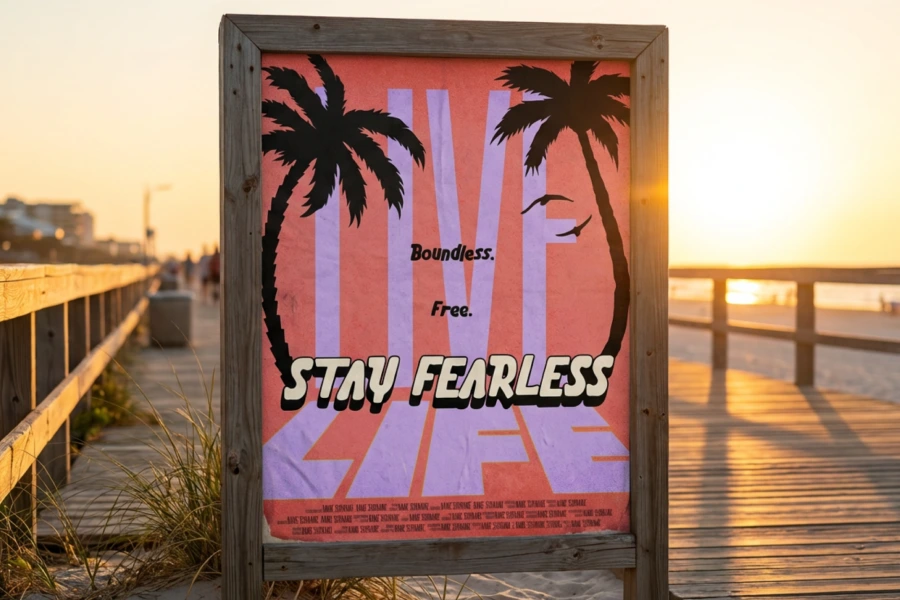
| 23) Vaporwave / synthwave | Neon grid + sunset gradient + glow + glitch | Generic neon palm tree | Big retro headline, Japanese-style subtext, and a clean “poster” composition with intentional spacing |
| 24) Dark academia | Gothic serif + sepia + distressed ink + frame borders | Dark background + random skull | Old book cover/title page layout with a crest, Latin phrase, and subtle coffee-stain texture |
| 25) Retro 70s/80s nostalgia | Sunset stripes + chunky rounded type + mild distress | Overused “retro” wave with no concept | Strong phrase-first design using sunset stripes as a backdrop element (not the whole shirt) + tight type hierarchy |
| 26) Anime/manga style (original art) | Kawaii or mecha-inspired originals + clean linework | Anything resembling trademarked characters | Original mascot character + bold outlines + limited palette + consistent “series” badges (volume 01, etc.) |
| 27) Streetwear / hypebeast | Oversized back print + minimal front chest mark + gritty textures | Souvenir-style centered clipart | Brand-like system: small chest logo + huge back graphic, barcode tags, and gritty halftone overlays |
| 28) Western gothic (cowboy goth) | Vintage western slab serif + occult line art + desert grit | Basic skull in a cowboy hat | Poster-style scene: skeleton cowboy + desert frame + snakes/horseshoes, with distressed ink texture |
| 29) Abstract/minimalist line art | Single-line illustration + lots of negative space + muted palette | Overcomplicated “minimal” with tiny unreadable text | One hero line-art form + small caption in a clean sans/serif pair, built for totes and wall art |
| 30) Pop art/comic style | Halftone dots + bold primaries + speech bubbles | Meme text dump | One punchline in a bubble + clean character/scene, using halftone shading and thick outlines for print clarity |
Some shortcuts for these popular print on demand niches:
- Make a style kit: 1 headline font, 1 support font, 3 textures, 6 colors. Reuse it so your shop looks like a brand.
- Use “poster logic”: big headline, clear focal point, supporting details last. If it reads in 2 seconds, it sells.
- Print safety: keep glows subtle, avoid ultra-thin lines, and don’t rely on tiny text for the main joke.
D. Location and local pride (the “hometown” advantage)

These print on demand niches win when they feel like an inside joke. Big markets like “New York” are flooded, but micro-local signals (neighborhoods, area codes, landmarks, highway names) turn generic pride into a wearable identity badge.
This is one of the easiest ways to create profitable print on demand niches with lower competition because outsiders won’t even think to search these phrases.
| Sub-niche | Recommended design style | Don’t sell | Do sell |
| 31) State/city specific (non-tourist) | Vintage varsity + local stamp textures | “I love [city]” tourist tee | “Local only” inside jokes using area codes, neighborhood names, and “I survived [highway] construction” lines |
| 32) National parks/outdoors | WPA poster style (flat vector, muted teals/oranges) | Generic park name + mountain icon | Trail/peak-specific poster layouts with a clean caption system (trail name, elevation, coordinates) |
| 33) Lake life/cabin life | Rustic badge + wood grain + nautical icons | “Lake hair don’t care” only | Cabin-name personalization, crossed oars/anchors, and established-year marks that feel like a family crest |
| 34) Beach/coastal grandmother | Soft watercolor + airy serif + linen tones | Basic seashell clipart | Minimal, “quiet luxury” layouts: watercolor shells + refined serif + subtle texture (think editorial tote vibe) |
| 35) College town spirit (generic) | Athletic block type + town-color palette | Anything with university logos/mascots | Town-culture merch: “Game day in [town]” with clean athletic typography and colorways (no trademarks) |
How to design these print on demand niche ideas so they feel right:
- Use “local data” as design elements: coordinates, zip codes, elevation, lake name, “est.” year, neighborhood abbreviations.
- Keep it wearable: locals buy these like uniforms, so avoid over-illustrating. Strong type and one icon are often enough.
- Make variants fast: the same layout can be cloned for 50 towns by swapping the location line, coordinates, and colorway. Or the simplest way? Use Kittl Flows.
E. Seasonal and event-based (high velocity)

These print on demand niches are where you catch spikes in demand. The trick is to avoid generic holiday phrases and instead stack specificity: role + event + year.
That’s how print on demand niche ideas become findable and why this category can create some of the most profitable print on demand niches when you move fast.
| Sub-niche | Recommended design style | Don’t sell | Do sell |
| 36) Halloween (the biggest POD holiday) | Horror typography (drippy slime, retro pulp, “Goosebumps” vibe) | Plain “Spooky season” text | Cross-niche costumes: “Spooky nurse,” “Ghost gamer,” “Witchy teacher” with themed type + icon set |
| 37) Christmas/ugly sweater | Pixel-knit pattern + busy layout (print-forgiving) | Generic Santa face | “Knitted” all-over pattern look with unexpected elements (T-Rex, Sasquatch, niche hobby icons) |
| 38) Back to school (for teachers) | Bright classroom textures (pencil/crayon fills, sticker icons) | “Teacher life” basic | Grade-specific designs: “Teacher mode: on” / “3rd grade crew” with playful texture fills and tidy hierarchy |
| 39) Wedding/bachelorette parties | Elegant script or retro groovy (depending on vibe) | “Bride tribe” only | Group sets with personalization: names/roles + event location/date, designed as a cohesive collection |
| 40) Graduation (senior year) | Athletic block + clean negative space | “Class of [year]” with clutter | Bold “Class of 2026” with strong type lockup, minimal icons, and negative space so the year pops |
What moves that win seasonal print on demand niches:
- Lead with the year: Treat it like the hero element so you instantly filter out older listings.
- Build collections: Sets convert (bride squad, family holiday group, teacher team). Make a consistent system of fonts/icons.
- Keep production in mind: “Ugly sweater” patterns hide printing imperfections and can look premium even on budget blanks.
F. Micro-niches (the long tail)

These print on demand niches are low-volume but high-intent. The buyer is searching something specific because they can’t find it in normal retail.
That’s why micro-long-tail searches often turn into the most profitable print on demand niches for smaller shops: less competition, more obsession, stronger “this is for me” energy.
| Sub-niche | Recommended design style | Don’t sell | Do sell |
| 41) Board game geeks | Clean icon system + badge/crest | Generic “board gamer” text | Insider humor with d20/meeple/hex tiles, styled like a premium club logo |
| 42) Knitting/crochet obsessed | Cozy doodle + yarn textures | Plain “I knit” | “Yarn hoarder” / stash humor with cute cats + yarn balls, sticker-style layout |
| 43) Chicken keepers (backyard farmers) | Rustic farmhouse + vintage type | Generic “farm life” | “Chicken math” / “crazy chicken lady” with rustic fonts and clean illustrative hens |
| 44) Mycology (mushroom foraging) | Vintage textbook/field guide | Cute random mushrooms | Accurate mushrooms labeled with Latin names in a specimen poster layout |
| 45) Bird watching | Minimal naturalist + classic illustration | Generic “bird lover” | Species-specific designs with binocular icons, taxonomy-style labels, and refined serif captions |
| 46) Mechanical keyboard enthusiasts | Tech schematic + terminal type | Keyboard clipart | Switch diagrams (blue/red), keycap layouts, “click clack” jokes in a clean blueprint grid |
| 47) Pickleball players | Sport crest + bright neons | Generic paddle clipart | Crossed paddles like swords, team-crest vibe, punchy type, neon green/yellow palettes |
| 48) Disc golf | Diagrammatic sport graphic | “Disc golf” plain text | Basket chains + flight path diagrams (hyzer/anhyzer) in a clean technical layout |
| 49) Cryptozoology (bigfoot/mothman) | Retro patch/badge + pulp texture | Generic bigfoot silhouette | “Hide and seek champion” / “mothman believer” styled like embroidered patches or vintage postcards |
| 50) Geology/rock hounds | Clean geometric crystals + nerdy pun type | Generic crystal clipart | “Gneiss” puns + labeled rock types, crystal diagrams, and tidy infographic-like spacing |
| 51) Genealogy/DNA testing | Family crest + clean serif | Generic “family” quote | “It’s in my DNA” with customizable country/region callouts + family tree graphic system |
How to turn these into evergreen niches for print on demand
- Go species-specific, brand-specific, or terminology-specific: That’s where the “insider signal” lives.
- Design like merch for a club: Consistent badges, patches, and “edition” systems outperform random one-offs.
- Make personalization optional: Region, year, species, role, or “level” (beginner/advanced) variants multiply your listings without diluting the look.
How to validate your print on demand niches
If you want to win in print on demand niches, intuition is not a strategy. Validation is. The goal is to find print on demand niche ideas that already have demand, but still leave room for you to stand out with better design.
1. Start with competitor analysis (fast and practical)
You don’t need a full data dashboard to learn what’s selling. You just need to look where buyers are already purchasing. You can shortcut that with advanced adspy analytics from Winning Hunter, which reveal the products and ads already scaling on Facebook and TikTok, so you validate demand before you design.
- Amazon: Many POD sellers (like Ryan Hogue on YouTube) use Amazon BSR (Best Seller Rank) to spot products that are actually moving. If a niche has multiple listings with strong rank momentum, demand is real.
- Etsy: Search the niche phrase hookup. If people are buying, the market will usually show it.
This is how you separate “cute ideas” from profitable print on demand niches.
2. Check search volume using Etsy search suggestions
Open Etsy, type your niche phrase, and watch the autocomplete suggestions appear. Those suggestions are a direct signal of buyer intent.
Try:
- “gift for…”
- “[job] shirt…”
- “[hobby] hoodie…”
- “funny [interest]…”
If Etsy suggests it, people are searching it. That’s often enough to move forward.
3. Spot the visual gap (your easiest advantage)
Here’s the simplest validation method that designers can win with:
- Search your niche.
- Look at the top 10 results.
- Ask: are the designs all ugly, generic, or repetitive?
If yes, that’s your opening. A niche can be competitive, but if the visual quality is low, you can still win by making something cleaner, funnier, or more premium. This is where Kittl gives you a superior angle: you’re not just copying what exists, you’re upgrading what buyers already want.
From a niche idea to product
Most people never succeed with popular print on demand niches because they treat POD like a single big bet. But POD is a testing game. The winners test fast.
1. Design velocity: test print on demand niches with Kittl Flows Smartboards
In print on demand, it’s common to test 10 designs to find 1 winner. That doesn’t mean you need to rush your quality. It means you need a system that helps you iterate quickly.
Think of it like this:
- each design = a mini experiment
- each listing = feedback loop
- each niche = a small portfolio, not a single shot
If you’re designing in Kittl, Kittl Flows (AI Image board) is basically a “variation board” that stays tied to your current artboard. You can take one solid layout and generate multiple directions (style, color, composition) without rebuilding from scratch.
So, you can test more print on demand niche ideas while keeping your type and layout discipline intact.
2. Use templating to scale across print on demand niches
Templating is how you move from “one design” to “a product engine.” Instead of reinventing the layout every time, you start with a proven structure (type hierarchy, spacing, texture stack) and just swap the niche hook.
Kittl’s Templates library is built for that kind of repeatable workflow: you can start from a free template and customize it with drag-and-drop, then jump straight into merch formats like T-shirts, hoodies, bags, hats, mugs, and stickers.
For POD specifically, the T-shirt template section is already organized by style (so you’re not hunting): typography, vintage, funny, lifestyle and hobbies, minimalist, Halloween, pride, graduation, and more.
Start with one strong layout and swap the text across many niches:
- “Best [Job] Ever”
- “Just a [Hobby] Girl”
- “I work hard so my [Interest] can have a better life”
With one base template in Kittl, you can create 30–50 variations quickly while keeping consistency (same layout, different niche). This is especially effective for evergreen niches for print on demand like jobs, hobbies, pets, family roles, and identity-based humor.
3. Mockups are not optional (they sell the lifestyle)
A flat design on a white background looks cheap, even if it’s great. A lifestyle mockup tells a story.
Better mockups:
- show the product in context (the niche lifestyle)
- match the audience (age, vibe, environment)
- feel like the buyer already owns it
Example: a “gardening” shirt will convert better on a mockup that looks like a real gardener outdoors than on a blank mannequin.
If you’re aiming for profitable print on demand niches, mockups are one of the easiest conversion upgrades you can make. And when you want to push it further, you can even make the mockup move with Kittl Video (quick, design-led motion clips from your existing canvas) so your listing or promo feels more like a real product moment than a static slide.
Pick a profitable print on demand niches and start today!
The “perfect” niche doesn’t exist. In reality, the executed niche does.
You can spend weeks debating print on demand niches, or you can choose one direction, build momentum, and improve with feedback.
Many popular print on demand niches look saturated until you realize most listings are lazy. Your advantage is execution: sharper design, faster testing, better mockups, and smarter iteration.
Don’t stare at a blank canvas. Pick a niche from your list, open a Kittl template, and have your first design ready in 10 minutes.