After years of flat design, muted palettes, and minimal interfaces, something unexpected is happening in 2026.
Design is getting glossy again.
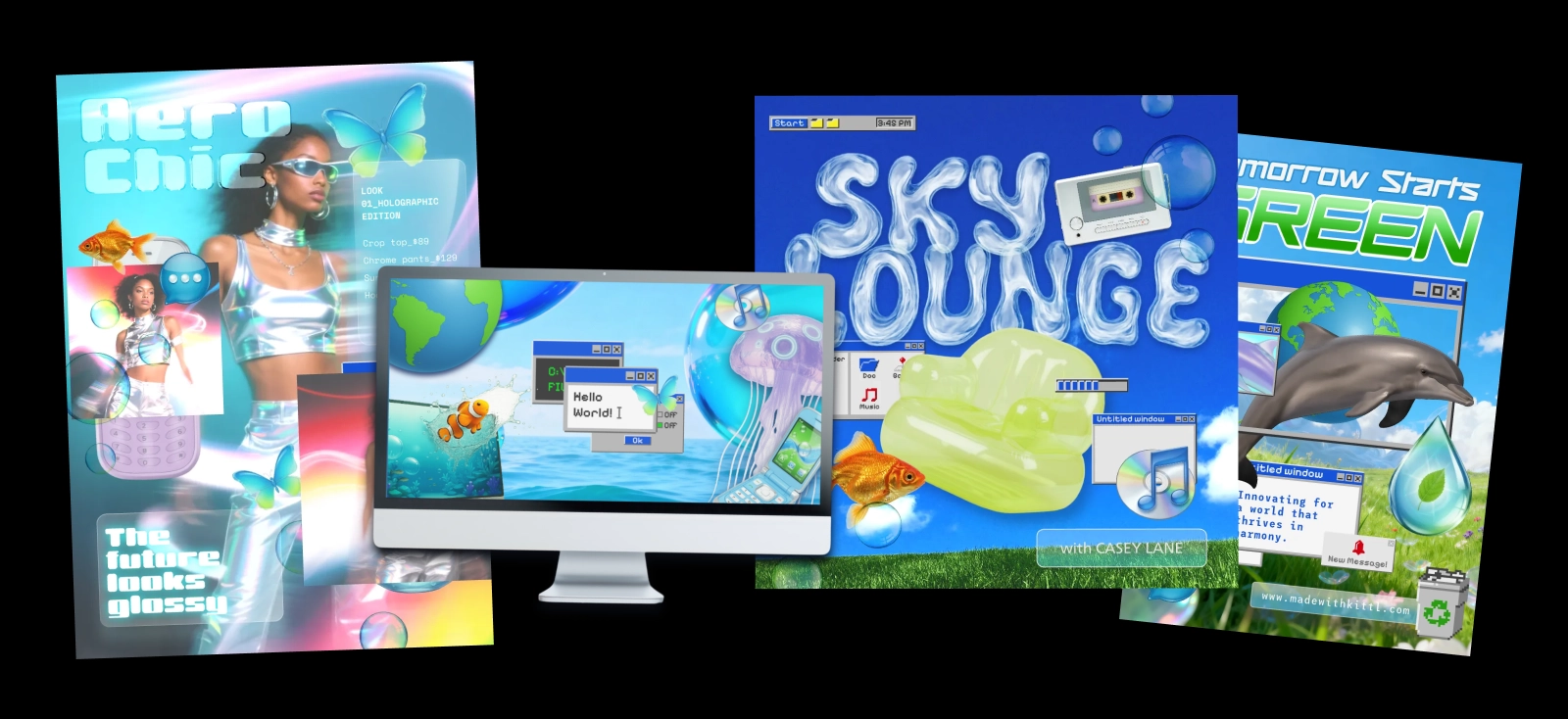
The Frutiger Aero aesthetic — a style that once defined early 2000s tech branding — is making a strong comeback. Think glassy buttons, bright blue skies, water droplets, floating bubbles, and that oddly optimistic vision of the future where technology and nature coexist perfectly.
It’s nostalgic, yes. But more importantly, it feels hopeful.
In this trend breakdown, we’ll explore what Frutiger Aero is, where it came from, why it’s trending again, and how to recreate the aesthetic using modern tools like Kittl.
Because sometimes, the future we imagined back then… still looks pretty good today.
What is the Frutiger Aero aesthetic?

The Frutiger Aero aesthetic is a design style that emerged in the early 2000s, most prominently across operating systems, consumer tech branding, and early mobile interfaces.
It’s often associated with systems like Windows Vista and the broader wave of Web 2.0 design, but reducing it to “glossy UI” doesn’t quite capture what made it work.
Because Frutiger Aero wasn’t just a look. It was a response.
At the time, digital interfaces were becoming part of everyday life. Computers were no longer niche tools — they were becoming personal, accessible, and constant. Designers suddenly had a new challenge: making digital environments feel intuitive to people who weren’t technical.
The solution wasn’t minimalism. It was familiarity.
Gloss, gradients, and reflections helped simulate physical materials. Buttons looked pressable. Surfaces felt like glass. Depth created hierarchy without requiring explanation. And perhaps most importantly, natural elements — water, air, plants — were introduced to soften the perception of technology.
This is why Frutiger Aero often feels strangely calming. It was designed that way.
It presented a version of the future where technology didn’t dominate life — it blended into it.
In today’s context, the aesthetic sits somewhere between:
- Signal Graphics (digital nostalgia)
- Grainy Blur (atmospheric gradients)
- Solarpunk (nature + tech optimism)
Pro Tip
If it looks like it belongs on a Windows Vista wallpaper or a 2007 tech ad, you’re probably in Frutiger Aero territory.
The origins of Frutiger Aero: From Y2K futurism to Web 2.0 optimism

To understand Frutiger Aero properly, it helps to look at what came just before it.
The late 90s and early 2000s were dominated by the Y2K aesthetic — metallic textures, chrome finishes, abstract digital forms, and a more experimental, sometimes chaotic vision of the future. It was futuristic, but not always approachable.
Frutiger Aero softened that vision.
Instead of sharp chrome and dark voids, designers shifted toward:
- open skies
- bright gradients
- soft lighting
- rounded forms
One of the most influential implementations of this shift was Windows Aero, introduced with Windows Vista. It wasn’t just a UI update — it was a complete visual system built around transparency, layering, and light.
Elements floated, overlapped, and reflected their surroundings. Interfaces felt spatial rather than flat.
That system quickly spread beyond operating systems. You saw it in:
- tech advertisements
- mobile phone interfaces
- product packaging
- early app design
For nearly a decade, this became the default visual language of “modern technology.”
Why Frutiger Aero is trending again in 2026
By the early 2010s, design priorities changed dramatically.
Flat design took over. Skeuomorphism was criticized for being overly decorative. Efficiency, speed, and clarity became the dominant goals, especially as mobile interfaces needed to scale across devices.
The result was cleaner systems — but also quieter ones.
A lot of visual personality disappeared in the process.
A return to expressive digital visuals
Now, more than a decade later, designers are starting to revisit that shift. Not to undo it entirely, but to question whether something was lost along the way.
Frutiger Aero is resurfacing because it offers something that many modern systems don’t:
- atmosphere
- depth
- visual storytelling
- emotional tone
It doesn’t just communicate function. It creates a feeling.
Nostalgia meets modern tools

Designers who grew up with early 2000s visuals are now revisiting them — but with better tools.
What once required complex rendering or UI systems can now be recreated quickly using modern design platforms and AI workflows.
A renewed interest in optimistic futures
Unlike darker or dystopian aesthetics, Frutiger Aero presents a future that feels:
- clean
- balanced
- harmonious
That tone feels refreshing again.
Visual traits of Frutiger Aero design
Frutiger Aero has a very distinct look. Once you recognize the elements, it becomes instantly identifiable.
Glossy, glass-like surfaces

The most obvious feature is the use of gloss and reflection, but what matters is what that gloss does. It makes elements feel interactive. It suggests material. It creates a sense of tactility that flat design intentionally removed.
Blue and green gradients

Gradients play an equally important role, but they behave more like lighting than decoration. Instead of simply transitioning between colors, they simulate how light moves across surfaces — soft, continuous, and atmospheric.
Color is almost always anchored in blues and greens. Not randomly, but intentionally. Blue suggests clarity and trust. Green introduces a connection to nature. Together, they reinforce the idea that technology is both clean and organic.
Pro Tip
If your palette doesn’t include blue, it probably won’t feel like Frutiger Aero.
Nature + technology fusion

Water droplets, bubbles, clouds, and leaves appear constantly in Frutiger Aero compositions, but they’re not just decorative. They serve as a bridge — visually and conceptually — between digital systems and the physical world. They make the interface feel less mechanical and more livable. More…human.
Clean, modern typography

Typography, in contrast, stays restrained. Clean sans-serif fonts — often humanist in style — provide structure without competing with the visual environment. They anchor the composition.
Where you’re seeing Frutiger Aero today

What’s interesting about its return is that it’s not coming back exactly as it was.
Instead, it’s being reinterpreted.
You’ll find Frutiger Aero influences in:
- digital posters and experimental graphics
- UI-inspired layouts used in branding
- AI-generated visuals with glossy, fluid textures
- social media content that leans into “liquid digital” aesthetics
There’s also a subtle crossover into pop culture. Some recent visual directions — including work around artists like Zara Larsson — echo the same glossy, fluid, almost utopian tone. It’s not a direct reference, but the influence is clear if you know what to look for.

In that sense, Frutiger Aero isn’t returning as a strict revival.
It’s becoming part of a broader design language again.
How to create a Frutiger Aero design in the Kittl Editor
Frutiger Aero might look like something you’d need a full 3D setup for, but honestly, you can get very close to the aesthetic just using Kittl — as long as you focus on layering, light, and restraint.
Think of this less like stacking effects, and more like building a digital environment step by step.
Step 1 — Set a gradient background

Start with your background first — not your elements.
This style lives and dies by its atmosphere, and that atmosphere comes from gradients that feel like light, not just color.
In Kittl:
- Click the background
- Open the color panel
- Apply a gradient
Try combinations like:
- blue → white
- aqua → green
- sky blue → cyan
But don’t just pick colors randomly. Think about how light would move across the canvas. A slight diagonal gradient often feels more natural than a straight vertical one.
This is what gives you that classic Frutiger Aero wallpaper base — soft, airy, and slightly luminous.
Pro Tip
Use soft gradient transitions. If the shift between colors feels too sharp, the whole design starts looking digital in the wrong way — more “graphic” than “atmospheric.”
Step 2 — Add glass-like shapes

Now that you have a base, start building depth.
Go to the Elements panel and add simple shapes — circles, blobs, or rounded forms work best.
Then:
- apply gradients to the shapes
- lower opacity slightly
- add blur or glow effects
This is where things start to feel like Frutiger Aero. These shapes aren’t just decorative — they act like layers of glass or light sitting in space.
You’re not trying to make objects yet. You’re creating depth and dimension.
If everything still feels flat at this stage, don’t move on yet. This layer is what makes the rest of the design believable.
Step 3 — Introduce nature elements

Now bring in the part that makes Frutiger Aero feel human.
Search in the Content Library for:
- bubbles
- water
- leaves
- clouds
Add them slowly.
Instead of placing everything at once, try this:
- place one element
- adjust its opacity
- see how it interacts with your background
Then add another.These elements are what create that signature nature + technology balance — the reason Frutiger Aero doesn’t feel cold or mechanical.
Pro Tip
Don’t treat these like stickers. If they look “placed,” it breaks the illusion. Lower opacity, soften edges, and let them blend into the environment.
Step 4 — Add clean typography

Typography comes in later — not at the beginning.
Add text using a clean sans-serif font. Search for:
- modern
- UI
- sans-serif
Keep it minimal. Short phrases, labels, or even just a few words are enough.
Frutiger Aero typography doesn’t try to steal attention — it stabilizes the composition.
If your text becomes the main focus, the design starts shifting away from the aesthetic.
Step 5 — Generate elements with AI

This is where you can push the style further.
Use Kittl’s AI Image Generator to create custom elements that match your scene — especially if you’re missing something that would balance the layout.
Example prompt:
glossy bubbles floating in blue sky, glass texture, soft light, frutiger aero aesthetic, no text
Then:
- Generate the image
- Remove the background
- Add it into your composition
The key here is control. AI should extend your design, not define it.
Use it to fill gaps, not to build everything from scratch.
Pro Tip
Include “no text” in your prompts. It saves you from weird AI lettering and keeps your typography consistent.
Step 6 — Add final polish

At this point, your design should already feel like Frutiger Aero. Now it’s about refinement.
Go back through and adjust:
- glow intensity
- transparency levels
- layering order
Small changes here make a big difference.
This is also the moment to step back and ask:
- does the composition feel balanced?
- is there enough breathing room?
- does the light feel consistent?
Frutiger Aero works best when it feels effortless, even though it’s carefully built.
Pro Tip
If something feels off, it’s usually not because you need to add more — it’s because you need to remove or soften something.
Common mistakes when designing Frutiger Aero
Frutiger Aero looks simple on the surface, but it’s surprisingly easy to miss what actually makes it work. Most mistakes come from copying the visuals without understanding the intent behind them.
Treating it like flat design with gradients
One of the most common pitfalls is recreating the colors without recreating the depth.
You might have the right blue gradient, maybe even some bubbles — but if everything sits on the same layer, the design feels flat. Frutiger Aero relies on subtle layering, transparency, and light behavior to create that sense of space.
If it looks like a background with elements on top, it’s not quite there yet. It should feel like everything exists within the same environment.
Adding too many elements too quickly
Because the aesthetic is visually rich, it’s tempting to keep adding more — more bubbles, more highlights, more shapes.
But the original Frutiger Aero compositions were actually quite controlled. There’s always room for gradients to breathe, for light to fade naturally across the canvas.
If everything is competing for attention, the design loses that calm, optimistic feeling the style is known for.
Using the right colors, but the wrong tone
Yes, Frutiger Aero uses blues, greens, and aqua tones — but it’s not just about picking those colors.
It’s about how they behave.
The gradients are soft, continuous, and light-driven. If the colors feel too saturated, too harsh, or too “graphic,” the design starts drifting away from the aesthetic.
Think less “color fill,” more “atmosphere.”
Missing the mindset behind the style
This is the one that’s hardest to spot. Frutiger Aero isn’t ironic. It’s not edgy. It’s not trying to be clever.
It’s sincere — almost idealistic.
If your design starts feeling sarcastic, overly stylized, or intentionally chaotic, you’re probably pulling from a different trend without realizing it.
Explore more 2026 design trends

Frutiger Aero doesn’t exist in isolation — it’s part of a wider shift happening across design in 2026.
Designers are revisiting older visual languages, not to replicate them exactly, but to reinterpret them using modern tools and new contexts.
In the Kittl 2026 Design Trend Report, you’ll see how different trends explore that idea in completely different ways:
- Signal Graphics leans into early digital chaos — pixelated, low-res, and intentionally imperfect
- Grainy Blur focuses on atmosphere, using gradients and texture to create emotional depth
- Future Medieval blends historical symbolism with digital composition, creating something both ancient and futuristic
- Kid Core brings back playful, expressive visuals rooted in childhood and nostalgia
What ties these together is a shared direction: design is becoming more expressive again.
Less about removing everything, more about choosing what matters and pushing it further.
If you’re curious how these styles connect — and how to actually use them in your work — it’s worth exploring the full report.
Key takeaways: Why Frutiger Aero still works
Frutiger Aero isn’t just a nostalgic aesthetic — it’s a reminder of a different approach to digital design.
A time when interfaces weren’t trying to disappear, but to engage. When visuals weren’t just functional, but atmospheric. When the future was imagined as something clean, fluid, and full of possibility.
That’s what still resonates today.
In 2026, bringing back Frutiger Aero isn’t about copying early 2000s visuals. It’s about reintroducing:
- depth
- clarity
- visual optimism
into a design landscape that has leaned heavily toward minimalism.
And maybe that’s why it keeps coming back.
Because it doesn’t just show how things looked — it shows how design can feel.
FAQ: Frutiger Aero aesthetic
What is Frutiger Aero?
The Frutiger Aero aesthetic is a design style from the early 2000s defined by glossy UI elements, soft gradients, and a blend of nature and technology visuals. It was widely used in digital interfaces, branding, and wallpapers during the Web 2.0 era.
Why is the Frutiger Aero aesthetic trending again in 2026?
The Frutiger Aero aesthetic is trending again because designers are revisiting more expressive and dimensional visual styles. Combined with modern tools, it’s now easier to recreate and reinterpret this nostalgic design language in new ways.
What colors are used in Frutiger Aero design?
Frutiger Aero design typically uses blue, green, and aqua tones, often applied as soft gradients that mimic light and atmosphere rather than flat color fills.
Is Frutiger Aero the same as vaporwave?
Not exactly. While both reference past digital aesthetics, vaporwave tends to be more ironic and stylized, whereas Frutiger Aero is cleaner, more polished, and rooted in optimism.
What is a Frutiger Aero wallpaper?
A Frutiger Aero wallpaper usually features glossy gradients, floating elements like bubbles or water, and a clean, futuristic composition inspired by early 2000s digital design.
Can you create Frutiger Aero designs without 3D tools?
Yes. With tools like Kittl, you can recreate the Frutiger Aero aesthetic using gradients, layered elements, and AI-generated visuals — no complex 3D software required.

Shafira is a content writer who turns boring business talk into reads people actually enjoy. She grew up hoarding $1 novels in Singapore and writing hilariously bad fiction, but now she tackles content marketing with all that creative chaos since 2019. From blogs and newsletters to UX and SEO, she writes how she thinks: nerdy, honest, and a bit offbeat. She believes the best content is human-designed, not just plain text.