You can pour a flawless candle, design a label worth framing, and still watch it stall on your Shopify page because the product photo undermines everything else. This happens to well-made candles constantly, and it has nothing to do with the quality of the product.
Candle photography is rarely a camera problem and more of a merchandising problem. Online buyers cannot smell what you made. They are evaluating your product entirely on what the image communicates about it.
This means, the perceived quality of the wax, the positioning of the brand, whether this candle reads as a $14 impulse buy or a $38 considered purchase. That read happens in under two seconds, and your photo either supports the price point or proves against it.
For indie founders managing multiple scents, the operational challenge compounds the creative one. You need a scalable way to produce consistent, premium imagery across every SKU without booking a studio shoot every time a new fragrance launches.
That is what this guide covers: eight candle product photography setups that actually convert, and a workflow for executing them without starting from scratch each time.
TL;DR: 8 candle product photography setups to try
Use these candle photoshoot ideas to create premium visuals for your store, social feed, wholesale linesheet, and launch campaigns:
| Setup | Best for | What it helps sell |
| Scent-visualizer scene | Scent-led product pages and launch visuals | The fragrance story before customers read the notes |
| Golden hour shadow cast | Premium Shopify images and social campaigns | Warmth, depth, and higher perceived value |
| Editorial bathroom vanity | Self-care, spa, and giftable candle lines | The lifestyle ritual around the candle |
| Dark & moody luxury glow | Evening scents, masculine fragrances, and holiday collections | Drama, intimacy, and luxury positioning |
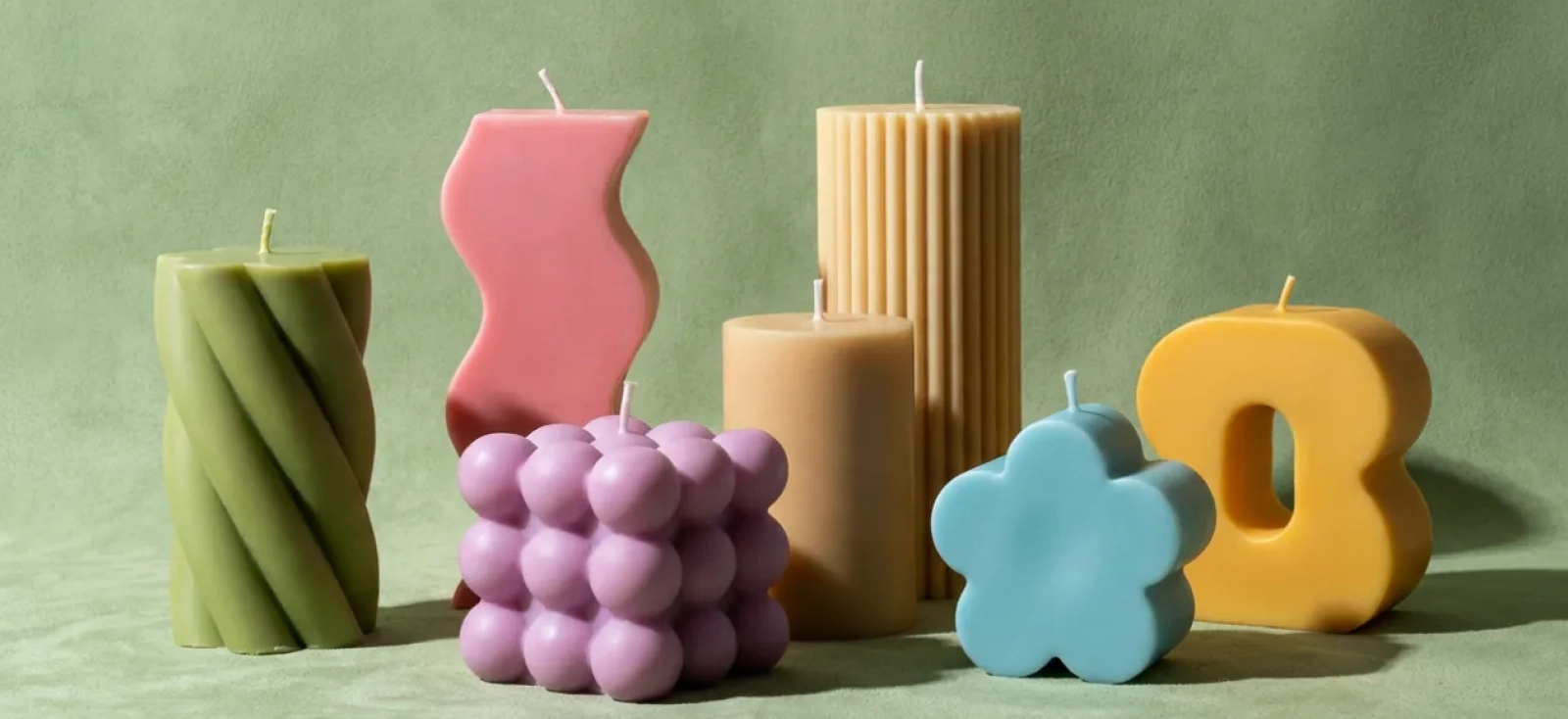
| Multi-SKU group lineup | Collections, bundles, and seasonal drops | Higher AOV by making scents feel better together |
| Raw ingredient flat lay | Pinterest, Instagram grids, and scent education | Craft, texture, and ingredient inspiration |
| Minimalist geometric pedestal | Modern DTC brands and hero images | A polished, design-led brand aesthetic |
| Boutique shelf mockup | Wholesale linesheets and stockist pitches | Retail readiness and clear product evaluation |
The strongest workflow starts with one real baseline shot of your candle, then uses AI product photography to build realistic lifestyle scenes around it. This keeps your actual label, jar shape, and product details intact while helping you scale your visuals across every scent.
Why your candle photos get views but no sales
Here is the uncomfortable truth about selling candles online: your customer cannot smell through a screen. Every purchasing decision they make is a bet they place based purely on what they see. And if what they see looks like it was photographed on a kitchen counter with a phone propped against a cereal box, they are not betting $36 on it.
The visual gap between a $12 candle and a $36 candle is almost entirely merchandising. The wax, the fragrance, and the vessel might be identical. But one brand photographs its product like it belongs next to a Byredo display and the other photographs it like it belongs at a craft fair table. Customers feel this difference before they can articulate it. It registers as trust, or the absence of it.
This is not about having an expensive camera. Plenty of stunning product imagery gets made on iPhones. This is about visual merchandising. The art of understanding that you are not literally photographing the candle jar, but constructing an atmosphere that makes a stranger decide your candle belongs in their home. When that atmosphere is missing, you get traffic, you get saves, you get engagement, but it all ends up in abandoned carts.
The “fake AI” problem in candle photography
A lot of candle founders have tried AI product photography tools and walked away frustrated. The output looks plausible until you look closely: a label font that has shifted slightly, a wick floating above the melt pool with no physical logic, a wax surface with a synthetic sheen that no real wax has. The whole image reads as generated before the customer has even processed why.
This is what happens when AI generates the entire product from scratch. The tool does not know what your candle actually looks like, so it invents something plausible. Plausible is not the same as real.
The solution is an approach called Atmosphere-First Product Photography. The concept is straightforward: you supply the actual, physical product. The AI supplies the environment around it. Your jar, your label, your wax texture, your branding remain untouched while the AI builds the surface, the background, and the ambient light. The result is grounded in something real because the central product is real.

This is where Kittl’s AI Image Generator earns its place in a serious founder’s workflow. Rather than hallucinating a product from a text prompt, Kittl takes your baseline product shot and places it into a generated scene while preserving the original shadow map and reflection data. Your candle looks like it is actually in the space, not composited onto a stock photo. That single difference is what makes the image convincing or unconvincing to a buyer.
On Kittl, you can even go a step further on triggering your audience’s imagination of your product on their hands with AI Video Templates.
Just see this pre-built template of a candle product video:

When clicking the AI panel below, you will find the pre-built AI prompt for you to use. All you have to do is add your product to the first frame and watch it become a whole product video output in minutes.

8 candle product photography setups that look hyper-realistic
1. The scent-visualizer scene
Candles have a specific challenge that most physical products don’t: the main reason someone buys one is completely invisible in a photo. You can show the vessel, the label, and the wax finish. You cannot show the scent.
What you can do is trigger the memory of it. The human sense of smell is more directly tied to memory than any other sense, which means a visual reference to your scent’s ingredients can activate an association before the customer has ever opened your jar.
Most buyers have smelled lavender, eucalyptus, or citrus at some point in their life. A single ingredient element in the frame gives their brain something to reach for. That reach is doing the selling.

The execution principle is restraint. One prop element, in soft focus, secondary in scale to the vessel. Keep every supporting element quiet enough that the buyer’s eye lands on the jar within the first second.
For founders who do not want to manage a physical prop inventory because botanicals die, citrus dries out, and nothing stays photogenic for long, Kittl’s AI image generator handles this without the overhead.
Upload your baseline candle shot and prompt the AI for scene elements that match your scent profile: “soft-focus dried eucalyptus stem, raw linen surface, warm diffused afternoon light.” Your real product stays exactly as it is. The environment builds around it.
Then all you have to do is leverage Kittl’s AI Background Remover and candle mockup to complete it.

This works because a buyer who can mentally connect the fragrance to a visual reference before reading your scent description is much closer to purchasing than a buyer evaluating a jar on a white background with only text to work from.
2. The golden hour shadow cast
If you study the Instagram grids of Byredo, Otherland, or Boy Smells, you will notice they all use some version of the same lighting approach: a candle on a surface, harsh directional light cutting across from the side, a long shadow stretching away from the vessel. It looks editorial and expensive without containing a single expensive prop.
This is because a candle with a strong directional shadow looks physically solid and substantial. It has good presence. The same candle photographed in soft, even light looks flatter, lighter, easier to scroll past. Shadow adds perceived weight to the product, and perceived weight translates directly into perceived value.

The challenge for multi-SKU founders is that this setup requires consistent light conditions across every product in a catalog. Late-afternoon window light is beautiful and free, but you cannot reliably recreate the same angle three months later for the next scent drop. Inconsistent shadow directions across a product grid signal to buyers that no single visual intelligence is operating across the brand.
When prompting Kittl’s AI for this setup, use “harsh directional light from the left, deep cast shadow, minimal warm-toned matte surface.” Lock that shadow direction across every SKU you generate. It is the single most important consistency variable in building a coherent product catalog.
3. The editorial bathroom vanity
Lifestyle product photography is often described as “showing the product in context.” That framing is technically correct but undersells what is actually happening. What a good lifestyle shot does is let the buyer rehearse ownership before they have committed to purchasing.
When a customer sees a candle on a marble vanity edge, with a soft linen towel out of focus in the background and morning light coming from the left, they are not evaluating a product anymore. They are mentally placing it in their own bathroom. That mental rehearsal, picturing the product in a specific moment of their daily routine, is one of the strongest purchase triggers available in product photography. It moves the buyer from “that’s nice” to “I want that in my life.”

Traditionally this shot requires a location rental or a physical set. Neither scales when you are launching multiple scents a year.
The Kittl workflow removes that constraint. Start with a clean neutral background shot of your candle. Upload it, use the background remover to isolate the product, then prompt the AI scene generator: “warm marble vanity surface, soft morning light from the left, white linen in soft focus background, minimal.”
With Kittl’s AI Video Generator, you can even create a motion of your candle that looks like this:

4. The dark and moody luxury glow
Most product photography tries to show the product as clearly as possible. This setup does the opposite: it uses darkness to make the candle feel more significant.
It usually sets up with a near-black background, a lit flame, warm and amber in the frame, that results in the vessel catching just enough ambient light to show its material quality without fully revealing itself.

This works specifically for candles because a candle is one of the few products that generates its own light. You are not just photographing an object. You are photographing the mood the object creates. For a buyer considering a $40-plus purchase, that mood is often the thing they are actually buying.
To shoot this physically: dark room, single warm light source slightly above and to the side, tripod, burst mode at the fastest shutter speed your conditions allow. Flames move constantly and register as blur at anything slower than 1/500. Shoot twenty frames and choose the one where the flame holds a clean upright shape.
In Kittl, you can also boost the flame tone toward amber-orange, lift the vessel mid-tones just enough to reveal the container’s finish, and let the background fall to true black.
But if you want to create your very own dark and moody scene without the setup, prompt it on Kittl’s AI Image Generator with prompts like:
A dark and moody luxury product photograph of a lit candle, styled against a near-black background. The candle flame glows warm amber-orange, becoming the main light source in the scene. The vessel catches only a subtle amount of ambient light, revealing its material and texture without fully exposing it. Deep shadows, soft contrast, and selective highlights create a rich, intimate atmosphere. Premium editorial product photography, cinematic lighting, minimal composition, warm glow, elegant luxury fragrance branding, high-end and atmospheric mood.
or
A dark and moody luxury product photograph of a lit candle in a smoked glass vessel, set against a true black background. The flame glows in rich amber-orange tones and acts as the primary light source, casting a soft warm halo. The glass catches just enough light to reveal its finish and form while remaining partially hidden in shadow. Minimal composition, cinematic mood, premium fragrance branding, elegant editorial photography, intimate, sophisticated, and atmospheric.
5. The multi-SKU group lineup
A collection shot is not a photograph of multiple candles. It is a visual argument that these products belong together, were designed together, and give the buyer a reason to think about the collection rather than a single candle.
Done well, it is the most direct lever available for increasing average order value. A buyer who opens a collection page and sees products that feel visually unified starts thinking about which combination they want, not whether to buy at all.

Done poorly, it exposes every gap in your production consistency. When you are shooting products one at a time across eight months, the light changes, your phone settings change, and the surface you used for the spring launch is not the surface you used for the autumn drop.
None of that is noticeable in isolation. Put those photos side by side in a collection lineup and the buyer sees it immediately, even if they cannot name what is off. What registers is that the brand does not look like a single coherent thing
For a DTC buyer that creates doubt. For a wholesale buyer evaluating whether to stock you, it can end the conversation before it starts.
In Kittl, the infinite canvas lets you bring all your product shots into a single workspace at once rather than treating each SKU as a separate project. You align them, apply a consistent AI-generated background across the set, and any adjustment you make to the scene updates across every image in the same session.
The light direction, surface tone, and color temperature stay identical because you are not rebuilding the scene per product. You are setting it once and populating it.

This is the perfect setup when you want a visually unified collection that reframes the buyer’s decision from “should I buy this candle” to “which combination do I want.” That reframe drives higher AOV, especially for gift sets and seasonal launches.
6. The raw ingredient flat lay
There is a pricing ceiling that follows most indie candle brands, and it has nothing to do with the quality of the wax or the vessel. It comes from the buyer’s inability to tell whether the fragrance was thoughtfully composed or just selected from a supplier catalog. Both produce a candle. Only one justifies $38 for it.
The raw ingredient flat lay solves this without a word of copy. When a candle labeled “Black Cedar and Smoked Amber” is photographed overhead alongside a piece of raw bark, a fragment of amber resin, and a few whole peppercorns, the buyer is not reading about the scent. They are looking at evidence that the scent was built from something real. Showing how the product is made is what moves a candle from commodity to craft in the buyer’s mind.

The physical challenge for multi-SKU founders is sourcing and maintaining twelve sets of photogenic ingredient props across a full year of launches. Organic materials have short visual shelf lives, and rebuilding the setup for every scent drop is the kind of overhead that quietly kills a content workflow.
In Kittl, you build the flat lay digitally. Place your top-down baseline product shot on a canvas, then arrange high-quality cutout botanical and ingredient assets around it. The vessel stays at the center. The ingredients sit outward from it as visual evidence, secondary in scale. The composition should feel like the product is surrounded by its own story, not lost inside someone else’s.
This also converts well because Flat lays perform disproportionately well on Pinterest and Instagram saves, which drives organic reach and increases the likelihood of discovery before a customer ever lands on your Shopify store.
7. The minimalist geometric pedestal
Spend time on the product pages of Otherland, P.F. Candle Co., or Aesop, and you will notice that none of them are trying very hard to show you the product. The candle is often partially obscured, sitting on something architectural, surrounded by deliberate negative space. The photography is not demonstrating the product. It is asserting that the product belongs in a specific kind of home, owned by a specific kind of person.
That is the function of the minimalist geometric pedestal setup. A plaster arch, a terracotta block, a pale curved ceramic form: these props do not add context to the candle. They add social context to the buyer. They signal that this product was selected with taste, and that purchasing it is an act of taste in return.

For a buyer already shopping in the premium DTC home goods space, that signal is immediately legible. They have seen it on the brands they trust, and they know what it means.
The practical problem is that these props are expensive relative to what they do, which is sit in photographs. They have no other function in a candle business.
When prompting Kittl AI for this setup, use “plaster arch form, soft terracotta tonal block, diffused overhead studio light, off-white tone, no other elements added”.
The discipline is keeping the composition clean enough that the candle is unmistakably the subject. The moment the geometric elements start competing for attention, you have built an architecture photo with a candle in it, which is not the same thing.
This aesthetic speaks directly to the DTC Shopify buyer who is already purchasing from design-forward brands and comparing your product against them. Visual fluency in their aesthetic language signals that your brand belongs in the same tier.
8. The boutique shelf mockup
Here is something that catches a lot of indie founders off guard: the photography that performs best on Instagram is not the photography that gets you into wholesale.
Instagram rewards atmosphere. Wholesale buyers reward clarity. A boutique buyer is not only asking whether your candle looks beautiful in someone’s home. They are asking whether it can sit on a retail shelf next to eight other brands and still look intentional, premium, and easy to merchandise.
That is the job of the boutique shelf mockup.
Instead of showing the candle in a lifestyle scene, this setup places it in a clean retail environment: one or several candles arranged on a simple boutique shelf, with soft neutral lighting, accurate shadows, enough spacing between products, and the label fully visible. The goal is not drama. The goal is believability. The buyer should be able to glance at the image and immediately understand how the product would look in their store.

This matters because wholesale is partly an imagination game, but the founder should not make the buyer do all the imagining. If your pitch only includes close-up lifestyle shots, the stockist still has to mentally translate your candle into their physical retail space. How tall is it? Does the label read clearly from a shelf? Does the packaging feel quiet and polished, or does it fight with everything around it? Does the product look easy to display?
A good boutique shelf mockup answers those questions before they are asked.
For single-SKU brands, it shows that one candle can hold its own as a premium object. For multi-SKU brands, it shows that the full collection has enough visual consistency to be merchandised together. The label alignment, vessel shape, color palette, and spacing all start working as proof that the brand is retail-ready.
In Kittl, you can build this without renting a studio or finding the perfect boutique location. Start with your clean product shot, remove the background, then place the candle into a simple shelf-style composition. Keep the shelf neutral, the lighting soft, and the styling minimal. Add a realistic base shadow so the candle feels physically grounded, not pasted on. If you are showing multiple scents, align the vessels evenly and keep every label facing forward.
The multi-scent consistency system (how to scale)
The photography problem nobody talks about for multi-SKU candle brands is not how to take a good photo of one candle. It is how to maintain a coherent visual identity across twelve candles photographed over twelve months by one person with variable time, variable light, and variable props.
The result is something most founders recognize immediately: the vanilla candle from the spring launch, the cedar tin from the autumn drop, the soy pillar from the holiday collection. Each photo is fine on its own. Together on a Shopify collection page or a Faire listing, they look like a portfolio of experiments rather than a brand with a point of view. That incoherence signals to wholesale buyers and high-value customers alike that the brand does not have a system. And a brand without a system does not command premium pricing.
The fix is not better editing. It is building a production standard upstream so consistency is structural rather than something you try to correct afterward.
The Multi-Scent Consistency System works in three steps:
Step 1: Establish a canonical scene.

Choose one AI-generated background environment in Kittl that matches your brand’s visual identity: a specific surface, a specific light direction, a specific color temperature. This is your standard, not a starting point you iterate from.
Step 2: Lock it as a Brand Kit template.

Save the background, shadow settings, and composition grid in Kittl. The only variable in this template is the product image at the center.
Step 3: Swap, not rebuild.

New scent launches. New baseline photo goes into the locked template. Adjust scale if the vessel format differs. Generate. That is the entire production workflow for a new SKU.
A founder rebuilding their photography setup per product spends roughly eleven hours a month on imagery. A founder using this system spends under two. More importantly, every image produced shares the same surface, the same light direction, the same shadow quality. Your collection page looks like a collection. Your linesheet looks like a brand. Those are not just aesthetic outcomes. They are commercial ones.
Build your candle brand assets in Kittl
Product photography is the front door of the brand. But what the buyer finds after they walk through it, the label design, the Shopify collection page, the wholesale pitch deck, has to match what the photo promised. A premium photo leading to an inconsistent label or a chaotic product grid loses the trust it just built in two seconds.
Kittl is built to hold the entire visual system for an indie product brand: AI product photography, label design, wholesale asset generation, and brand consistency tools that do not require a design agency or a studio retainer. For founders who want their $38 candle to read as a $38 candle at every touchpoint from the first Instagram impression to the stockist meeting, it is the infrastructure that makes that possible without rebuilding it from scratch every season.
Start with one candle. Build one scene. Scale it across the catalog.
FAQ
Why do my candle product photos look cheap?
The most common culprits are flat lighting (which removes depth and texture from the vessel), a distracting background, and no intentional styling to contextualize the product. Cheap-looking photos lack a visual point of view. They show the product but do not merchandise it.
How do you photograph candles without a professional studio?
A clean surface, a single light source positioned to the side (natural window light or an affordable LED panel), and a simple backdrop are the physical minimum. From there, AI tools like Kittl can generate lifestyle environments around your baseline shot, removing the need to build physical sets for every scene.
What is the best lighting setup for candle photography?
For unlit candles: soft, directional sidelight that reveals the vessel’s material quality and the texture of the wax. For lit candles: a dark environment with a single warm overhead or side light to allow the flame to read clearly without washing out. Avoid direct flash in all cases.
How do I make AI product photos look realistic instead of fake?
The key is using AI to generate the environment, not the product itself. Start with a real photograph of your physical candle. Use an AI tool that preserves the original shadow data when placing your product into a generated scene. The shadow is what grounds the product in the space and prevents the floating, synthetic look.
What props should I use for luxury candle photography
Linen fabric, raw stone or marble surfaces, dried botanicals, ceramic vessels, and architectural geometric blocks all read as premium in product photography. Avoid plastic, synthetic textures, and anything too obviously seasonal or trend-dependent. Props should amplify the candle’s scent story or aesthetic positioning, not tell their own story.
How do I maintain visual consistency across multiple candle scents?
Build a master scene template in Kittl with locked background variables (surface, light direction, color temperature). Save it. For each new SKU, swap only the product image. This gives every photo in your catalog the same visual DNA without reshooting from scratch each time.
How do you photograph a lit candle flame without blur?
Use a tripod or brace your phone against a stable surface. Set your camera app to the fastest available shutter speed or use a night mode that prioritizes shutter speed over sensor time. Shoot in burst mode and select the frame where the flame holds its shape cleanly. Avoid shooting in breezy conditions.

Shafira is a content writer who turns boring business talk into reads people actually enjoy. She grew up hoarding $1 novels in Singapore and writing hilariously bad fiction, but now she tackles content marketing with all that creative chaos since 2019. From blogs and newsletters to UX and SEO, she writes how she thinks: nerdy, honest, and a bit offbeat. She believes the best content is human-designed, not just plain text.