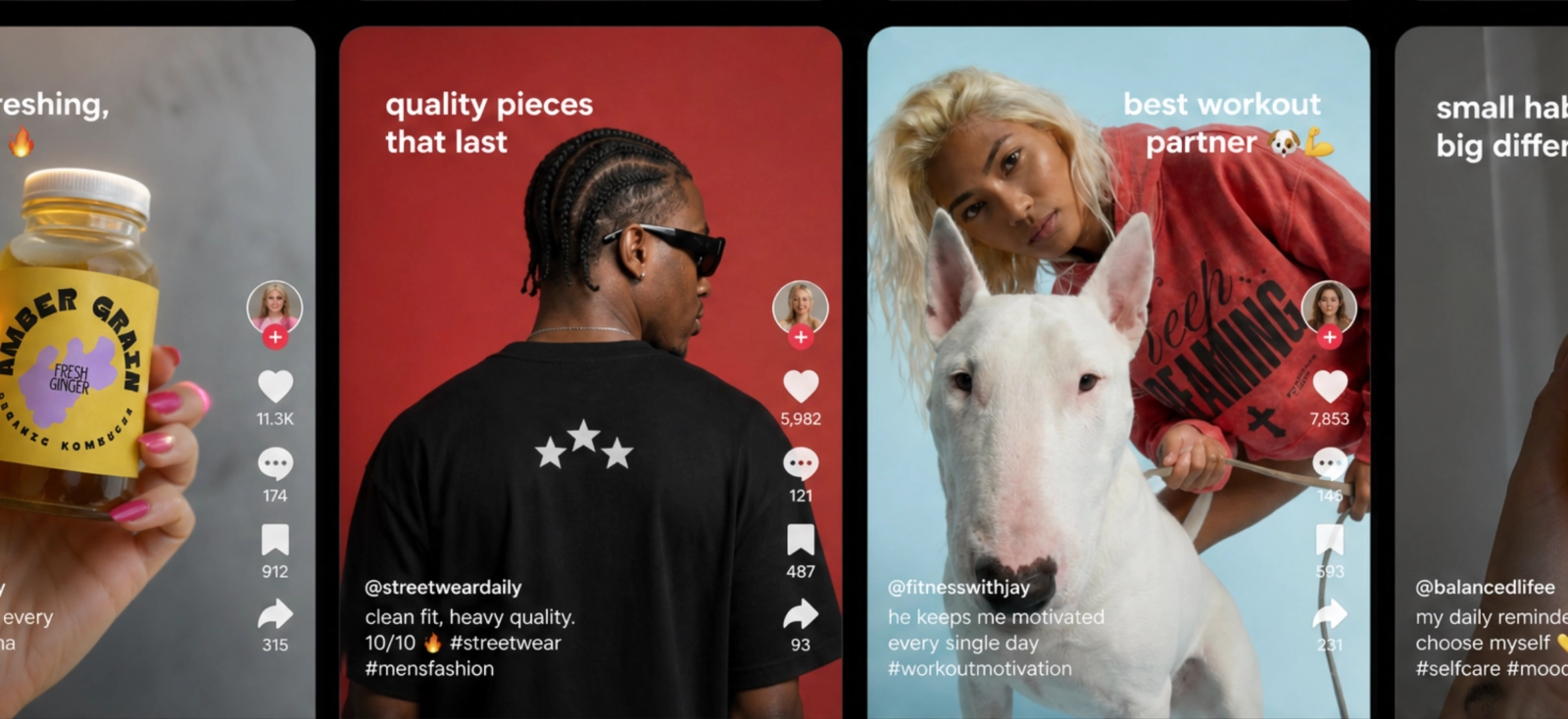
If your print-on-demand product video looks like an ad, you have already lost.
TikTok users, especially in the merch and apparel space, have developed an almost reflexive scroll response to anything that feels produced. Fancy transitions, studio lighting, and branded lower-thirds can make a video feel too much like a campaign before the product itself has had a chance to connect.
And on a platform where the first two seconds determine whether anyone sees the rest of your video, anything that feels staged can make people move on before they understand what you are selling.
That is why print-on-demand marketing is shifting toward UGC-style content: casual, creator-style videos that feel native to the feed instead of lifted from a traditional ad campaign.
The sellers gaining traction in 2026 are building POD TikTok videos that feels closer to a FaceTime call with a friend than a traditional commercial. And the technology behind this authentic TikTok marketing, specifically the Kittl and Printify template workflow, is now accessible to any solo seller, regardless of budget, inventory, or camera experience.
Learn how to create TikTok content templates built specifically for print-on-demand marketing with this new workflow.
Why polished ads are losing ground in print-on-demand marketing

Part of the reason is structural. TikTok’s algorithm rewards watch time, completion rate, and engagement, which are shaped by whether the content feels worth watching in the feed, not how expensive it looks. But the shift is also happening on the buyer side.
Modern shoppers, especially Gen Z, have grown up surrounded by ads, sponsored posts, influencer partnerships, and polished brand campaigns. They can recognize a sales message almost instantly, often before the product itself has had time to register.
That is why ecommerce TikTok marketing works differently from traditional product marketing. A clean product shot or polished reveal can still help, but on TikTok, buyers also look for social proof, context, and small credibility signals: a real person explaining why they made something, a product shown in a normal room, a casual sentence that sounds unscripted, a slightly imperfect frame that feels like it belongs in the feed. These details lower the viewer’s guard because they feel closer to peer recommendation than brand persuasion.
This is the psychology of the scroll. People swipe past anything that announces itself as an ad too quickly because it asks for attention before earning trust. A polished product video with studio lighting and a scripted voiceover may look professional, but on TikTok, professional can also read as distant, rehearsed, and easy to ignore.
A seller filming a hoodie on their kitchen table, talking honestly about why they designed it, gives the viewer a reason to pause because the content feels immediate, specific, and human.
For POD sellers, that difference matters because every product video has to compete with the rest of the feed, not only with similar products. UGC-style content works because it makes the product feel discovered rather than pushed. It gives the buyer enough human context to think, “Someone made this for someone like me.”
If you want some ideas on print-on-demand niches for 2026, check out our article here: 50+ print on demand niches for 2026.
On TikTok, this includes formats like:
- Casual mirror selfies
- Car seat confessionals
- Pack-an-order flat lays
- Behind-the-scenes design previews
- Faceless product showcases
- Quick try-on style videos
The aesthetic is intentional. The lo-fi look is engineered, not accidental.
UGC-style content gives POD sellers a way to make their products feel native to the feed, even when the video is still intentionally created for marketing.
Do not confuse “raw” with “random.” The best UGC-style content still has structure: a clear hook, a believable visual, and one simple reason to keep watching
Why TikTok marketing for POD depends on raw, creator-style content
The creator economy has fundamentally changed what trust looks like to a buyer.
A generation of consumers has grown up watching creators talk about products from their cars, their bedrooms, their living room couches, and half-lit corners of their apartments. Messy bookshelves in the background, natural window light, and a slight “um” mid-sentence can make a video feel familiar, personal, and native to the platform.
But this is also where most conversations about UGC stop too early. A lot of ecommerce marketing advice treats user-generated content as something you harvest after the sale: customer reviews, unboxings, try-ons, testimonials, and organic posts from people who have already bought the product. That approach works well for brands with existing buyers, active communities, and enough order volume to create a steady stream of customer content.
For most print-on-demand sellers, waiting for customers to post reviews is too slow.
If you are launching a new shirt, mug, poster, or hoodie, you may not have customers posting about it yet. You may not even have the product sample in your hands. Waiting for someone else to create social proof can stall your marketing before the product has had a fair chance to sell.
That is why UGC-style content matters so much for POD. Instead of waiting to harvest customer reviews or organic posts, sellers can create videos that borrow the visual language of UGC themselves: casual framing, honest hooks, creator-style pacing, product-first storytelling, and formats that feel native to TikTok rather than lifted from a brand campaign.

The point is to avoid pretending a video is a customer review, while still creating marketing that feels human enough to earn attention before you have a large audience, a long review history, or a warehouse full of samples. For solo POD sellers, this gives you a repeatable way to show up in the feed from day one, instead of hoping someone else talks about your product first.
| The reality | What it means for POD sellers |
| You do not always have physical inventory in hand. | Spontaneous “look at this shirt I’m wearing” content becomes harder to produce. |
| TikTok favors native, personal-feeling content. | You do not need studio-quality footage to compete. |
| Buyers want trust before they buy. | Honest hooks, creator-style visuals, and believable motion matter more than polish. |
| Consistency drives visibility. | A low-friction content workflow becomes a serious growth advantage. |
The takeaway is simple: POD sellers do not need to mimic big-brand production to make videos people care about. They need content that feels native enough to earn attention and clear enough to make the product understandable quickly.
That is exactly what the Kittl and Printify template workflow is built to deliver. It gives sellers a way to create creator-style product videos from the assets they already have, without waiting on samples, customers, or a full content production setup.
TikTok now processes over 140 billion searches per year, with 40% of young users turning to TikTok instead of Google to discover products. UGC-style content sits at the intersection of discovery and trust. It is how products get found and why they get bought.
Creator-style video converts 3.2 times better than brand-produced ads on the platform, and UGC formats increase conversions by 38% compared to standard video ads.
These shifts can meaningfully change how quickly a product gains traction, especially for sellers who need every piece of content to work harder.
Take one product and write three hooks for it: one emotional, one practical, and one curiosity-driven. If all three hooks sound like product descriptions, rewrite them like something a real person would say in a TikTok caption.
The solo POD seller’s dilemma: High friction, low output
Here is the specific wall most Printify sellers hit.
You design a product. It looks good in the mockup. You publish the listing. You know TikTok is where you should be marketing it. But to make video content the conventional way, you need to order a physical sample — 2 to 7 business days production plus shipping — film it, edit it, and post it. One product. One video. Repeat indefinitely.
Most solo sellers cannot sustain that pipeline. So the product gets posted once with a static image, maybe shared to Instagram, and then quietly deprioritized in favor of the next design. The catalog grows. The content library does not.
The deeper issue is that scripting, filming, and editing cause real burnout for people running their entire business alone. Content creation starts to feel like a second job with no clear return.
Sellers know they need to post consistently, especially because TikTok rewards accounts that post 4 to 5 times per week. But building that rhythm on top of designing, listing, and managing orders is genuinely hard.
The real unlock is friction reduction. When creating a video takes an afternoon instead of two weeks, consistency becomes achievable.
Build content before you feel “ready.” For POD sellers, video should not be the final step after a product launch. It should be part of the product launch itself.
How Kittl + Printify simplify TikTok content for print on demand

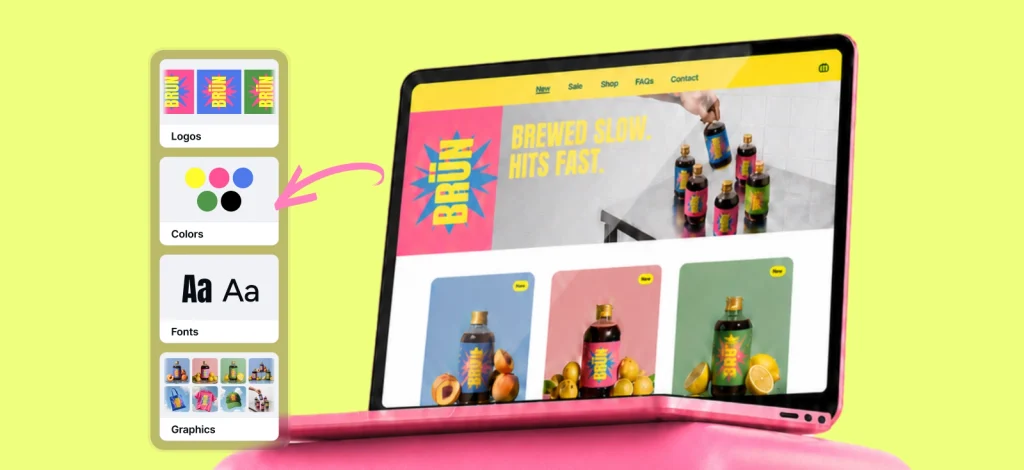
Kittl built a dedicated set of TikTok video templates in direct partnership with Printify, designed specifically around what POD sellers need to market products they do not physically hold.
The design brief behind these templates was deliberate: no baked-in music, no voiceover, no rigid script. Just the visual foundation: the motion, the pacing, and the hook structure, leaving the audio and personal layer completely open.
A seller can add their own voice, use Kittl’s AI audio generation, or post clean and add trending TikTok audio in-app. The output looks like UGC because the production fingerprint of a polished brand is absent.
The full workflow runs in Kittl’s browser-based canvas with no downloads and no tool-switching:
1. Bring in your product image

Upload the mockup from your Printify dashboard, or use Kittl’s built-in mockup generator to place your design onto apparel, mugs, bags, candles, or home decor directly on the canvas.
2. Choose a template

The Printify-specific TikTok library includes hook-style openers, product reveals, gift-idea posts, offer callouts, and faceless showcases each built around formats that earn watch time.
3. Customize the content layer

Swap placeholder text for your product name, a line about the design, a price point, and your chosen font. The structure is already built. You are filling it in, not starting from scratch.
4. Generate the video.

Open the Kittl AI panel, choose “Generate your video,” set your product image as the start frame, write a short motion prompt, and generate. The clip lands directly on your canvas as a movable tile.
Example prompt: “Product slides into frame, text fades in, soft natural motion.”
5. Add audio and export.
Record your own voice, prompt AI-generated audio, or leave it open for in-app TikTok audio. Export as an MP4, ready to post on TikTok, Instagram Reels, YouTube Shorts, or drop directly into your Printify or Etsy product listing.
The same workflow also helps beyond TikTok. A listing with video consistently outperforms a static-image listing because buyers can see scale, texture, and movement. One afternoon of creation produces a full asset set for a product launch.
Export a clean version without trending audio first. That gives you a reusable master file for TikTok, Reels, Shorts, Pinterest, product listings, and future edits.
Once the workflow is easier, the next challenge is knowing what to make. The easiest way to build a stronger TikTok marketing strategy is to stop treating every video like a one-off idea. For print-on-demand sellers, the smarter approach is to work from repeatable formats: hooks, scenes, overlays, and visual structures that can be reused across different products without making every post feel identical.
That is where UGC-style TikTok content becomes especially useful for small businesses. You do not need a studio setup or a new concept every day. You need a handful of believable creator-style formats that make each product feel specific, personal, and native to the feed.
6 UGC-style TikTok content ideas for POD sellers
These formats work with or without physical samples. They are the specific hooks and structures that perform in the POD and merch space — and each one maps directly to templates available in Kittl.
| Format | Best for | Why it works |
| Car seat confessional | Strong opinions, niche apparel, founder-style storytelling | Feels intimate, urgent, and unscripted |
| Casual mirror selfie | Apparel, merch, outfit-based products | Makes the product feel worn, owned, and real |
| Pack an order flat lay. | Giftable products, stationery, apparel drops | Creates proof that the shop feels active |
| Authentic try-on | T-shirts, hoodies, sweatshirts, apparel | Builds purchase confidence through honest details |
| Behind-the-scenes sneak peek | Product drops and new collections | Makes viewers feel like insiders before launch |
| Faceless aesthetic content | Home decor, stationery, aesthetic products | Lets the product carry the entire visual story |
1. The “car seat” confessional
The psychology here is intimacy. A person talking directly to camera from the front seat of a car feels urgent and unscripted, like something they felt strongly enough about to record right now, without setting anything up. TikTok audiences read this format as genuine opinion, not marketing.
For POD sellers, choose a hook-style template with a tight, face-forward frame aesthetic. Use a motion prompt like: “Close-up product drift into frame, warm natural light, casual handheld feel.”
Open with a bold text overlay carrying the hook. Something like: “I couldn’t find a shirt that matched my vibe, so I made one”. Then, you just need the product visual to do the rest. Or simply grab these templates:

Reel Talk T-Shirt AI Video.
Use Template

Cherry Coded Dad Cap AI video.
Use Template
2. The casual mirror selfie
This one is also a favorite because mirror selfies are the native language of apparel content. It signals that a real person owns this product and chose to wear it, which is one of the strongest endorsements a garment can have.
On Kittl, you can grab templates like these:


With this format, you can see how the handheld and imperfect feel makes the product look like it was authentically captured in someone’s bedroom, not staged in a studio.
Mirror selfie content works best when the overlay sounds casual. Think “made this for the people who always overdress for coffee” instead of “premium graphic t-shirt available now.”
3. The “pack an order with me” flat lay
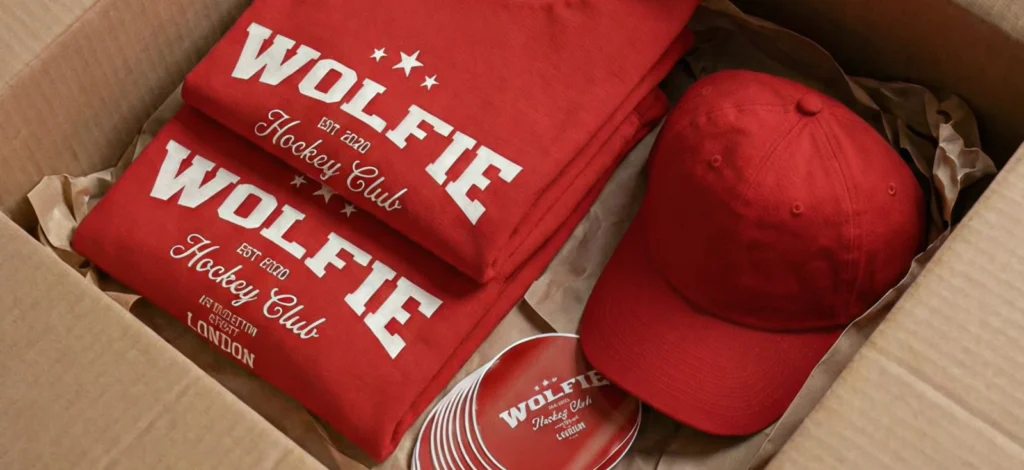
A top-down product footage like this is satisfying and ASMR-adjacent. It communicates that real orders are going out, that real customers bought this, and that the brand experience is thoughtful, all without saying any of it explicitly.
On Kittl, you can grab flat lay templates like these and build from there:


You can also add on the pre-built prompt on the template like “overhead product reveal, items slide gently into frame, clean surface, natural texture.” Layer your product mockup with simple props like tissue paper or kraft packaging in the visual. The result communicates an active, thriving shop without a single physical item being actually packed.
4. The authentic try-on haul
Try-on hauls are one of the highest-converting formats in apparel TikTok because they give buyers the information they actually need before purchasing: how does it fit, what does the print look like up close, does it match the mockup. Honest answers to those questions build more purchase confidence than any polished commercial.
The format works in Kittl by choosing a close-up product motion template and writing a prompt that emphasizes natural movement, such as “apparel shifts softly in frame, gentle rotation, warm indoor light.” Or simply grab one of our templates here:


Then, carry the “try-on” authenticity through text overlays:
- “Runs slightly large”
- “Print is sharper than expected”
- “Softer fabric than I thought”
- “Actually works with baggy jeans”
- “The kind of hoodie I’d steal from myself”
The copy carries the honesty, while the motion makes the product easier to picture.
5. The behind-the-scenes sneak peek
Showing the creation process builds anticipation and makes the audience feel like insiders before a drop. It creates a buying moment before the product is even live — and for POD sellers, it is one of the easiest formats to produce because the “behind the scenes” is literally your Kittl canvas and your Printify dashboard.
Choose a sneak peek or reveal template and prompt for a gradual unveil: “design fades in from blur, slow zoom, text appears with subtle animation, closes on full product reveal.” Add a release date overlay such as “dropping Friday”, and the video becomes a pre-sell asset that does real work before a listing even goes live.


6. Faceless aesthetic content
Not every seller wants a person on camera, and for many niches, including home decor, stationery, aesthetic apparel, face-free content can work especially well because the product becomes the entire visual story.
Choose a faceless showcase template and prompt for motion that places the product in context: “product rests on coffee shop table, soft morning light, gentle drift, cinematic feel.” Or try these pre-built templates, optimized for TikTok:


Then, add trending TikTok audio in-app after export to complete the atmosphere. Once the visual context is clear, the template and motion tools can do most of the heavy lifting.
How to make UGC TikTok content feel authentic with add-on voice
Templates are starting points. The difference between a video that converts and one that gets scrolled past is almost always in the human layer added on top. And what’s a better human touch than your own voice?
Here’s some tips to create a great one:
Lead with a hook that earns the next three seconds
Strong openers for POD content include:
- “I couldn’t find this anywhere, so I made it.”
- “POD sellers, you need to know this.”
- “This is why my shop finally started converting.”
- “I made this for people who take niche jokes way too seriously.”
- “This started as a random design and now I want it on everything.”
The hook is a promise. It tells the viewer exactly what they will get if they stay.
Do not over-edit
Keep the pauses, keep the natural rhythm. A slightly imperfect delivery reads as authentic. A suspiciously smooth one reads as scripted, which collapses the UGC effect immediately.
Add trending audio in-app, not in the file
Export your Kittl video clean, then add trending TikTok sounds inside the TikTok editor. This gives you the algorithmic benefit of the trend without baking audio into the master file, meaning the same clip stays reusable across Instagram and YouTube without feeling stale.
Post the same video everywhere
TikTok, Instagram Reels, YouTube Shorts, Pinterest, your product listing page. One video, five channels, one afternoon of creation.
That is the real output of a Kittl workflow: a full launch asset set for every product in your catalog.
Write your voiceover like a note to one specific buyer, not a pitch to the entire internet. The more specific the sentence feels, the more believable the video becomes.
Scale your print-on-demand marketing with authentic TikTok videos

In 2026, strong designs, fair pricing, and a healthy ad budget can all help a print-on-demand business grow. But on TikTok, consistency and trust often decide whether buyers pay attention long enough to care.
The sellers winning on TikTok right now are pairing good product design with honest, low-friction storytelling. The Kittl and Printify template workflow is built to make that combination accessible to any solo seller, regardless of how much time, budget, or camera confidence they have.
Your product photos are already in your Printify dashboard. The UGC-style templates are ready in Kittl. The content calendar you have been putting off builds itself one afternoon at a time.
Stop over-editing your TikToks. Access the raw, UGC-style templates from Kittl and Printify today, and use code PRINTIFYMONTH for 40% off Expert and Max monthly plans for your first 3 billing cycles. Offer ends August 31, 2026.
FAQ
What is UGC-style content on TikTok?
UGC-style content is marketing material created to look and feel like organic user-generated content. For POD sellers, that can mean casual product showcases, car seat confessionals, mirror selfie videos, flat lay reveals, or faceless aesthetic clips.
How do I market my print-on-demand store on TikTok?
Start with short-form videos that feel personal, specific, and native to the platform. Use hooks, product mockups, creator-style templates, honest overlays, and clean exports that can be reused across TikTok, Reels, Shorts, Pinterest, and product listings.
Can I make TikTok videos for print-on-demand without showing my face?
Yes. Faceless content works especially well for aesthetic apparel, home decor, stationery, and giftable products. With Kittl’s Printify-specific TikTok templates, you can turn a product mockup into a product-forward video without filming yourself.
Do I need to buy inventory to make POD TikTok videos?
No. You can use your existing Printify mockup as the starting point, then create UGC-style motion videos in Kittl. This makes it easier to create content before ordering samples or holding physical inventory.
What are the best TikTok video ideas for selling custom t-shirts?
Try car seat confessionals, casual mirror selfies, pack-an-order flat lays, authentic try-on style videos, behind-the-scenes sneak peeks, and faceless aesthetic showcases. Each format gives the product a different kind of context, from personal storytelling to launch anticipation.
How can I use Kittl and Printify to create TikTok content?
Upload your Printify product mockup into Kittl, choose a Printify-specific TikTok template, customize the text, generate motion with Kittl’s AI video tool, add your own voice or trending TikTok audio, and export the final video as an MP4.

Shafira is a content writer who turns boring business talk into reads people actually enjoy. She grew up hoarding $1 novels in Singapore and writing hilariously bad fiction, but now she tackles content marketing with all that creative chaos since 2019. From blogs and newsletters to UX and SEO, she writes how she thinks: nerdy, honest, and a bit offbeat. She believes the best content is human-designed, not just plain text.