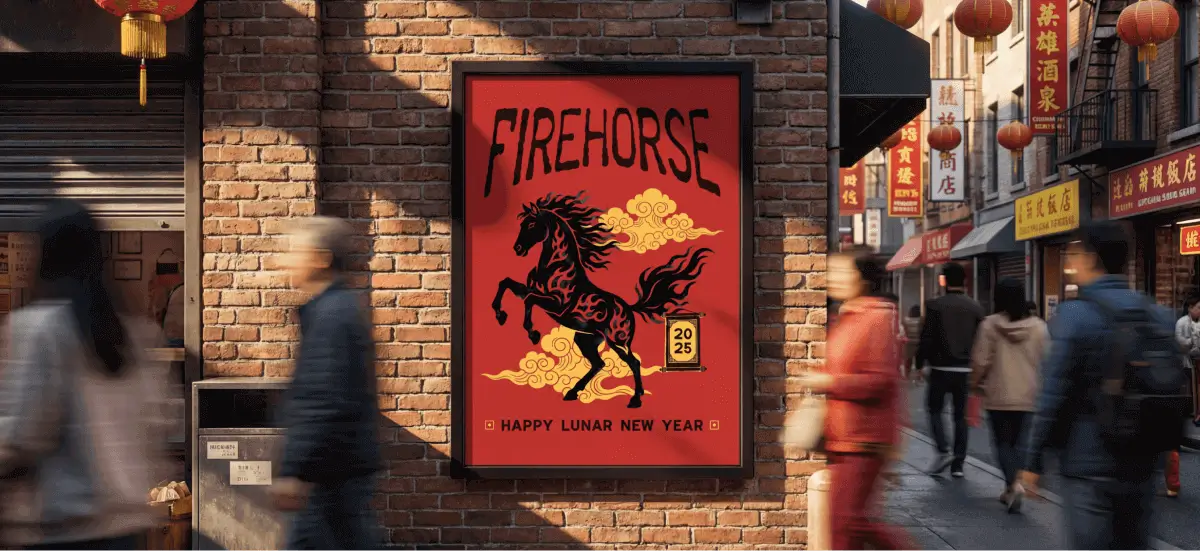
Chinese New Year 2026 is one of those moments smart creators plan for early.
With the holiday landing on 17 February 2026, brands that prepare ahead of time usually win more attention, more engagement, and more sales during one of the biggest seasonal shopping periods of the year. According to global retail and travel shopping reports around Chinese New Year, the holiday consistently drives a surge in consumer spending as shoppers actively look for festive products, promotions, and limited-edition designs.
2026 is the Year of the Horse, which basically screams “let’s go.” Fast energy, big confidence, main-character momentum.
And Lunar New Year design culture loves a good inside joke too. One year, people in China started using Draco Malfoy’s face on New Year decorations because of a lucky-sounding name pun tied to “horse” and “fortune.”
Imagine walking into a shop and getting blessed by Malfoy. It’s chaotic, it’s clever, and it proves the point. When you ride the right bandwagon at the right time, people notice and purchase.
If you sell print-on-demand or run a small shop, jumping on a seasonal moment like this can be a real boost. Kittl’s guide on making money online with design also calls out print-on-demand and other design-led income streams, which is exactly why a timely Chinese New Year drop can be worth planning early.
What the Chinese New Year 2026 represents for designers and brands

Chinese New Year 2026 marks the Year of the Horse, which falls on the 17th of February 2026, a zodiac sign often linked with speed, ambition, confidence, and forward momentum.
From a design point of view, that energy matters because each year brings a slightly different visual mood. Some years lean playful, others more refined.
Many of the visual cues and design choices that show up every year are rooted in long-standing traditions. Some of these cultural details, including why certain symbols and festive visuals repeat so consistently.
At the same time, the bigger picture stays the same. Chinese New Year consistently shows up as a reliable income and engagement moment, regardless of the zodiac animal.
You can see how seriously brands take this season if you look at how they show up. Apple, for example, doesn’t treat the Chinese New Year like a small social post. Every year, it releases a full Lunar New Year short film as part of its Shot on iPhone series, turning the holiday into a storytelling moment built around emotion and cinematic visuals.
Gucci comes at it from a different angle, using Lunar New Year capsule collections and campaign imagery to create a cohesive look that runs across products, social, and editorial. Even Starbucks leans heavily into design, launching Chinese New Year drinkware and packaging that feels collectible and giftable, which is exactly why people line up for it.
The takeaway here is to notice the pattern. Chinese New Year is treated like a real creative window, definitely not an afterthought.
For designers and creators, 2026 is a chance to tap into that same momentum with visuals that feel festive, modern, and ready to roll out across social posts, posters, packaging, or merch without overthinking every detail.
Chinese New Year 2026 lucky colors
If you only remember one thing about Chinese New Year design, make it this: the right color palette does most of the work for you.
Palette 1: the “always-safe CNY” luxury palette

- Deep gold brown: #763F02
- Prosperity gold: #D9AC2A
- Soft harmony yellow: #D8D583
- Fortune red: #720017
- Dark ceremonial red: #270101
This is the one you can use every year, and it looks premium by default.
WOFS describes 2026 as Fire-heavy and recommends balancing choices across elements, while still acknowledging Fire tones (reds/maroons) as meaningful in the year.
Palette 2: the “wealth magnet” Water-balance palette (very feng shui-coded for 2026)

- Midnight navy: #0B1B2B
- Ink black: #111111
- Electric/sapphire blue: #1F6FEB
- Fortune red accent: #C1121F
- Soft gold highlight: #D9AC2A
In Fire Horse years, feng shui guidance often favors balancing Fire energy with Water and Earth tones.
That’s why palettes combining red and gold with deep blue, dark neutrals, or grounded browns tend to feel more harmonious and commercially effective during Chinese New Year.
This one is a killer for modern brands that want CNY to feel sleek, not traditional-heavy.
Palette 3: the “jade prosperity” Wood palette

- Jade green: #2E8B57
- Emerald: #0B6E4F
- Cream (not pure white): #FAF3E6
- Prosperity gold: #D9AC2A
- Deep festive red: #8B1E2D
Greens (jade/emerald/forest tones) are auspicious for 2026 in the context of Wood energy. And broader CNY feng shui guides often describe green as renewal/growth, which translates beautifully to packaging and lifestyle products.
Good for beauty, wellness, home goods, and “gift set” visuals.
Palette 4: the “smart and successful” Metal palette

- Champagne ivory: #F6E7D2
- Warm silver: #C9CED6
- Rich gold: #D4AF37
- Burgundy red: #7A0019
- Espresso brown: #2B1B14
Metal tones (white/gold/silver) are supportive for clarity and creativity in 2026, but for CNY design, we’d use ivory/champagne instead of stark white to avoid mourning vibes.
This is perfect for agencies, premium brands, and anything “limited edition.”
Colors that shouldn’t dominate your design
Fun fact: In traditional feng shui and Chinese color theory, colors are never judged in isolation. Each color represents an element, and what really matters is how those elements interact.
Using one dominant color on its own, especially during Chinese New Year, is often seen as unbalanced. That imbalance doesn’t mean “bad luck” in a dramatic sense, but it can feel too extreme, too aggressive, or too draining depending on the year’s dominant element.
- Avoid designs that read as mourning-coded, especially heavy white/black combos and cold greys.
- Green is generally positive, but avoid “green hat” imagery for men (it’s a well-known idiom).
- If you use black, use it as ink/contrast, not the “main mood.”
In other words, combination changes meaning. The same color can feel lucky or unlucky depending on what it’s paired with.
Restoring balance: How to use color combinations to change “luck”
Feng shui works on the idea of mutual generation and balance, not avoidance. A color that feels risky on its own can become auspicious when it’s paired correctly.
Some classic examples:
- Red + gold: Fire (red) is supported by Earth/Metal (gold), turning intensity into prosperity
- Red + dark blue or black: Fire is balanced by Water, which helps control excess energy
- Gold + earthy browns: Wealth energy feels grounded and stable rather than flashy
Green + gold (used carefully): Growth (Wood) supported by prosperity, without overwhelming the palette
Chinese New Year design ideas that perform well every year
If you’ve ever scrolled through Lunar New Year drops and thought, “Why does this always sell?” it’s usually because the product is simple, familiar, and easy to gift.
These are the kinds of designs creators quietly bring back every year, with small twists, and they keep working.
1. T-shirts and hoodies

This is where most people start for a reason. A single festive phrase, a short New Year greeting, or a subtle zodiac nod goes a long way. Keep it bold, keep it wearable, and let color and typography do the heavy lifting.
2. Tote bags

Totes are low-commitment, high-usage items, which makes them perfect for seasonal designs. A centered message or symbolic mark feels intentional and gift-ready without screaming “holiday-only.”
3. Stickers and sticker packs

This is where you can experiment. One lucky phrase, one symbol, one idea, then remix it into multiple variations. People love collecting and bundling these, especially when the designs feel cohesive.
4. Posters and wall prints

Chinese New Year decorations are often temporary, which makes bold, graphic posters an easy yes. Clear messaging and strong contrast matter more than fine detail.
5. Phone cases and tech accessories

Small surface, big impact. Simple color blocking, stamp-style symbols, or short phrases feel modern and easy to carry around.
6. Mugs and drinkware

These work best when the design is short and personal. Blessings, badge-style graphics, or minimal festive marks tend to feel more giftable than large illustrations.
7. Caps and beanies

Less really is more here. Small text, subtle symbols, or quiet festive references work far better than full artwork.
8. Gift tags and modern red-envelope-style cards (hungbao)

Quick to design, easy to sell in sets, and perfect for people who want something festive without committing to merch.
9. Packaging labels and box sleeves

This one’s a sleeper hit. The product stays the same, but feels limited edition packaging suddenly feels limited edition for the season.
10. Social media templates

Every merch drop needs visuals. One strong design can turn into posts, stories, banners, and promos that keep everything looking cohesive.
The common thread across all of these is simplicity. Chinese New Year merch doesn’t need to be complex to sell. If a design looks good on a shirt, a tote, and a poster with minimal changes, it’s usually a strong one.
Don’t feel locked into illustrating one animal. Many creators design pieces that feature multiple zodiac symbols, abstract motifs, or strong New Year typography instead. These feel festive without being time-bound, which makes them easier to rewear and resell.
(If you’re curious how to do that well, scroll down — we’ll break it down in more detail next.)

Chinese New Year 2026 Template. Use Template

Chinese New Year 2026 Template. Use Template

Chinese New Year 2026 Template. Use Template
Chinese New Year 2026 typography, symbols, and visual elements (with bonus templates)
Once your color palette is set, the next layer that shapes how a Chinese New Year design feels is type, symbols, and structure.
1. Typography that works for Chinese New Year merch and visuals
- Bold, confident type performs best: Chinese New Year designs benefit from type that holds its shape against strong color palettes. Clean sans-serifs like Avenir Next, Neue Haas Grotesk, DIN Next, Gotham, and Univers Next feel stable, modern, and trustworthy, which is why they work so well on merch, posters, and packaging.
- Structured display fonts add festive weight: When you want more personality without losing clarity, heavier display styles help. Fonts such as Adventurer, Bridgewall, Steelmark, or Royal Signage bring an old-world, ceremonial feel that pairs naturally with reds, golds, and earth tones.
- Calligraphy exists, but it works best as an accent: Kittl does include hand-drawn and calligraphic styles like HT Modern Hand Script, HT Modern Hand Script 2, Bistro Signature, and Kuenstler Script, but these are most effective when used for short blessings, single words, or stamp-style details. Used sparingly, they add warmth and human touch without hurting readability.
Pair AI elements with the right fonts: When using AI-generated Lunar New Year elements, keep things balanced by pairing a bold headline font with a simple supporting typeface. A quick font pairing guide can help you keep designs festive without feeling cluttered.
Highly decorative or flowing scripts shouldn’t carry full sentences or product names. Chinese New Year designs perform best when an expressive type supports a strong base font.
2. Symbols that instantly feel like Chinese New Year
- Familiar symbols always outperform abstract ones: Lanterns, coins, knots, clouds, seals, and red envelope shapes are easy for people to recognize as Chinese New Year visuals. If you’re ever unsure why certain symbols feel more “right” than others, this overview of popular symbols and their meanings gives useful background without overthinking it.
- Zodiac elements should stay subtle for 2026: For the Year of the Horse, silhouettes, stamps, badges, or repeating patterns feel more refined than large, literal illustrations.
- Symbols work best as supporting elements: They should enhance the message, not compete with typography or overwhelm the layout.
3. Layout and visual structure that keeps designs clean
- Simplicity is what separates strong designs from crowded ones: Centered compositions, symmetrical layouts, and clear visual hierarchy feel especially appropriate for the Chinese New Year
- Balanced layouts feel culturally “right”: Designs built around balance and symmetry communicate harmony and stability, which is why this approach shows up so often in festive visuals.
- Motion can be suggested, not exaggerated: Curved lines, flowing shapes, or subtle diagonals hint at movement and momentum, which fit the Year of the Horse without being literal.
- Whitespace adds value: Space helps colors, typography, and symbols feel more intentional and premium rather than busy.
Kittl’s Chinese New Year templates are designed as strong, reusable foundations. The layouts, typography, and spacing already follow what works for festive campaigns, which makes them ideal for remixing with new colors, symbols, and wording for 2026 and the Year of the Horse.
Start with a proven structure, then adapt it until it feels fully aligned with your brand and the season.

Good Luck in 2024 T-Shirt Design. Edit this template

2024 – Year of the Dragon.
Edit this template

Dragon Spirit Design.
Edit this template

New Year New Beat Cute Drum Design. Edit this template

Feline Fine And Always Feeling Lucky. Edit this template

Goodbye 2024 Welcome 2025.
Edit this template

Happy Chinese New Year Design. Edit this template

Chinese New Year Design – Snake. Edit this template

Happy Lunar New Year Design.
Edit this template

Chinese New Year Design.
Edit this template

Year Of The Snake Design.
Edit this template

New Year Design – Snake.
Edit this template

Chinese New Year Design.
Edit this template

Year of the Dragon Design.
Edit this template

Maneki Panda Blessing Design. Edit this template
Want more AI-inspired Lunar New Year elements? Check out our Kittl Flows template!
Not sure where to start or what to generate for your merch? If you’re looking to go beyond static templates, Kittl Flows is where things get really interesting.
These AI-powered flows let you generate Lunar New Year–inspired elements like decorative motifs, symbols, patterns, and visual accents that you can instantly remix into your designs.
Instead of starting from scratch, you can explore pre-generated festive elements and adapt them to match your color palette, layout, or product format.
It’s an easy way to add more personality and variation to your Chinese New Year designs while keeping everything consistent and on-theme.

Lunar New Year Card Design.
Generate more elements!

Temple Lunar New Year Card.
Generate more elements!

Temple Lunar New Year Design.
Generate more elements!

Lunar New Year Greeting Card
Generate more elements!

Firehorse Lunar New Year Card.
Generate more elements!

Delft Lunar New Year Card.
Generate more elements!

Horse Lunar New Year Card.
Generate more elements!

Lunar New Year Greeting Card.
Generate more elements!

Horse Lunar New Year Design.
Generate more elements!
Key takeaway: Start your Chinese New Year 2026 design in minutes
Chinese New Year 2026 is a high-momentum moment for designers and brands. It’s the Year of the Horse, which visually favors confidence, movement, and bold choices, and it’s also a season when people are actively shopping and gifting.
With just a few base designs, you can prep merch, social visuals, and packaging early without locking yourself into one zodiac or over-designing.
- Colors that work: red and gold first, balanced with earth tones, cream, or deep blue
- Fonts to reach for: Avenir Next, Neue Haas Grotesk, DIN Next, Gotham, paired with Adventurer or Royal Signage
- Symbols that convert: lanterns, red envelopes, seals, coins, knots, clouds, subtle zodiac accents
- Designs you can remix: t-shirts, hoodies, totes, stickers, posters, phone cases, mugs, caps, gift tags, social templates
- Best mindset: build one strong design and adapt it everywhere
Ready to create your Chinese New Year 2026 designs? With Kittl, you can remix proven templates, test color palettes, generate variations with AI, and turn one idea into merch, social posts, and packaging in minutes. Sign up today to enjoy the Kittl benefits!