You’ve read about balance in design—and maybe even wrapped your head around visual weight. But applying those principles when you’re staring at a blank canvas? That’s a different challenge altogether.
Designing a layout isn’t just about making it look “centered” or filling the space. It’s about guiding the viewer’s eye, creating harmony between elements, and making sure nothing feels out of place.
That’s where technique comes in — small choices like resizing an image, adjusting opacity, or using a grid can completely shift how balanced your layout feels.
In this article, we’ll focus on the hands-on part: how to design balanced layouts using Kittl. From practical layout tools to the common mistakes that throw designs off balance, consider this your go-to guide for turning ideas into clear, well-structured visuals.
How to design balanced layouts using Kittl (practical tips: opacity, scale, grids, and more)
In the digital age, we have an advantage that Leonardo da Vinci didn’t – we can drag-and-drop elements, undo, use alignment tools, and generally iterate much faster.
Tools like Kittl (a user-friendly design platform) make it easier to experiment with composition. But no matter what software you use, the principles of balance remain the same.
In this section, we’ll focus on how you can leverage specific features (found in Kittl and many other design apps) to achieve asymmetrical and symmetrical balance in your designs.
01. Use grids and guides for structured balance

One of the simplest ways to ensure a balanced layout is to align elements using a grid. Kittl has a built-in grid and ruler guide system that you can toggle on the Editor.
By snapping your elements to a grid, you create an underlying structure so that, for example, your left-aligned text and right-aligned image sit on the same horizontal plane.
This not only makes the design look tidy, but it also helps distribute weight evenly. If your grid is symmetrical (say a centered layout), you can achieve symmetry easily.
But grids are equally useful for asymmetry: the Swiss design approach famously involved placing elements asymmetrically on a rigorous grid to maintain unity.
In Kittl, you might set up a 3×3 grid (like rule-of-thirds) and place a big element on one intersection and a couple of smaller ones on the opposite intersection – the grid ensures the spacing and margins are equivalent, giving an underlying balance even though the content differs.
02. Adjust scale (size) to balance visual weight

If an element looks too heavy, try resizing it down; if something’s not pulling its weight, size it up. Kittl’s editor lets you freely scale objects, so use that to your advantage.
For example, suppose you’re creating an event flyer with a decorative icon and some text. Initially, you have a large icon at the top and a long text block below. If the top icon feels too dominant (making the design top-heavy), you could either shrink the icon or enlarge some typographic elements to compensate.
Don’t be afraid to play with proportions – sometimes a 10% reduction in a photo’s size can suddenly make the whole layout feel balanced with the text. Kittl also allows grouping elements; you could group a cluster of smaller items and treat them as one unit to resize collectively.
Practically, a tip is: zoom out of your canvas to thumbnail size – if one part of your design is all you see at small size, its elements might be oversized relative to others.
03. Leverage opacity and color for fine-tuning

One neat trick to adjust visual weight without moving or resizing anything is using opacity (transparency). Heavier elements can be made a bit lighter by reducing their opacity, effectively making them fade a little into the background.
In Kittl, every shape or image has an opacity setting. For instance, if you have a very bold graphic that’s necessary but overpowering, try setting its opacity to 80% – it will literally become visually lighter.
This is especially useful for asymmetrical balance: say you have a dark solid shape on one side and a detailed illustration on the other. You can’t change their sizes easily without breaking the design, but you could make the dark shape semi-transparent so it doesn’t dominate.
Color intensity works similarly: a bright element can be toned down by switching it to a lighter or cooler color. Kittl’s color picker can help you try a less saturated version of the same hue.
These subtle tweaks – lowering opacity, muting a color – reduce the visual weight of elements without changing their position or size, helping to balance out a composition that might be slightly off.
Conversely, if something needs more weight, you can give it a punchier color or 100% opacity or even add a drop shadow (shadows can add weight by making an element “pop” forward).
04. Positioning and spacing

Where you place elements relative to each other can either create balance or throw it off. A good practice is to use even spacing between multiple elements. Kittl provides alignment tools that distribute objects evenly.
For example, if you have three icons in a row and one is too close to the other, the cluster will look heavier on that side. Using the distribute spacing function will equalize the gaps, thus equalizing the visual weight across them.
Similarly, pay attention to margins (Kittl’s margin view can show you safe zones). If your design has a lot of empty space on one side and stuff crammed on the other, it will feel unbalanced due to the density difference. Try to allocate whitespace more evenly. This might mean intentionally leaving some blank areas around heavy elements to “lighten” them.
One pro-tip: the center of your design is like the fulcrum of a seesaw. The further from the center an element is, the more its weight is magnified (because of leverage). So if you have a heavy element, you might position it closer to the center line to mitigate its pull, whereas lighter elements can sit further out.
Designers often intuitively do this – e.g., a big bold logo might be centered, with smaller menu items flanking it toward the edges. The center placement nullifies the imbalance.
With Kittl’s infinite canvas and drag controls, you can easily experiment by nudging things left or right. Sometimes a composition looks off until you move one object a few pixels and suddenly it clicks. Use those alignment smart guides that show up – they help you snap objects symmetrically or at common intervals, which directly contributes to balance.
05. Utilize Kittl’s templates and design kits

Routes of Caribbean – Nautical. Use Template

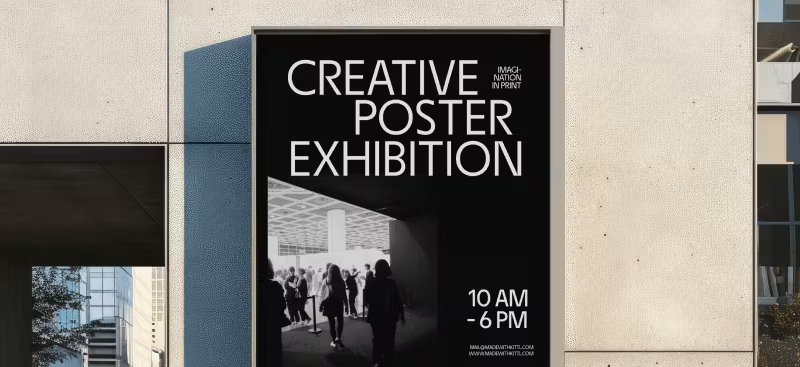
Balance Poster. Use Template

WANTED: The Office Coffee Bandit. Use Template
If you’re unsure where to start, Kittl offers a vast library of templates created by professional designers. These can be fantastic learning tools and starting points.
Each template inherently has a balanced composition (otherwise it likely wouldn’t have been published). You can load a template that matches the type of design you need – say, a poster with asymmetrical layout – and then customize it.
Pay attention to how the template achieved balance: maybe the title is big but a color shape on the opposite corner evens it out, or maybe there’s a grid underpinning the layout. By customizing, you’re essentially reverse-engineering the balance decisions the original designer made.
Kittl’s templates give you a shortcut to balanced designs, and you can tweak them to make them your own. For asymmetrical balance especially, this is helpful; if you’re not fully confident freestyling an asymmetrical layout, use a template that demonstrates it.
Change the text, swap the imagery, but try to keep the overall balance. This way, you internalize what a balanced asymmetrical design looks and feels like. Kittl also has “design kits” and example projects – these often come with presets of fonts, graphics, and suggested layouts.
Using them can guide you, for example, to “organize elements asymmetrically on a grid to create unity”, as the Swiss style dictates. Over time, you’ll rely less on templates, but they’re excellent for honing your sense of balance.
06. Check in preview or mirror mode

When designing, it’s easy to get used to your current layout. A trick many designers use is to flip the design horizontally (mirror) or view it in a fresh context.
Kittl might not have a one-button mirror for the whole canvas (though you could group everything and flip it), but you can certainly take a quick export and mirror it in another program, or just step away, then look with fresh eyes.
The mirror image trick is known to reveal imbalances that your brain tuned out. Alternatively, preview the design on the medium it’s intended for (use Kittl’s mockup feature or just imagine the poster on a wall).
When you simulate the final context, you might notice, for example, that all the dark elements ended up toward the bottom, which feels a bit heavy – then you can redistribute some color upward.
07. Balance in Kittl’s AI and assets

Kittl even has an asset library and AI tools – for instance, you could generate additional decorative elements to use as counterweights in your design. If one corner looks empty, you might grab a subtle ornament or shape from the library to anchor that space.
If your design needs a more defined focal point—especially in branding projects—the AI Logo Generator offers a fast way to create logos that not only look professional but also help structure the layout visually. Since the logos are fully editable vectors, you can adjust them to balance with supporting graphics, type, and negative space across your composition.
Sometimes, adding a small flourish or adjusting the background tone on one side can bring a nice equilibrium.
Common mistakes to avoid when creating a balanced layout
Even experienced designers can slip up and create less-than-balanced compositions. Let’s highlight a few common mistakes related to balance, so you know what to watch out for in your own work.
Being aware of these pitfalls can save you from that nagging feeling of “something’s off” in a design.
01. Overcrowding and clutter
One classic mistake is thinking that filling every inch of the canvas will somehow create balance.
In fact, overcrowding a design with too many elements often has the opposite effect – it overwhelms the viewer and makes the composition feel chaotic. When everything is shouting for attention, nothing gets it, and the visual weight distribution becomes confusing.
Avoid the temptation to use all the cool ideas in one layout.
Embrace negative space (empty space) as an element itself. A balanced design needs breathing room. Give your main elements some padding and margin. If you cram content edge-to-edge, the piece can feel visually “heavy” everywhere (and thus nowhere in particular).
After finishing a design, try removing one or two elements – does it improve the balance? Often it does. As the adage goes, “less is more” – or at least, less clutter is more balance!
02. Neglecting hierarchy (no focal point)

The flip side of balance is that you still usually want a focal point.
Sometimes in trying to make everything balanced, designers mistakenly make everything the same size/color/etc., resulting in a dull or confusing design with no clear hierarchy.
Even in an asymmetrically balanced layout, typically one element is primary. If you neglect to establish what the most important element is, the viewer won’t know where to look first, and the design can actually feel unbalanced because their eye zigzags trying to find focus.
To avoid this, consciously decide on a focal point and supporting points. You can have balance and hierarchy at the same time – they are not mutually exclusive. A common error is adding lots of bold, different elements (to achieve balance by variety perhaps) but not giving any one priority.
The result is visual competition. The lesson: ensure you have a hierarchy. Balance the composition around your focal point rather than treating every element as equally important.
03. Assuming “balance = symmetry” all the time
Many beginners think a balanced design means everything must be perfectly centered or mirrored. This misunderstanding can lead to very stiff designs or missed opportunities for creative layouts.
While symmetry is one form of balance, as we’ve covered, it’s not the only one – and often not the best for the job. Don’t default to centering everything unless the context calls for it (e.g., a formal invitation might benefit from symmetry, but a music festival poster might be more striking with asymmetry).
A related mistake is forcing symmetry even when the content isn’t naturally symmetrical. For instance, trying to mirror text on both sides of a brochure when one side has way more content – you might end up with awkward empty gaps or squished text just to pretend it’s balanced.
It’s okay to embrace asymmetrical balance; it can look just as harmonious. So, avoid the misconception that balance in art means making both halves identical. Instead, define balance as equalizing visual weight, which might be symmetrical or not.
If you find all your designs are centered and it’s making them boring, challenge yourself to do an asymmetrical one that’s still balanced.
04. Ignoring context and purpose

Another subtle mistake is not considering what type of balance suits the project or audience (which is a kind of conceptual imbalance).
For example, a super asymmetrical, cutting-edge layout might be cool, but if the project is a bank’s website, the audience might perceive it as too chaotic or untrustworthy. Conversely, a highly symmetrical approach for an underground art zine might seem dull or old-fashioned.
The balance style should match the tone and audience – even a corporate site may benefit from symmetry, while a creative portfolio can use asymmetry for a modern feel.
Remember: Ignoring these preferences is a mistake.
Always ask: what feeling should this design convey? and choose a balance strategy accordingly. If you mismatch, even if the design is technically balanced, it can feel off to viewers (they might not engage because it subconsciously doesn’t meet their expectations).
05. Inconsistent alignment or spacing
This is a more mechanical mistake, but very common. If some margins are 20px and others are 40px without reason, or elements that should line up are a few pixels off, the design can feel sloppy and oddly unbalanced.
Human eyes are very good at detecting when something is just slightly misaligned – it introduces a subtle tension. Lack of consistency in spacing or alignment can make a design feel chaotic, even if the right elements are present.
The fix is straightforward: use those guides and alignment tools, double-check spacing between elements (many tools will show spacing values or have distributed functions).
Consistency is your friend. This mistake often occurs when you make last-minute additions or edits and don’t realign everything.
It’s worth taking a final pass purely to tidy up alignment – the result will be a crisper, more balanced look because all parts relate to each other systematically.
06. Over-reliance on one element to carry the balance

Sometimes designers put one huge thing (like an illustration or a title) and then compensate with many tiny things.
While this can be a valid asymmetrical strategy, it can also fail if that one element is too overpowering. If you find you have to add 10 other objects to balance one monster graphic, consider scaling that graphic down or breaking it up.
A mistake is to fall in love with one super-strong element and not want to tweak it, leading to contortions elsewhere in the design that might complicate it.
Balance should feel natural, not like you had to duct-tape a bunch of pieces to hold down a heavyweight champion. The solution is sometimes to dial back the dominant element a notch and simplify the supporting cast.
07. Not stepping back (or using the squint test)
A practical mistake is simply not checking the balance with fresh eyes. When you work zoomed in on details, you might miss the forest for the trees. Always zoom out or take a break and revisit your design.
Often, you’ll immediately spot that, say, the right side feels a bit empty compared to the left. It’s a mistake to trust that your first arrangement is optimal. Design is an iterative process – even masters adjust and refine.
So, the error here is perfectionism or laziness in the wrong place: thinking “it’s fine” without verification. Balance issues have a way of popping out once you print something or put it live (“Oh no, why does it look lopsided on mobile?”).
To avoid this, actively look for an imbalance before finalizing. Move things around just to test alternatives – sometimes you discover a better balance by accident that way.
Final tip: Never ignore the role of typography to get balanced layouts
Text carries visual weight just like shapes — a bold headline can command as much attention as an image. With Kittl’s text effects and font tools, you can dial up or down that weight to suit the layout.
Think heavy sans-serif titles versus light script subtitles — the balance shifts instantly. You can even use placeholder text boxes to simulate weight and spacing before your final copy is in.
If you’re experimenting with text as a visual element — say, wrapping it around an image or weaving it into the composition — exploring object typography can open up new ways to balance type and layout together.
Design balanced layouts with more confidence
Getting your layout to feel “just right” isn’t about guessing — it’s about using the right tools with intention.
From scale and spacing to opacity and alignment, every decision shapes the flow and balance of your design. The nice thing about Kittl is it’s visual by nature — you see things move and snap into place, which sharpens your instincts as you go.
And because it’s built by designers for designers, everything you need is there: grids, guides, snapping tools, and smart defaults that support real creative decisions.
Using Kittl’s design tools makes this process a lot more intuitive, especially if you’re experimenting with asymmetrical balance or building out complex layouts. The more you practice balancing elements—visually and structurally—the more natural it becomes.
So next time you open up a new project, take a moment to step back and ask: does this layout feel balanced? If not, now you’ve got the tools (and a few tricks) to fix it.And if you’re ready to see these techniques in action, browse Kittl’s templates to start designing balanced layouts faster—with the creative control to make them your own.