Have you ever hit page 18 of a font search and thought, “Why is nothing matching the idea in my head?” Maybe you’re looking for something a little sharper, a little weirder, a little more you. And every font foundry you scroll through starts to blend together.
It happens to designers all the time. You know the look you want, you can almost see the letterforms, but somehow you’re still scrolling.
So what do you do when the perfect custom font isn’t out there?
For the longest time, the answer was: you compromise. You reshape your idea. You soften a detail. You accept a typeface that’s “good enough.” But now, you can make something yours. And you don’t need to be a trained type designer to do it.
Thanks to Kittl Flows, you can generate entire alphabets, numbers, and stylistic variants using AI, then turn those characters into a fully functioning custom font. It opens up a creative path that didn’t exist a few years ago: the ability to create your own letterforms without learning specialized font software or spending weeks refining curves.
Here’s how it works.
Why designers are beginning to make their own custom fonts
Most designers aren’t out to create a 900-glyph professional type family. They’re trying to solve real, everyday creative needs:
- You’re making branding for a client who wants a very specific personality.
- You have a lettering style you’ve drawn for years and want to finally turn it into a usable typeface.
- You need a stylistic alphabet for apparel, merch, album art, posters, or thumbnails that doesn’t look like anything else.
- You want consistency across a project, but current fonts don’t match your aesthetic.
In the past, making a custom font required knowing how to use complex type software, handling Bézier curves, mastering spacing and kerning, and understanding typographic anatomy. It was absolutely doable; but not simple.
Now? The barrier between “I have an idea” and “I have a font” is dramatically smaller.
Kittl Flows lets you generate letterforms that match the style you imagine, then adjust, refine, export, and build on them. And the surprising part is how fast the process is. In the video, the designer generated a working Gothic-style alphabet in under an hour — a task that would normally take days.
So let’s open that door and walk through the process.
How to make your own custom font with AI in Kittl (the workflow from the video)
1. Set up a new Smart Board
Start in Kittl and open a new Project and add a smart board.
Flows are like visual thinking spaces — a series of smartboards where each prompt generates a new result.
Think of each smartboard as a “letter generation panel.”
2. Generate your first letter

Pick a style you want and start with one letter.
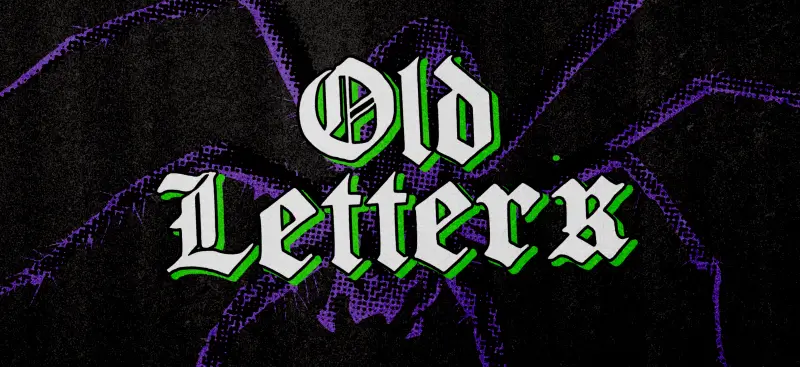
In the video, the designer typed: “Create a capital H in a Gothic style.”
The AI returns a rendered letter right on the smartboard.
If you like the direction, keep going.
3. Expand the style to the rest of the alphabet

Each time you add a smartboard, you can request more characters:
- Uppercase set:
“Generate all capital letters in the same Gothic flat-nib style.” - Lowercase set:
“Generate all lowercase letters in the same style, transparent background.” - Missing characters:
“Generate the letter J in the exact same style.”
“Generate the letter Y in the same style.”
In the video, Drew filled nearly every letter this way — uppercase, lowercase, numbers, punctuation.
4. Generate numbers and punctuation
A complete custom font needs more than letters.
- “Generate numbers 0–9 in the same style.”
- “Generate basic punctuation in the same Gothic nib style.”
Everything stays within the same stylistic language.
5. Prepare the characters for export
Once all characters are generated, download each letter:
- as an image
- with transparent background
- vectorize if you want cleaner scaling or color changes
This gives you a neatly organized folder of glyphs: A–Z, a–z, 0–9, punctuation.
6. Use a custom font-building tool (Calligrapher)
In the video, we use Calligrapher, which is free.
You simply:
- Upload the letters
- Place them in the appropriate grid slots
- Assign them to their correct character
- Generate the TTF font file
- Download it
The result is a usable, installable custom font you created with Kittl Flows.
7. Test your new custom font in Kittl

Upload your TTF into Kittl under Text → Upload Fonts.
Then type with it, preview it, adjust spacing, and try it across different templates.
You’ll immediately see which characters feel consistent and which ones you might want to refine — and refining is easy, because you can always regenerate or tweak individual letters back in Flows.
Creating your own custom font doesn’t mean you have to start from zero

One of the nicest parts of this workflow is the freedom it gives you:
- You can build a full font from scratch.
- You can generate a few key letters and use them as inspiration.
- You can remix styles.
- You can build a handwriting font in minutes.
- You can prototype an idea quickly before investing more time in refinement.
But you can also choose not to build anything at all.
Because if what you’re craving is simply a font that fits your mood, your aesthetic, or your creative direction, Kittl already has thousands of exclusive fonts built directly into the editor.
And they’re not buried in endless, overwhelming menus. Meaning you can skip the 22-page scroll. There’s a high chance the one you’re looking for is already there — clean, browsable, and instantly usable.
Whether you build or browse, the fun part is in the experimentation
Designers love options.
Some days you want to handcraft something unique. Other days, you want the right tool to appear instantly. With Kittl, you get both.
Whichever route you choose, you’ll end up with something that feels right for you. And that’s the real power here: the freedom to create, discover, and play with typography on your own terms.

Shafira is a content writer who turns boring business talk into reads people actually enjoy. She grew up hoarding $1 novels in Singapore and writing hilariously bad fiction, but now she tackles content marketing with all that creative chaos since 2019. From blogs and newsletters to UX and SEO, she writes how she thinks: nerdy, honest, and a bit offbeat. She believes the best content is human-designed, not just plain text.