International Women’s Day 2026 is coming. And if you’ve designed for this moment before, you already know how it goes.
Around mid-February, the requests start rolling in.
“Can we do something for Women’s Day?”
“Maybe something empowering?”
“Purple would be nice.”
“Not too political, but still meaningful.”
It’s one of the most visible awareness days of the year. And that visibility cuts both ways.
In 2026, audiences are more aware of performative branding than ever. A generic Women’s Day post might not cause outrage — but it rarely creates impact either.
The brands that stand out aren’t louder. They’re more intentional.
This guide is for designers, small businesses, and creative teams who want their Women’s Day visuals to feel aware, modern, and actually aligned with their brand — not like a last-minute purple template.
Let’s build something better.
When is International Women’s Day 2026?
International Women’s Day is celebrated every year on March 8.
In 2026, it falls on a Sunday.
Most brands begin posting between March 1–8, but campaigns that perform well usually start warming up earlier — especially if they involve storytelling, collaborations, or product launches.
If you’re designing more than a single post, planning should start at least two weeks before March 8.
If the idea only comes together on March 6, the execution will feel rushed. And on a day this visible, rushed show.
What is International Women’s Day?

The first Women’s Day was organized in 1909 in the United States. It quickly spread across Europe, where women gathered to advocate for voting rights, fair pay, and better working conditions. March 8 became an internationally recognized date in the early 20th century, and the United Nations officially began observing it in 1975.
It began as a movement rooted in activism and labor rights.
Over time, it evolved into a global awareness moment observed by governments, communities, and brands worldwide.
That history matters — because International Women’s Day sits at the intersection of celebration and advocacy.
And that dual identity is exactly why tone matters in design.
What International Women’s Day represents in 2026
International Women’s Day has always been about recognizing the achievements of women and advocating for equality. But culturally, the expectations around how brands participate have evolved.
Audiences are used to brands posting. What they notice now is:
- Whether the message feels consistent with year-round values
- Whether representation feels genuine
- Whether the design feels considered
- Whether action backs up awareness
This doesn’t mean every brand needs a bold campaign.
It means intention matters more than decoration.
A clean, honest message aligned with your brand values will always outperform a dramatic visual that doesn’t match who you are the rest of the year.
What works in International Women’s Day graphic design

Across social media, posters, and campaigns, the same pattern appears again and again:
Simpler performs better.
Clear messaging.
Strong hierarchy.
Intentional color.
Breathing space.
If your design feels slightly overloaded, it probably is.
Here’s what tends to resonate in 2026.
1. Community-centered visuals

The “single powerful silhouette” approach isn’t wrong — it’s just overused.
In 2026, audiences connect more with real people than abstract empowerment graphics.
Here’s how to apply that depending on your business type.
Some examples:
If you’re a retail or ecommerce brand:
Post a carousel titled: “Meet the women behind our designs.”
Slide structure:
- Photo
- Name + role
- One short quote
Example quote:
“The part of my job I’m most proud of is seeing our ideas become something people wear.”
If you’re a retail or ecommerce brand:
Create a LinkedIn-style post: “The women shaping our product every day.”
Feature 3 team members with one-line insights.
Why it works: It moves from symbolic empowerment to visible representation.
If real women shape your brand, show them. Authenticity always outperforms abstraction.
2. Editorial typography over heavy symbolism

Strong type is doing more work than decorative icons in 2026.
Instead of relying on:
- Overused Venus symbols
- Floral borders
- Stock empowerment poses
Focus on:
- Confident typography
- Clear hierarchy
- Minimal supporting elements
Some International Women’s Day 2026 quote examples:
“Designed by women.”
“Progress takes all of us.”
“Support isn’t seasonal.”
Large type. Clean background. One accent color.
Why it works: Clarity feels confident. Overdesign feels insecure.
3. Thoughtful color adaptation
Purple symbolizes justice and equality — but forcing it into every brand palette can feel disconnected.
Instead:
- Use plum as an accent
- Pair lilac with earth tones
- Blend symbolic hues into your existing system
Here’s some color palettes that can work out:


Place your Women’s Day post next to your regular feed. If it looks like a different company made it, adjust it.
4. Data storytelling (kept simple)
Educational visuals are increasingly effective.
But keep it focused:
One meaningful statistic.
One clear takeaway.
One clean layout.
Some International Women’s Day 2026 statistic examples:

The statistic: The 2025 Global Gender Gap Report finds the world has closed around 68.8% of the global gender gap overall — meaning full equity isn’t expected for over a century at current rates.
How to use it in a visual: Headline can be “68.8% gender parity across the globe”. Subtext can be “Progress continues — but there’s more work ahead”
Design tip: One large percentage figure + a short supporting line is easier to digest than a full chart.

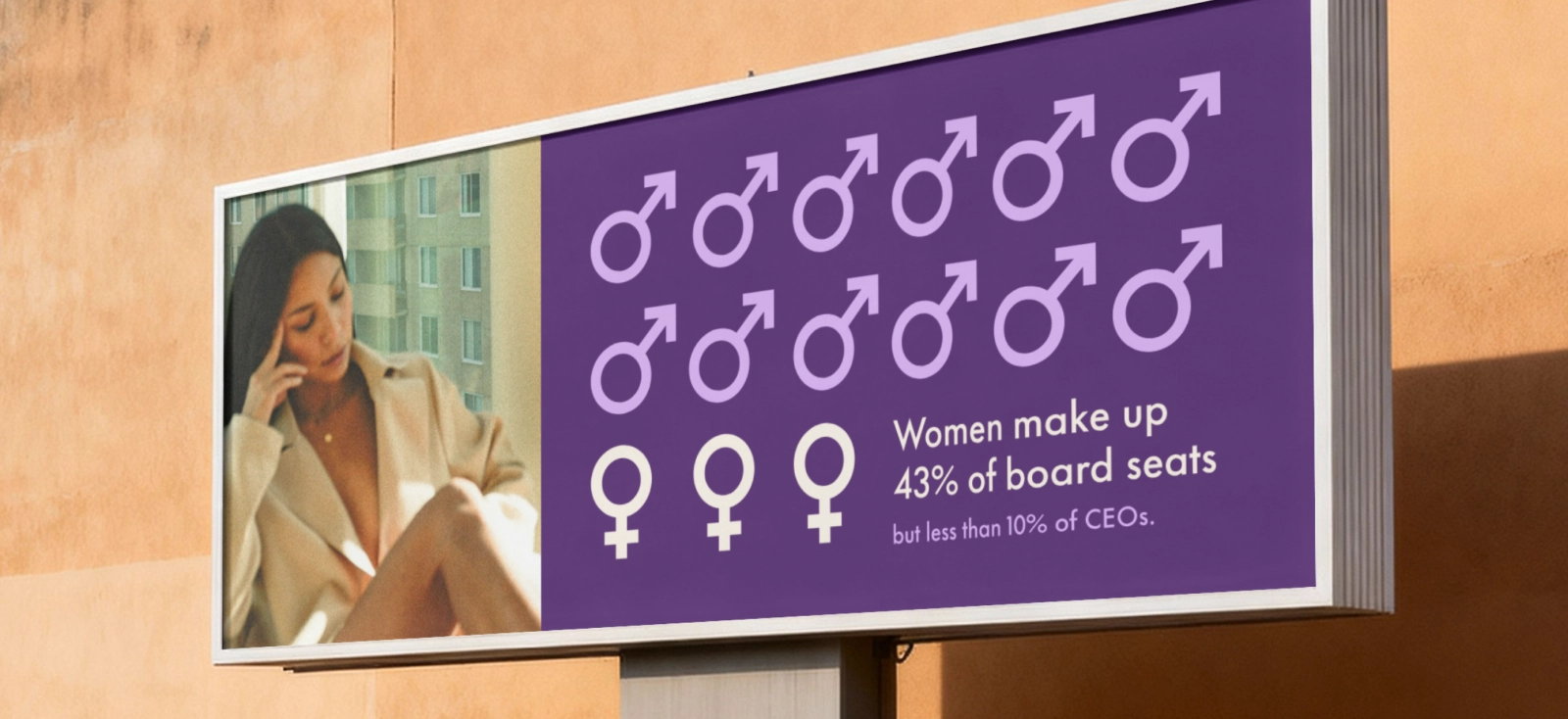
The statistic: In the UK, women now occupy about 43% of board positions at major companies (FTSE 350), but only around 15% of executive director roles and fewer than 10% of CEO roles — showing leadership gaps remain even where board representation has improved
How to use it in a visual: “Women make up 43% of board seats — but less than 10% of CEOs.”
Design tip: Use a simple bar chart or split headline + rate call-out to keep it clean and immediately readable.

The statistic: Recent reporting on global inequality shows that, even when accounting for paid and unpaid work combined, women’s hourly earnings are much lower than men’s — highlighting persistent global inequity.
How to use it in a visual: Headline can be “Women still earn significantly less than men globally.”. Subtext can be “Women earned around 28–32% of total global income — despite working more hours.”
Design tip: Pair with an icon-less layout and single color emphasis on the % figure.

The statistic: The Women in the Workplace 2025 report also highlights that only about half of companies actively prioritize women’s career advancement, and barriers like remote work stigma and lack of sponsorship persist
How to use it in a visual: Headline can be “Only ~50% of companies prioritize women’s advancement.”. Subtext can be “Progress needs ongoing focus”
Design tip: Use a simple “before/after” or “priority vs reality” framing.
International Women’s Day 2026 campaign ideas that feel intentional
A single post is visibility.
A campaign is positioning.
Here are realistic campaign frameworks that work for different types of brands.
The 3-day awareness series

Best for: Small businesses and solo brand builders
This works especially well if you don’t have a huge team or budget.
Day 1 — Brand message
Day 2 — Spotlight story
Day 3 — Community call to action
Example: International Women’s Day campaign for a small retail brand
Day 1
Post: “Today we celebrate the women who build, lead, and support this brand.”
Day 2
Feature one or several team member(s):
“Meet Sara — our lead designer.
‘The best part of my job is seeing customers connect with what we create.’”
Day 3
Post: “Tag a woman who inspires your work.”
That’s a full campaign — without being overwhelming.
Keep the visual system consistent across all three days. Cohesion makes it feel like a campaign, not random posts.
The collaboration campaign

Best for: Creative entrepreneurs & ecommerce brands
Instead of just talking about empowerment, collaborate.
Partner with:
- A women-owned business
- A female illustrator
- A local creative
Create:
- A limited product
- A co-branded graphic
- A giveaway
- A downloadable resource
This shifts focus from statement to shared visibility.
Example: International Women’s Day campaign for a print-on-demand seller
Partner with a female illustrator to create:
- A limited-edition print
- A co-branded social post
- A shared giveaway
Post copy example:
“We partnered with @username to create a limited Women’s Day print celebrating creative community. Available for 72 hours.”
This shifts the focus from self-promotion to shared visibility.
The “then and now” industry reflection

Best for: Agencies and B2B brands
Show progress in your industry about what happened then, now, and what’s next.
This positions your brand as informed and engaged — without being overly political. Here’s an example:
Example: International Women’s Day campaign for a marketing agency
Slide 1
Headline:
“Women hold 32% of senior leadership roles globally.”
Source: Grant Thornton Women in Business Report
Slide 2
“Progress is happening — but leadership still isn’t equal.”
Slide 3
“What does real advancement look like in our industry?”
Then connect it back to your brand:
- Mentorship
- Hiring practices
- Pay transparency
- Internal initiatives
The give-back campaign

Best for: Ecommerce and product brands
For 24–48 hours:
- Donate a percentage of sales
- Highlight a nonprofit partner
- Share transparent impact
Lead with clarity. Avoid vague promises.
Action builds credibility.
International Women’s Day 2026 templates + poster ideas
You’re already here.
Which means you’re not rushing your International Women’s Day campaign.
That’s a good start.
But even when you’re not rushing, it can still feel overwhelming.
Different formats. Different messages. Different expectations.
So instead of starting from a blank canvas, here are a few Kittl templates you can use as a starting point — or at least as creative direction.
International Women’s Day 2026 Post Templates

Not every brand needs a campaign.
Sometimes the most appropriate move is simply acknowledging the day — especially if:
- You don’t have a strong internal initiative to highlight
- You don’t want to over-position yourself
- You’re a small brand with limited capacity
A clean greeting template works when it feels aligned, not performative. Something like this would do just fine:


Here’s what makes it feel intentional instead of generic:
- Keep the message short. One strong line beats three safe ones.
- Use your actual brand palette — not default purple unless it fits.
- Treat it like a brand post, not a holiday sticker.
For example:
Instead of:
“Happy International Women’s Day! #IWD2026 💜”
Try:
“Celebrating the women who build, lead, and create — today and every day.”
Same format. Different weight.
A greeting works when it feels like something your brand would say on any day — not just March 8.
International Women’s Day 2026 Banner Templates
These aren’t social posts. They’re brand-level placements.
Our templates for this category looks like this:


Use these if you’re …
- Updating your homepage hero for a week
- Changing your LinkedIn cover
- Adding a temporary campaign header
- Refreshing your storefront visual
Keep the copy broader than “Happy Women’s Day.” Think positioning, not greeting.
Example:
Instead of a holiday line, use something like:
“Designing spaces where women lead.”
Subtle. Brand-aligned. Less seasonal, more positioning.
Banners work best when they reinforce your identity — not override it.
International Women’s Day 2026 Quote templates
Quote templates are where brands either shine or sound like everyone else.
The difference isn’t design.
It’s authorship.
If you’re going to use a quote layout, make it yours.
That means:
- A founder saying something real
- A team member sharing lived experience
- A customer reflecting on impact
- A sourced statistic with context
For example:
Generic:
“Empowered women empower women.”
Stronger:
“Mentorship changed my career. That’s why we prioritize it here.” — [Founder Name]
See the shift?
The template stays the same.
The ownership changes everything.
Quote templates are powerful when they feel spoken — not collected from Pinterest.


Features / Highlights
If your brand talks about community, prove it visually.
Feature templates are built for:
- Portrait
- Name
- Role
- Short insight
But the insight is what matters.
You can try out our testimonial templates like these here:


Instead of:
“Marketing Manager. Loves coffee.”
Try:
“I lead our campaigns — and I make sure younger creatives are heard in the room.”
Now it’s layered and has depth.
These templates work best as a series. Something like this:

Promotion
A promotion template works when it acknowledges the moment. You can use templates like these:

International Women’s Day Sale Poster Template Use Template

International Women’s Day Sale Poster Template. Use Template

International Women’s Day Sale Poster Template. Use Template
Instead of: “Women’s Day 30% OFF”
Try:
“This Women’s Day, we’re supporting women-led initiatives.
Enjoy 20% off — March 8 only.”
Same mechanics. Different framing.
The template handles hierarchy. You handle tone.
Events
Holding your own International Women’s Day event?
Opening up a women-focused conversation in your space?
Let people know — and give them a reason to be excited about it.
Whether it’s a panel, workshop, networking night, or even a small internal celebration, this is your moment to invite people in.
We’ve got event templates that can get you started fast — with space for your speakers, date, and details.


Make it clear. Make it inviting. Make it feel like something worth showing up for.
And honestly, we can’t wait to see what you create with it.
Bonus: Stickers!
Running merch? Hosting an event? Sending out packages?
Stickers are a fun way to make Women’s Day feel tangible.
They’re small, bold, and easy to customize — perfect for print-on-demand drops, event giveaways, or packaging inserts.

International Women’s Day
Sticker Pack Free. Use Template

International Women’s Day
Sticker Pack Free. Use Template

International Women’s Day
Sticker Pack Free. Use Template
Sometimes the smallest format ends up traveling the furthest.
How to create International Women’s Day 2026 designs efficiently in Kittl
By now, you probably have a direction.
Maybe it’s a quote series.
Maybe it’s team spotlights.
Maybe it’s a simple greeting plus a small promo.
The mistake most brands make?
They design each asset from scratch.
Instead, build once. Then scale.
Here’s how to do that without overcomplicating it.
1. Start with one strong base design

Pick one template. Lock in:
- Your headline style
- Your color system
- Your layout structure
If the base looks solid, everything else becomes easier.
This is where most of the thinking happens. After that, it’s just adaptation.
2. Use Infinite Canvas to keep everything aligned

Instead of jumping between files, keep your:
- Instagram post
- Story version
- LinkedIn banner
- Poster version
Side by side with Kittl’s Infinite Canvas.
When you can see everything at once, it’s easier to spot inconsistencies — and fix them fast.
Consistency is what makes it feel like a campaign, not scattered content.
Also see what designers and small business owners usually use our Infinite Canvas for in our article here.
3. Create variations with Kittl Flows

If you’re running:
- A 3-day spotlight series
- Multiple quotes
- Different stats
- Slightly different headlines
Don’t rebuild the layout every time. Use Kittl Flows to swap text and generate variations while keeping structure intact.
Same system. New message. That’s how you scale without losing cohesion.
4. Clean up visuals fast with AI tools

Featuring real people? Use AI Background Remover to quickly create clean, campaign-ready cutouts.
Need a custom visual instead of stock imagery? Use the AI Image Generator to create something aligned with your brand aesthetic.
It saves time — and keeps things visually consistent.
5. Preview before you publish

Before you hit export, drop your design into a mockup.
See it:
- On a poster wall
- Inside a social feed
- On packaging
- As a website hero
Sometimes a design that looks good on canvas needs one small adjustment in context.
Mockups help you catch that early.
Frequently asked questions about International Women’s Day 2026
When is International Women’s Day 2026?
International Women’s Day is observed every year on March 8.
In 2026, it falls on a Sunday.
Most brands begin posting between March 1–8, with peak visibility on March 8 itself.
What is the theme for International Women’s Day 2026?
Each year, International Women’s Day has an official global theme announced by IWD organizers. While themes vary annually, they typically focus on accelerating gender equality, inclusion, and collective action.
You don’t have to copy the official theme word-for-word — but aligning your messaging with its spirit helps your campaign feel connected to the broader conversation.
What should brands post for Women’s Day?
It depends on your intention.
Common and effective approaches include:
- A short, thoughtful brand message
- Spotlighting women within your team or community
- Sharing a founder or leadership statement
- Posting one meaningful statistic (with source)
- Running a small, contextual promotion
The key isn’t volume — it’s alignment.
Can brands run promotions on International Women’s Day?
Yes — but framing matters.
If you’re running a sale, connect it to the moment.
For example:
- Supporting a women-led initiative
- Donating a portion of proceeds
- Highlighting women behind your products
Lead with the message. Then introduce the offer.
Do Women’s Day posts have to use purple?
No.
Purple is traditionally associated with International Women’s Day, symbolizing justice and dignity. But forcing a full purple rebrand for one day can feel disconnected.
Use it if it fits. Adapt it if it doesn’t.
Consistency builds more trust than symbolism alone.
When should I start planning my Women’s Day campaign?
Ideally, at least 2–3 weeks before March 8.
That gives you time to:
- Clarify your message
- Choose templates intentionally
- Create variations
- Align formats
- Avoid last-minute decisions
Intentional beats rushed — every time.
Designing International Women’s Day 2026
International Women’s Day shows up every year.
What changes is how brands show up with it.
In 2026, audiences notice the difference between something posted and something considered.
You don’t need to do more.
You just have to:
- Choose your direction.
- Use the right template.
- Build once.
- Scale smartly.
And create something that feels less like a holiday obligation — and more like an honest extension of your brand.

Shafira is a content writer who turns boring business talk into reads people actually enjoy. She grew up hoarding $1 novels in Singapore and writing hilariously bad fiction, but now she tackles content marketing with all that creative chaos since 2019. From blogs and newsletters to UX and SEO, she writes how she thinks: nerdy, honest, and a bit offbeat. She believes the best content is human-designed, not just plain text.