If you’re searching Kittl vs Illustrator for print on demand, you’re probably not “tool shopping.” You’re trying to stop losing time (and confidence) to a workflow that feels heavier than your business needs.
Maybe Illustrator has started lagging or freezing right when you’re batching designs or cranking out variants. Adobe users have reported multi-second delays, glitches, and slow response times even on strong machines.
And if you’ve ever tried to follow a POD platform’s upload requirements, you’ve likely felt the export anxiety too: pixel dimensions, “ppi vs dpi,” transparency, and the fear that your “print-ready” file won’t actually print clean.
On top of that, there’s trend fatigue. A lot of creatives are tired of feeling locked into a subscription, and some are actively looking to move away from Adobe because of how aggressively generative AI is being pushed into the ecosystem.
This guide is built for that exact headspace: skeptical, busy, and trying not to get burned. We’ll compare Kittl vs Illustrator for print on demand based on what actually matters for POD sellers: speed to a print-ready export, speed to mockups, and speed to an ecommerce-ready listing set. Kittl positions itself as an end-to-end POD workflow (design + mockups), with export controls like file type, units, and DPI built into the download flow.
We recreated the same POD designs in both tools and tracked the steps.
Quick verdict of Kittl vs Illustrator for print on demand
| What POD sellers care about | Kittl (POD-first workflow) | Adobe Illustrator (pro vector suite) |
| Best for | POD sellers who want speed, templates, typography, mockups, and quick listing assets | Designers who need advanced vector illustration control and professional print workflows |
| Time to first listing | Fast: design → export → mockups → listing images in one place | Slower: design is powerful, but listing assets + mockups are typically separate steps/tools |
| Typography-led merch | Strong: built for text-heavy, layout-forward designs | Very strong, but often “more tool than you need” for simple POD typography work |
| Complex vector illustration | Solid for many merch graphics, but not built as a deep illustration suite | Best-in-class vector depth for complex illustration and precision path work |
| Export clarity for POD | Simple export choices (file type + size + units + DPI) | Powerful export options, but easier to get lost in settings if you’re not print-production fluent |
| Print confidence (fear of mistakes) | Higher for beginners: fewer knobs, more guided decisions | Higher for pros: maximum control, but more room for wrong settings |
| Performance + friction | Browser-based, lighter setup | Some users report lag/freezing issues depending on version/system and workload |
| Learning curve | Faster for non-designers and busy sellers | Steeper learning curve (especially if you’re “just trying to sell tees”) |
| Cost/commitment | Easier to start and experiment | Subscription commitment can feel heavy if you only use a small slice of features |
| Best “switching” path | Replace most POD work (especially typography + listing visuals) | Keep for advanced vector illustration; offload POD production steps elsewhere |
1. Choose Kittl if you want the fastest path to “listed and selling”
Kittl is the better pick for most POD sellers in Etsy and Shopify who live in typography-led tees, badge-style graphics, and fast variant production, especially when your real bottleneck is getting from a design idea to a complete listing with mockups.
Kittl’s POD positioning and built-in mockup workflow are designed for shipping listings, not mastering a heavyweight pro suite.
It’s also consistently framed by reviewers as strong for typography and POD-style output without the steep Illustrator learning curve.
2. Choose Illustrator if you’re doing complex vector illustration or prepress-heavy work
Illustrator still wins when you need deep vector control: intricate path editing, advanced illustration workflows, or print production pipelines where you’re routinely handling professional prepress details.
Not convinced? If you want to test this yourself, try the same 20-minute POD workflow in Kittl.
What we measured when testing the Kittl vs Illustrator workflow for print-on-demand
Most POD sellers aren’t designing to win an illustration contest.
You’re designing to sell quickly in thumbnails, and on most e-commerce stores, that usually means simple, readable typography that looks good at a glance (and doesn’t fall apart when you export/print).
So instead of comparing “who has more Pro Tools,” we tested the thing that actually matters for POD:
How fast can you go from idea → print file → mockups → Etsy listing images?
We tracked 3 “POD reality” timers. These are the moments sellers care about because they map to money tasks, not “designer tasks.”
1) Time to first print-ready file: Stop the clock when you have a print-safe export you’d actually send to a POD printer (typically a transparent PNG at high resolution, or SVG/PDF for vector workflows).
2) Time to first mockup: Stop when you have a mockup you’d confidently upload as an Etsy listing image. Kittl is designed to do this in-product with dedicated T-shirt mockups (including color adjustments and an “autowrap” style placement).
3) Time to ecommerce-ready listing set (5–7 images): Stop when you have your main mockup plus enough variations to look like a real shop listing (different garment colors, close-up crop, lifestyle vs flatlay, etc.).
Kittl vs Illustrator for print on demand
For POD, the tool is only useful if it helps us ship a listing that looks clickable and prints clean.
So we keep this Kittl vs Illustrator for print on demand comparison grounded in one real task: make a typography tee that reads at thumbnail size, export it the way POD printers expect, and turn it into listing images without turning the workflow into a second job.
1. Designing the typography tee

When we build a typography tee in Kittl, we usually start with a layout that already fits the way POD work happens.
We pick a design from the T-shirt templates, swap the message, and iterate on hierarchy and spacing until it reads clearly at thumbnail size. That template-first flow is consistent with how Kittl describes its print-on-demand workflow, where speed and repeatable variations matter.
Typography feels straightforward in Kittl because we can test styles without leaving the tool. We browse and preview type directly through the fonts feature, and if we already have brand fonts, we can keep that consistency by uploading our own fonts, depending on the plan details listed on Kittl pricing.
When we do the same job in Illustrator, we get more control when the typography needs custom shaping, complex vector edits, or a more illustration-led finish.
That precision is the point of Illustrator. The tradeoff is that Illustrator is a general-purpose pro tool, so the POD workflow is something we assemble ourselves. We spend more time on setup and production decisions before we get to the listing loop.
2. Mockups and listing visuals

Mockups are not decoration in POD. They are what shoppers use to decide if they trust the product.
Kittl keeps mockups in the same workflow, which matters because on-model images do more than “look nicer” on Etsy and other e-commerce sites.
Baymard’s usability research found that for wearable products, human model images increase confidence because shoppers can judge fit and feel better than with flat product shots alone.
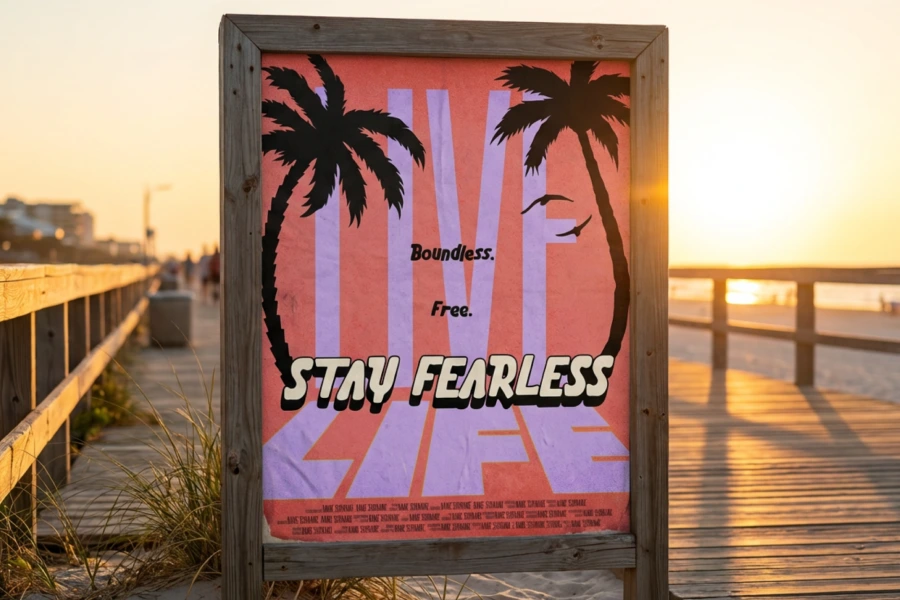
So when we use Kittl’s T-shirt mockups library, we are not just making the listing prettier. We are removing guesswork. We can pick scenes that include real-life people, swap garment colors fast, and export consistent variations for a real listing set without leaving the tool.
So the difference is not “can it mock up.” It is “does mockup creation feel like the default path to a listing.”
3. Exports that do not trigger refunds

Most POD issues are not the design idea. They’re the file.
For apparel, the safest default is a transparent PNG, exported at high resolution in RGB or sRGB. Printful explicitly recommends sRGB for DTG artwork in its DTG file guidelines, and Printify also recommends designing in RGB because files are converted during production in its T-shirt design size guide.
In practice, we work backward from print area. A common full-front print is around 12 × 16 in, which at 300 DPI is roughly 3600 × 4800 px. Some products go larger, so the rule is simple: design big first and never upscale later.
Color is the other silent mismatch trigger, since screens and fabric won’t match perfectly. Staying in sRGB and avoiding extreme neon or out-of-gamut colors reduces surprises, and guidance.
Where Kittl vs Illustrator for print on demand differs most at export time is friction. Kittl keeps export choices straightforward in its download settings, which helps reduce “wrong size” and “forgot transparency” mistakes.
Illustrator has more control, but it’s easier to accidentally export too small or misinterpret resolution settings, and you can see how often people hit that in Adobe community threads like “Illustrator is exporting blurry PNGs”.
For posters and print products, Illustrator is usually the safer pick because prepress needs can get strict. Some providers spell out PDF requirements, bleed, and print-ready standards. Kittl can export PDF and SVG, but it’s not designed as a full prepress environment.
Quick print-ready checklist we use every time
- Match the platform’s recommended pixel dimensions
- Keep transparency on when needed
- Stay in sRGB or RGB unless the provider says otherwise
- Export big enough that we never upscale later
- Test on a mockup and sample new product types
Decision tree: choose Kittl vs Illustrator for print on demand in 30 seconds

Frequently asked questions: Kittl vs Illustrator for print on demand
Do I need Adobe Illustrator for print on demand?
No. You only need Illustrator if your POD workflow depends on advanced vector work like hand-drawn illustration, complex path editing, or prepress-heavy deliverables. If you mostly sell typography tees, quote shirts, badges, and simple layout-led designs, you can ship high-quality POD products without Illustrator.
Is Kittl good enough for professional POD?
Yes, for most POD businesses. Kittl is especially strong when “professional” means consistent branding, great typography, fast iteration, and listing-ready assets. It is built around templates, a strong font ecosystem, and mockups, which are the things that matter most when you are publishing products weekly.
What file type should I upload for T-shirts: PNG, SVG, or PDF?
For most T-shirts, upload a transparent PNG at the pixel dimensions your POD provider recommends. Use SVG when the platform supports vector uploads, and you want scalability. Use PDF mainly for posters and print products, or when a provider specifically requests PDF.
How do I avoid blurry prints on POD?
Blurry prints usually come from exporting too small and then scaling up. Start with the POD provider’s recommended pixel dimensions, export at that size, and avoid upscaling after export. If your design is vector-based, keep it vector as long as possible. Always check the design on a mockup and order a sample when you are launching a new product type or print method.
Can I use Kittl for Etsy listing images and mockups?
Yes. Kittl is built for generating mockups and listing visuals quickly, including model and lifestyle style mockups that help shoppers imagine wearing the merch. This matters for click-through and trust on Etsy, because the listing image often sells the product before the buyer ever reads your description.
What’s the fastest workflow for making POD variants?
The fastest workflow is to build one repeatable layout system and then swap copy and styling in batches. In Kittl, that usually looks like starting from a template or saved layout, changing the phrase and colors, then generating mockups and exporting a full listing set right away. In Illustrator, variants can be fast too, but you usually spend more time on setup, exporting, and mockup production.
Can I combine Illustrator and Kittl in one workflow?
Yes, and it is often the best setup. Use Illustrator for complex vector illustration and precision path work. Then bring the finished art into Kittl for typography polish, fast variants, mockups, and Etsy listing assets. You do not have to quit Illustrator overnight. Start by moving the POD steps that slow you down into Kittl.
Key takeaway: Kittl vs Illustrator for print on demand
If you sell POD on Etsy, we learned that the “best” tool depends on the kind of designs you actually publish.
- Kittl is built for POD speed: templates, typography workflow, mockups, and fast listing visuals
- Illustrator is built for depth: best for complex vector illustration and precision editing
- A hybrid workflow often works best: Illustrator for detailed art, Kittl for typography polish, mockups, and Etsy-ready images
- When Illustrator is the better choice: If the product is driven by hand-drawn vector illustration, complex path editing, or prepress-heavy requirements, Illustrator earns its place. That depth is hard to replace.
- When Kittl is the better choice: If the product is mostly typography tees, badges, and repeatable layout-led designs, Kittl often feels like the more logical daily driver because it compresses the path from design to listing assets without extra steps.
For most sellers, the winners are simple, typography-led shirts and repeatable layouts. That is where Kittl shines because it gets us from design to listing assets faster with templates, a strong built-in font ecosystem, and mockups with models, plus quick color variations.
Try Kittl for your next 3 POD listings and compare your time-to-publish.