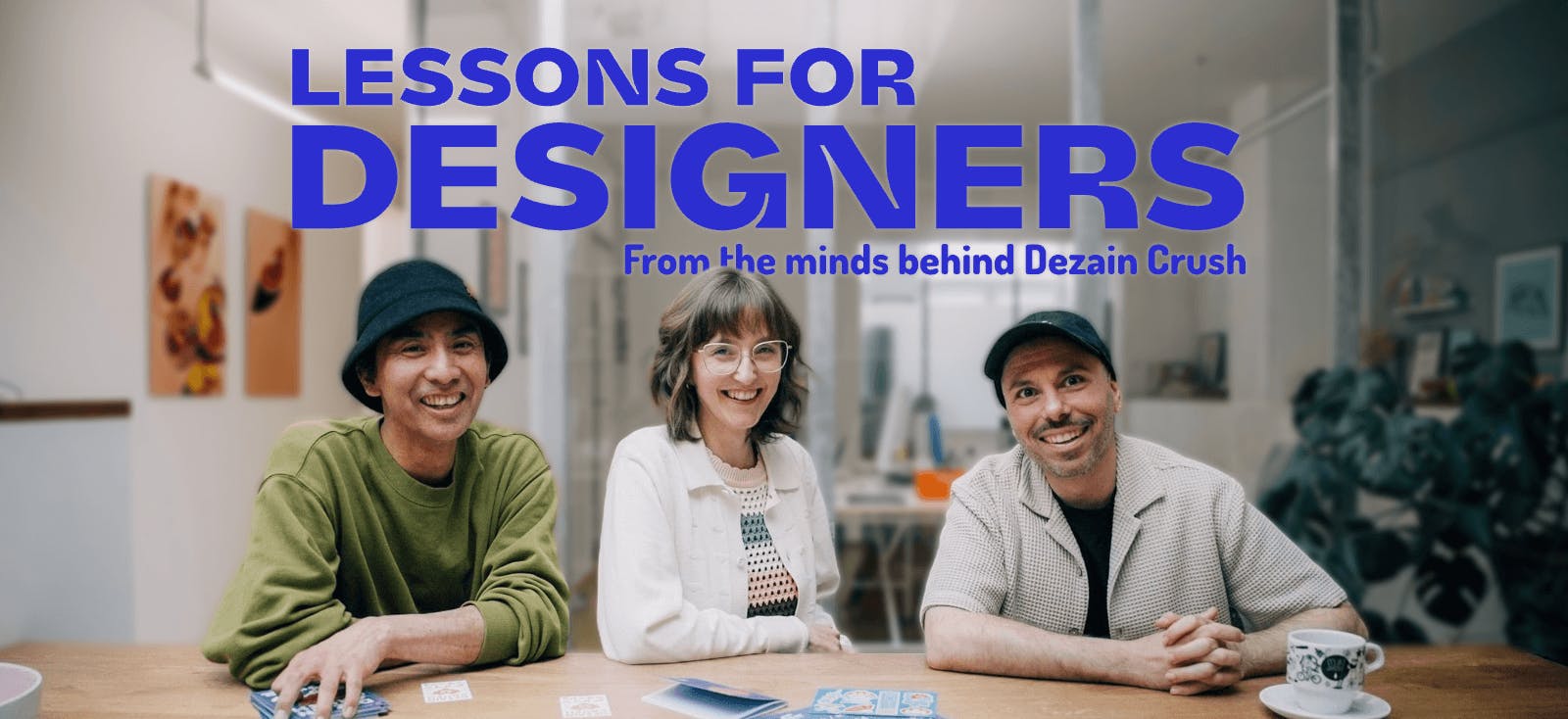
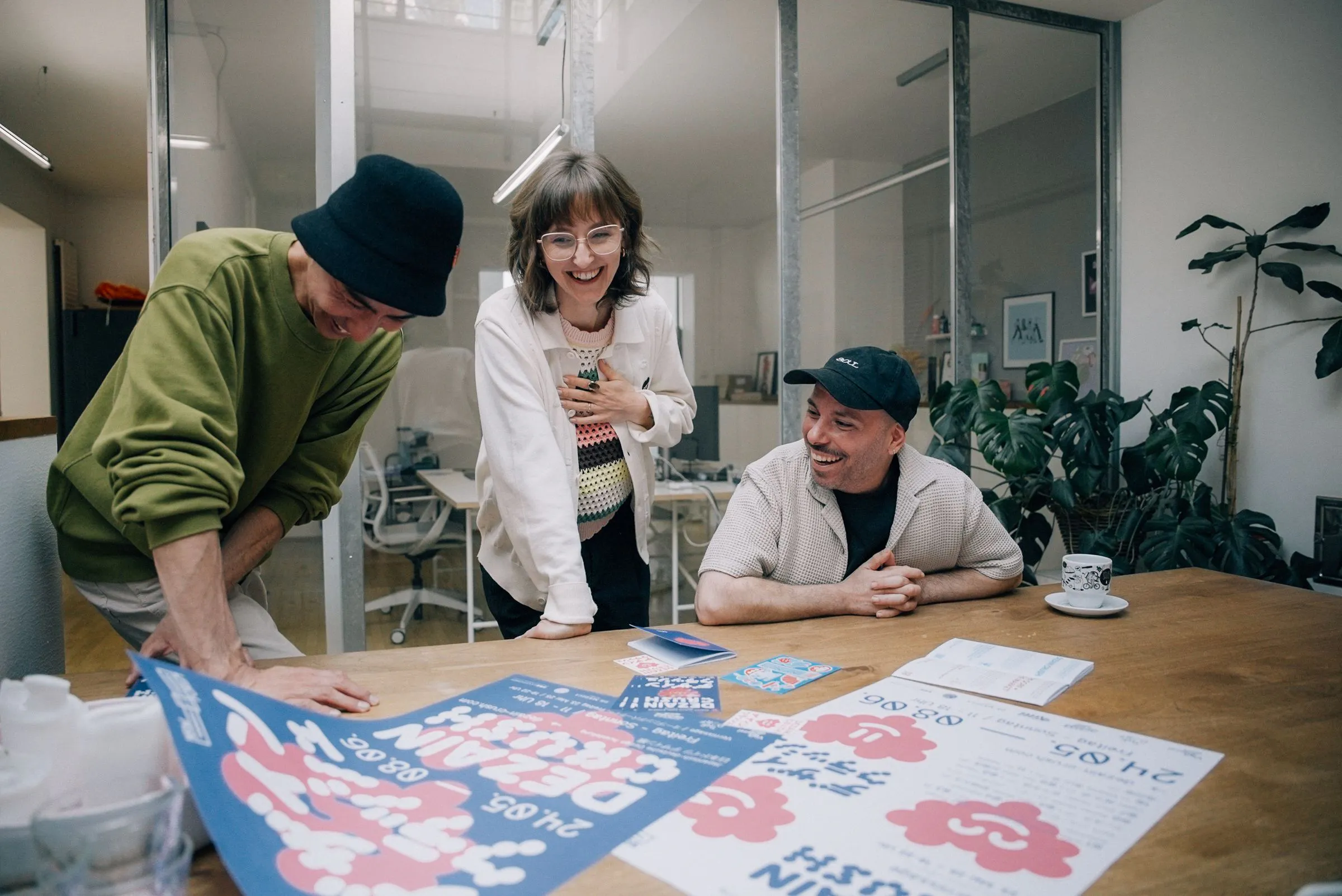
Dezain Crush brings together emerging and established voices from across the design world — sparking meaningful conversations, uncovering hidden creative gems, and celebrating what makes design a force for change and connection.
More than just an event, Dezain Crush is a platform for growth, storytelling, and inspiration, especially for designers navigating their own evolving paths.
Before the incoming Dezain Crush 2025, we had the privilege of chatting with the creators behind the event not just to hear their stories, but to ask the kinds of questions that designers everywhere are thinking about:
- How do I grow my skills?
- What career moves matter?
- How do seasoned creatives stay inspired?
In this feature, youll find real talk, thoughtful insights, and genuine advice straight from professional designers who started their own studios.
Use the lessons from these incredible minds to help you gain clarity around your creative work, career decisions, and personal growth.


Meet the Dezain Crush Creators
Before they teamed up to launch Dezain Crush, each of the creators carved their own unique path through the design world from hands-on letterpress to cutting-edge branding and collaborative exhibitions. Together, their stories embody the spirit of risk-taking, reinvention, and relentless creativity that defines this event.
Dezain Crush, a festival, exhibition, and series of satellite events, is shining a spotlight on Japanese-German design this year in Düsseldorf. Inspired by the event, we’re hosting our own Kittl Challenge! More than just a chance to win, Kittl Challenges are a space to experiment, get noticed by industry leaders, and grow your portfolio. Ready to get started? Check out the design brief and join the challenge!
Kiyo Matsumoto, founder of Letterpress 77
Follow Letterpress 77 on Instagram
Kiyo’s journey began in Minneapolis, where a visit to a small print shop in SoHo, Manhattan sparked a lifelong passion for letterpress. What started as a side hobby alongside graphic design eventually transformed into owning his own letterpress studio: Letterpress 77.
Lilly Friedeberg, co-founder of Design Studio B.O.B.
Follow Design Studio B.O.B. on Instagram
Previously a senior designer for design agency, Lilly co-founded Design Studio B.O.B. in 2018 with Alessia Sistori. The studio has earned awards from the German Brand Award, Red Dot, and Art Directors Club. Their collaborative, forward-thinking approach has been featured in publications like Eye on Design, Dieline, Creative Boom, and Design by Women (to name a few).
Alexandros Michalakopoulos, co-founder of Morphoria
Follow Morphoria on Instagram
After graduating, Alex co-founded Morphoria in 2014 with friends following a project for the Kunstpalast museum in Düsseldorf. The studio has worked with clients like Riot Games, Goethe Institute, Klarna, and MTV (to name a few) and earned awards from ADC Germany, Red Dot, and TDC New York, plus many more.
1. What inspired you to start your own design studio?
Kiyo
After graduating from the Minneapolis College of Art and Design, I moved to New York to look for a job as a graphic designer.
Around that time, a friend told me about a small letterpress shop in SoHo. I dropped by out of curiosity — and that visit changed everything. That was 26 years ago. Even after finding a job as a graphic designer, I kept working in the print shop during evenings and weekends. I loved the hands-on process, the smell of ink, and being surrounded by beautiful paper.
Designing on a screen just wasn’t enough — I wanted to make things I could actually touch. Eventually, I started dreaming about having my own studio where I could do both the design and the printing.
After 11 years in the U.S., I moved to Germany (my wife’s home country) and finally opened my own letterpress shop in Düsseldorf in 2006!
Lilly
I worked in a design agency as a senior designer.
During this time I had so much fun working in this great team, but at the same time I realized that I would regret it if I never tried to run my own design studio.
It was during this time that I met Alessia Sistori, who I knew from my studies in Berlin. We started working together on small projects and we immediately had a great dynamic of working together and complementing each other.
So in 2018, we founded our own studio with a focus on packaging, illustration and branding.
Alex
After graduating, I struggled to find a job in the design industry.
However, during my studies, I had already built a small network through freelance work for larger agencies and by developing my own base of smaller clients.
Shortly after finishing my degree, an opportunity came up to design an exhibition for the Kunstpalast museum in Düsseldorf together with some friends. This project became the catalyst for founding with my friends our own design studio.
2. Can you describe a time when you had to overcome a challenge that resulted in growth or a new opportunity?
Lilly
Two years ago we had a difficult time in our studio, for the first couple of years it went well, but then we hit a wall. We were a bit stuck and felt like we didn’t quite have the projects we wanted.
Of course we were happy with the clients we had, but we felt like it was hard to get to the next steps. So we decided to spend a lot of time creating a new version of not only our website, but also our own branding.
We realized that our previous website was too cutesy and playful. The branding and the look and feel were too focused in one direction. Maybe we bring a certain style, but it’s also very important for us to work closely with the client together. We follow the brief, the target group and create a unique, individual solution for each project.
So we realized that we needed a new website and branding that stays true to ourselves, while at the same time not being too loud. Our old website had dominated too much, with the update we are giving the stage to our projects.
This process sounds so easy in retrospect, but it was very difficult and a bit of a rollercoaster. But the work was worth it, very quickly after the launch we noticed a strong increase in inquiries and especially in larger inquiries.
This experience has shown us that you are never finished. In our profession, you have to constantly reposition yourself and work hard on your portfolio. It’s important to keep questioning yourself critically.
3. What was the most important factor in developing your unique design style?
Kiyo
To be honest, I don’t really think of my design/illustration as having a truly unique style. These days, it’s hard to say any style is completely original — everything’s been done in some form.
It’s not about “only I could do this,” but more like, this kind of work just fits me perfectly. With all the changes happening around AI, design is getting more complex and layered. But I know what I can do — and how to design and illustrate in a way that works best for letterpress printing.
I’ve always been drawn to simple, one or two colored designs, and that aesthetic naturally complements the tactile, crafted feel of letterpress. So in the end, my style developed from doing what I love and what feels right for the medium.
Lilly
During my design studies in Berlin, I focused a lot on illustration. I only wanted to work in this field. For years, I worked really hard towards this goal.
But after working in a small team during my internship at a stop-motion studio, I realized that I like working with others and creating something bigger. I realized that I wanted to expand my skills in other directions.
For me, illustration is still a big part of my work, but I’m so glad I didn’t stop there. For me, there is no greater joy in my job than creating something with others.
It doesn’t matter whether it’s a branding project, a product line or — as in the case of Dezain Crush — an entire exhibition. You can create so much together and complement each other perfectly. What has remained the same over all these years is my love of color.
Alex
I wouldn’t say that I have a unique, personal design style. In fact, I believe it’s not necessarily the right approach to apply the same style across very different clients and projects — but of course, that’s just my personal view and others might see it differently.
Another important reason why I wouldn’t describe my work as having a single, recognizable style is because I work as part of a collective at Morphoria.
Our core philosophy is to collaborate closely on every project, meaning that different design perspectives and philosophies from various team members naturally blend into each piece of work. As a result, the designs we create are shaped by multiple influences rather than a singular, individual style.
4. What should designers who want to start their own studio think about? What are some of the first steps and mistakes to avoid?
Kiyo
In a way, I just started without thinking too much about how to start. I didn’t study any business plan in my art college, well there was no class like that — and honestly, I’m not sure I would’ve wanted to. I was ambitious enough to just go for it. I didn’t have much money, but somehow I knew I’d figure it out.
Nothing about being self-employed is easy — it’s full of ups and downs, even now. But I love what I do, and for me, that’s what matters most.
As for mistakes to avoid… I’ve made plenty! But I don’t really think of them as mistakes. Everything is part of the learning process. I’ve been lucky to meet so many amazing people through Letterpress 77. For example, Lilly and Alex!! And I’m so grateful we get to work together on Dezain Crush!
Lilly
Oh, that’s a big question, haha… there’s a lot to it. For us, the key was taking everything one baby step at a time. We couldn’t afford to take big risks in the beginning, so we focused on learning how to build and run a design studio slowly but steadily. That approach turned out to be perfect for us, it’s really paying off now. But of course, it also meant being patient and resilient for quite a while.
One really important thing: you have to really want it. You need to be a little crazy and a bit obsessed to succeed. Passion fuels the long hours and the inevitable setbacks. And just as important you have to give yourself breaks too, or you’ll burn out.
Alex
One of the most important things for designers who want to start their own studio is to have perseverance, ambition, and not be afraid of setbacks or losses. You need to get used to dealing with failures in many forms — sometimes it’s losing a pitch, sometimes a client doesn’t like a design because they imagined something completely different. This is simply part of working in a creative field, and it’s important to accept it early on.
A rejection doesn’t necessarily mean that the design was bad; often it simply means that the client’s vision didn’t align with the studio’s philosophy. However, it’s important to find the right balance: graphic design is ultimately a service, and the designer’s personal expression should not overshadow the client’s needs.
At the same time, it’s crucial to remember that the designer is the expert when it comes to creative and visual decisions. Educating the client and helping them understand the value of professional design is a necessary part of the process. Building this mutual respect ensures better collaboration and stronger results.
5. What role does collaboration play in your creative practice?
Kiyo
Collaboration plays a big role in my creative practice. It’s always fun and inspiring to print beautiful designs and illustrations from talented designers and illustrators. Working with other creatives brings fresh energy into the printshop.
I also really enjoy collaborating with customers — especially on personal projects like wedding invitations or birth announcements. I love getting to know a bit about their lives through the process.
One of the most rewarding parts of my work is seeing people come back over the years — starting with business cards, then wedding invitations, and later baby announcements. It feels like being part of their story in a small but meaningful way.
Lilly
As shared above:
For me, there is no greater joy in my job than creating something with others. It doesn’t matter whether it’s a branding project, a product line or as in the case of Dezain Crush an entire exhibition. You can create so much together and complement each other perfectly.
Alex
Collaboration plays a central role in my creative practice. At Morphoria, we work as a collective where multiple designers contribute their ideas, perspectives, and styles to each project.
We strongly believe that collaboration leads to richer, more diverse results than working alone. Sharing thoughts, challenging each other, and combining different approaches allows us to create designs that are more thoughtful, refined, and innovative.
For me, collaboration is not just a way to divide work — it’s a way to constantly learn, push boundaries, and achieve outcomes that none of us could reach individually.
6. How important is personal branding for you? If its something you pay a lot of attention to, do you have advice for a junior designer trying to work out their personal brand?
Lilly
We love playing around with our own brand, Design Studio B.O.B., but as mentioned earlier, we had to tone it down a bit… we needed a personal branding that left more room for all the different projects we work on.
With Dezain Crush, though, we really wanted bold, loud, fun branding. It was such a great experience to be our own client and have the freedom to do exactly what we wanted.
My advice for starting a career is to be a bit crazy and loud. You have to stand out, you can always tone it down later. But if everything looks the same and is too well-behaved, it’s boring.
Alex
I have mixed feelings about personal branding. I believe that the identity of a studio, or even of an individual designer, should be crafted with a high level of technical perfection but remain visually understated.
What should truly stand out is the portfolio: the actual work and the results achieved in collaboration with clients. A potential new client should be able to quickly understand the range of services offered and the breadth of creative capabilities through the work itself, rather than being overly influenced by a strong personal or studio brand.
My advice for a junior designer would be to focus on building a strong and diverse portfolio first, and let the quality of the work speak louder than the branding around it.
7. What’s something (a book, a podcast, an event you attended, etc.) that inspired you recently?
Kiyo
So many things inspire me — it’s hard to pick just one! I’m constantly inspired by children’s books. I could list a hundred, but a few favorites are Rotraut Susanne Berner, James Krüss, Marc Boutavant, Taro Gomi, Tupera Tupera, Shinsuke Yoshitake, Jutta Bauer, Tanja Esch, and Max Fiedler. The list goes on and on!
Nature always inspires me too — the forms, colors, even the smells.
I also find endless inspiration in kids’ drawings. There’s something so raw and pure about them that really speaks to me. Music is another big influence. I listen to music always when I print! I especially love album covers.
I love looking at old records — Hipgnosis created so many iconic designs in the ’70s. Posters and flyers I see around the city, always catch my eye. When I am at home in Japan, I am totally inspired by everyday visuals—posters, shop signs, packaging, street signage… even arrows painted on the road. I just love them!
And the last but not the least, I try to see as many exhibitions as I can — recent favorites include Yoko Ono, Hilma af Klint, Etel Adnan, and Piet Mondrian.
Lilly
Oh there is so much that inspires me. I love a good series. I loved the style and atmosphere of Poker Face, season 1 Natasha Lyonne is such a big inspiration to me.
Recently I am also inspired by the podcast Good Hang by Amy Poehler. It’s light and fun but also gives really interesting insights into different careers.
I really love movies as well, I loved the movie Perfect Days by Wim Wenders.
And of course like everyone, I love traveling, especially to Athens and London, where we have family and friends. What always makes it the best 🙂
And I am so inspired by the Japanese culture that I was able to get to know through We Düsseldorf. My dream is to travel to Japan with our team as soon as possible and meet the people we got to know through Dezain Crush there again.
Alex
Recently, I’ve been really inspired by documentaries about how things are made and biographies of entrepreneurs or stars with remarkable careers.
I’m particularly drawn to the creation stories behind films, as the film industry is a true “royal discipline” of the creative process, connecting all creative fields.
What inspires me most isn’t the final result, but rather the journey to get there. It’s fascinating to see how all creatives face similar challenges, and how you can spot patterns of both failures and successes.
What also resonates with me is how they often find cost-effective ideas, especially when we working with limited budgets, like in cultural projects. It’s a reminder that innovation often comes from constraints and thinking outside the box.
8. Have you ever experienced burnout? If so, what did you do to move past it? What advice would you give to a designer who’s feeling burnt out?
Kiyo
I think the only time I really experienced burnout was when I was a student in Minneapolis. It sounds a bit silly now, but my friends and I would challenge each other to stay up all night for days — trying to finish assignments or work on personal projects. We pushed ourselves way too hard, barely slept or ate. Sure, we got a lot done, but it was such an unhealthy way to live. That’s when I learned: I need sleep to think clearly and do good work.
Everyone gets stressed sometimes — whether you’re self-employed or working for a company. What’s important is not to forget to enjoy life. No fun, no life, right?
Spend time with your family, but also make time for yourself. Go to a concert, see an exhibition, go for a walk, shop, read, listen to music, bicycling, hang out with friends. Having fun keeps you curious, and curiosity keeps you creative.
Lilly
I have never experienced a real burn out until now, fortunately. but I have had to deal with back problems several times. Since then, I’ve had to pay more attention to my exercises and take care of myself.
Back problems are a big issue in our profession, I can only advise you to buy a good office chair as soon as possible and to do lots of good exercises.
Also I fundamentally believe in balance. It’s so important to work really hard and give it your all sometimes. But just as important is taking time off afterward, as a reward. For me, one doesn’t work without the other.
Alex
Fortunately, I haven’t experienced burnout, so I can’t speak from personal experience. However, I believe that maintaining a healthy work-life balance is essential, and it’s important not to undervalue yourself or your work.
Setting boundaries and making time for rest and personal life should be fundamental principles for any designer.
It’s easy to get caught up in the hustle, but taking care of your mental and physical health is crucial to sustaining long-term creativity and success.
9. What do you think is the biggest mistake junior designers make when starting their careers, and how can they avoid it?
Kiyo
I think the biggest mistake junior designers make is thinking they shouldn’t make mistakes. That mindset can make people play it too safe or hesitate to try something new. And sure, if the safe way works for them, that’s fine, but sometimes you need a little adventure.
No risk, no fun! Don’t be afraid to make mistakes.
Like I said earlier, everything you do is part of the learning process. That’s how you grow — not by being perfect (nothing is perfect anyway), but by trying, failing sometimes, and figuring things out along the way.
10. If you were hiring a junior designer, what is the first thing you would look for in their portfolio, and how can they ensure their portfolio stands out?
Lilly
I’m always on the lookout for that “wow” factor. I want to see something that surprises me. We’re so busy, and usually, we only have about five minutes a day to browse through new portfolios, which is never enough time.
So, what I never do at first is read long texts. The visual impact is what matters most. I want to see something fresh, something that shows the person had fun with it.
I also love seeing a variety of skills: for example, a designer who’s not only a illustrator but can also create graphic compositions, 3D art, or whatever else. If a portfolio catches my eye and gets me excited, that’s when I dig deeper and read everything… but only if that first impression is solid. And please don’t send too huge files to download 😉 10 MB should be the absolute max.
Alex
When we were hiring a junior designer at Morphoria, the first things we would look for in their portfolio were creativity and craftsmanship.
I’m particularly drawn to portfolios that are divided into these two areas, as it helps me understand the designer’s strengths more clearly.
On one hand, I want to see how creatively and visually interesting their work is, but on the other, I also want to see how well they handle the technical side of design.
It’s important for a junior designer to show that they can not only come up with innovative ideas but also handle the more practical tasks that come with the job, such as preparing print-ready files for posters, flyers, stickers, and other smaller projects.
A well-rounded portfolio that highlights both creative and technical skills will definitely stand out.
11. What do you think is the most effective way for junior designers to level up their skills should they focus more on personal projects, freelancing, or other avenues?
Kiyo
I would say… no matter what path you take, personal projects, freelancing, or something else — I think the most important thing is to stay true to yourself. That’s not always easy, but it’s so important to love what you create, whether it’s for a client or just for yourself.
When your work feels honest, it shows, and that’s how you really grow.
Lilly
I would say the balance again: looking back for me it was the mixture between self initiated personal projects and freelance jobs. This combination eventually leads to projects that feel like a mixture of both 🙂
Personal projects are perfect to explore your style and new tools, freelance projects help to follow a briefing and work together with a client.
Alex
I believe that any approach can help as long as you stay within your creative field. That’s what worked for me.
I didn’t have the privilege of focusing solely on personal projects during my studies — I had to work part-time to cover my university and living expenses. But I made sure to only take on graphic design jobs, no matter how exciting or unexciting they were. Most of them were quite boring, but they still taught me valuable lessons.
With every project, you always learn something, as long as you stay committed to your craft. Whether it’s through personal projects, freelancing, or other avenues, the key is to keep working in your field and building your skills.
12. What skills do you think will be most important for the next generation of designers to master?
Kiyo
Honestly, I’m pretty simple when it comes to design tools. All I really need is a pencil, a sketchbook, and software like Illustrator. That’s because I love the hands-on process. It keeps me connected to the work. I think it’s fascinating to see what AI can do these days, but personally, it doesn’t really interest me enough to learn about it.
What I would say to the next generation of designers is: Remember the basics. Carry a pencil and a sketchbook. Keep a creative journal off the computer.
There’s something really powerful about stepping away from the screen and letting ideas flow by hand.
Lilly
Right now, I find the rise of AI both amazing and intimidating. I’m not one to try to predict the future, but I can share my own experience to answer this question: When I was studying in Berlin and wanted to become an illustrator, I often got advice telling me I should learn animation or 3D art. Both were probably good pieces of advice, but I didn’t listen to either because I simply wasn’t interested in animation or 3D.
What I was interested in was art direction, branding, and packaging. So, I became obsessed with those fields, and today, those are the skills that have been the most beneficial to my career.
I know many amazing animators and 3D artists with fantastic careers, but some of them are now feeling the pressure from AI. It’s a reminder that you never really know which field will be the “safe bet.”
One thing I can say for sure is that whatever skill you choose to pursue, you really have to want it. For me, I can only get truly good at something when I’m genuinely obsessed with it — not just because someone else told me it’s a smart move.
Alex
This is a difficult question to answer, especially since we are currently in a transitional phase where AI plays a significant role, and we don’t yet fully know what the long-term impact will be.
In the past, we’ve already seen such shifts — whether it was the Industrial Revolution or the advent of the computer, which transformed graphic design from a craft-based profession into a digital one. What we can learn from history is that it’s important not to close ourselves off to new technologies.
Personally, I view them as tools that can accelerate my vision and enhance my creative process.
The most important skills for the next generation of designers will likely involve a blend of traditional design principles and an open mindset toward emerging technologies. Embracing these changes, rather than resisting them, will help designers stay relevant and continue to innovate.
Ready to get involved? Join the Kittl Challenge and submit your work for a chance to be one of five winners! All winners get a spotlight on Kittl’s feed plus more prizes curated to support you in your creative journey. Practice your skills, get noticed by industry leaders, and grow your portfolio join the challenge now!