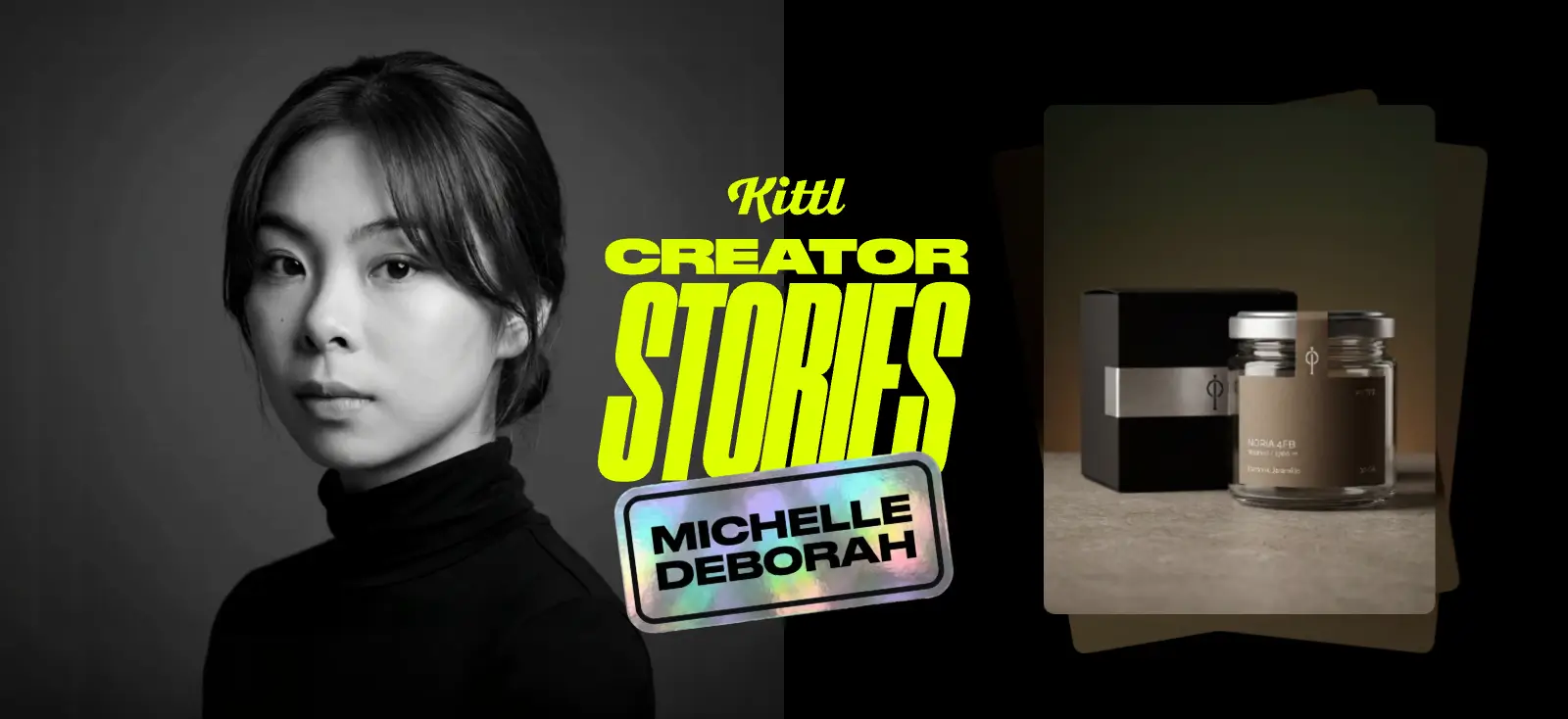
Brand and packaging designer, Michelle Deborah, founder of artsbyemde, used to rely on ready-made mockups to present her designs to clients. But when she realized they weren’t showcasing her designs effectively.
Not only were other designers using the same mockups, but the pre-made mockups failed to capture the scene she envisioned.
So she stopped settling.
With Kittl, she took full creative control and began art-directing her own — building fully personalized, stylized mockups that reflect each brand’s identity exactly as imagined. No complex 3D software. No expensive photoshoots. And on top of that, she’s saving time.
“Before Kittl, I mostly relied on ready-made mockup scenes that many other designers also use. Now, I can create fully customized scenes based on my own imagination and brand direction, without needing to learn complex 3D software.”
At a glance
- Creator: Michelle Deborah, Owner of artsbyemde
- Use case: Branding, packaging, editorial mockups
- Result with Kittl: On-brand, and fully customized, art-directed mockups

The challenge: Custom mockups unique to each brand project
For Michelle, the biggest challenge wasn’t designing packaging — it was presenting it properly.
Before Kittl, she relied on ready-made mockups. But these mockups were already used by many other designers. They felt generic, flat, and misaligned with a brand’s intended mood.
“As a branding and packaging designer, mockups are everything, they shape how clients perceive the final outcome.”
When she wanted something more editorial, more intentional, and more aligned with a specific brand story, she couldn’t find it.
Designers in this situation risk their designs being diluted by bad presentation, which can potentially lead to missing out on client work.
The traditional solution would be to use complex software to manually create custom mockups for every project, or invest in photoshoots to create pro-types. But neither of these options are realistic for ambitious freelance designers managing multiple projects.
She needed creative control — without the technical barrier.
The solution: Art-directing custom scenes with Kittl Flows
Kittl gave Michelle the ability to build scenes from her own imagination instead of adapting to what already existed.
Her workflow blends several tool and features inside Kittl:
- Remix to generate a strong base scene
- AI Mockups to place packaging naturally in the environment
- Kittl Flows to explore variations in perspective and atmosphere
- Texture adjustments to simulate print finishes like matte, grain, or embossed effects
- Nano Banana for refined visual outputs
- Kittl Video to experiment with motion and scene depth
Instead of hunting for the “perfect” mockup, Michelle now art-directs her own enabling her to experiment more, present stronger visuals to clients, and communicate texture and print intention clearly before production.
“Now, I can create fully customized scenes based on my own imagination and brand direction, without needing to learn complex 3D software.”


The benefits to designer (plus, stakeholders and clients)
1. Speed and flexible creative control
Instead of spending weeks learning 3D software or searching endlessly for the “perfect” mockup, Michelle can now art-direct her own to create fully customized, on-brand visuals.
“Kittl allows me to produce high-quality, editorial-style mockups quickly, which has significantly improved my efficiency and creative control.”
2. Stronger brand storytelling
Presentation now matches the mood and intention behind each design. Each of Michelle’s projects can now be distinctly unique to each brand. An extremely valuable benefit to designers leading to more positive recognition on socials and more client satisfaction.
3. Creating clarity between designer, manufacturer, and client
With Kittl Flows, Michelle has been able to present realistic visuals not just to clients, but also to print manufacturers.
For another Instinct project that hadn’t yet gone to print, Michelle used Kittl to simulate textures and finishes directly within the mockup. Instead of imagining the final result, the client and print partner could clearly visualize it before production.
That clarity reduced uncertainty and strengthened decision-making.
“Instead of imagining it, they could see it.”
4. Simplified asset production
For Michelle, Kittl’s impact extends beyond client work. She also runs a matcha brand between Japan and Indonesia which means managing campaigns, visuals, and storytelling remotely. Faced with this specific challenge, she’s learned how to streamline steady content production and maintain a cohesive brand presence with Kittl.
With Kittl Flows, she can:
- Create campaign visuals and promotional scenes from anywhere.
- Develop storytelling-driven content without needing physical product shoots.
- Maintain a consistent, on-brand brand presence even when she’s not on-site.
Instead of relying on in-person production or external teams, Michelle can art-direct and launch visuals independently, keeping her brand momentum strong across borders.
Learn the workflow
A notable example of this shift was her packaging project for Instinct Roastery.
The design itself was refined and premium — but Michelle struggled to present it in a way that captured the brand or her vision: an elegant, editorial look. Available mockups felt too commercial or generic. So she took full creative control. Using Kittl Flows, she built a fully customized scene that reflected the exact mood she envisioned — controlled lighting, intentional composition, and textured finishes that elevated her design.
I treat it almost like art direction, guiding the AI until it aligns with the brand’s identity.
She shares that she typically begins each of her projects by using Kittl Remix to generate a strong base scene. From there, she refines the output by specifying details such as lighting direction, shadow intensity, material finishes, and overall mood.
For the Instinct Esmeralda project, my workflow started with defining the mood and atmosphere before even building the scene. I knew I wanted an elegant, editorial look, so I focused on lighting, composition, and texture direction first.
Once she completes the base scene, she moves onto:
- Mockups to place the packaging naturally into the environment.
- Kittl Flows to experiment with different scene variations and perspectives.
- Adjusting textures and surfaces to simulate print finishes (matte, embossed feel, subtle grain, etc.).
- Fine-tuning composition to make it feel more editorial rather than commercial.
She posted the project and was surprised to find it wasn’t just positively received, it also reached a wider audience — particularly designers and brand owners seeking a similar refined aesthetic.
“It made me realize that the right scene doesn’t just present a design — it communicates a feeling.”
The takeaway
For brand and packaging designers, mockups can’t afford to be an afterthought. They carry the weight of how a client, producers, and your audience percieves your designs. They’re a key component of the design narrative, directly influencing perception and engagement of your work.
Kittl Flows allows brand and packaging designers like Michelle to experiment, refine, and communicate concepts with intention. For Michelle, it helped her stand out not just through design, but through the scenes she creates.
Because sometimes the difference between a good design and a powerful one is how it’s presented.
Use the designer’s toolbox
To create packaging visuals that feel editorial, immersive, and aligned with brand identity Michelle regularly uses:


Kittl gives you the power of a world-class creative agency on one platform. Build product imagery, labels, packaging, and campaign assets in one place, with AI tools, a professional editor, and templates built by some of the best designers in their fields. Set your brand once, then create on brand every time.