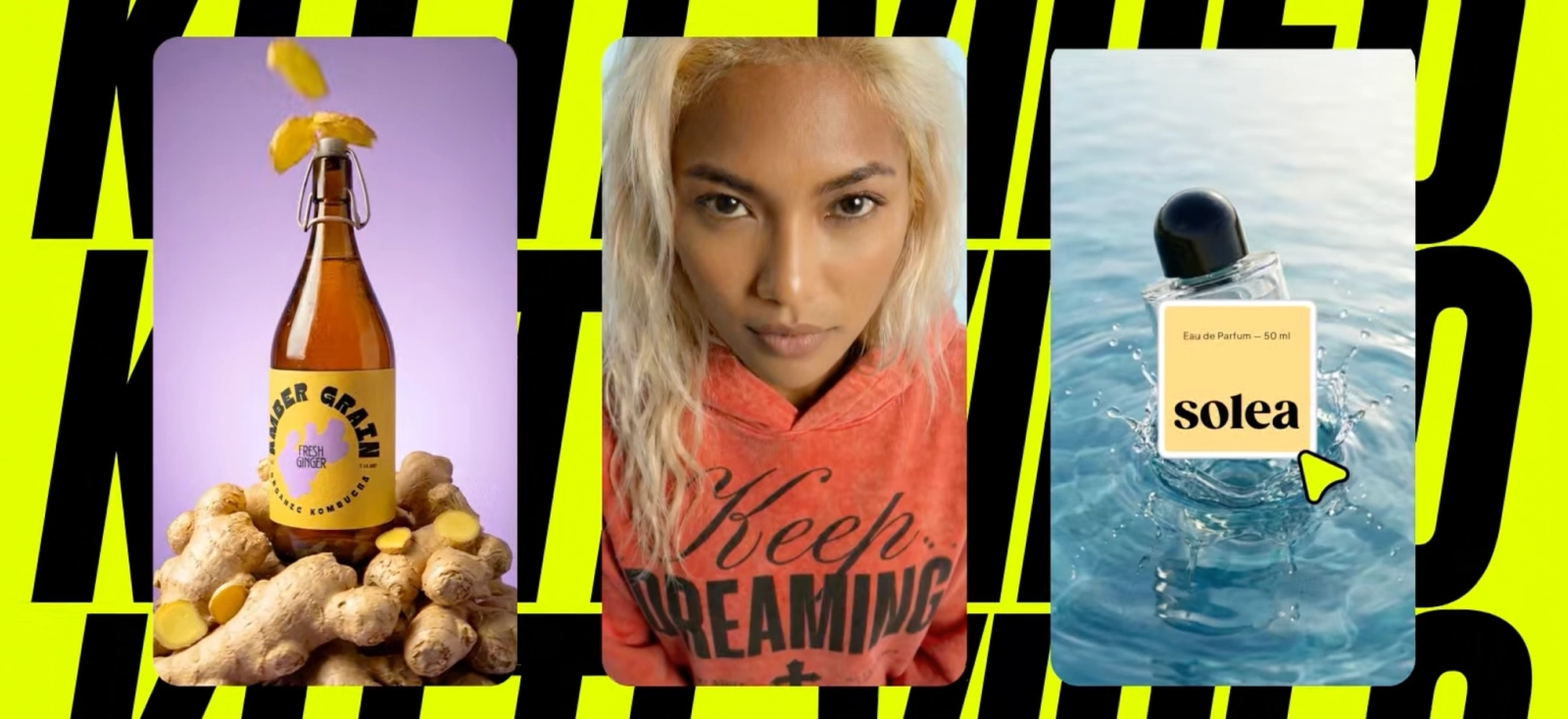
Most people search image to video AI for one reason: they want motion without adding a whole new tool to their workflow. But generic AI video outputs can be unpredictable, especially when your design has typography and layout that must stay consistent.
And this is not just a trend. As our Co-Founder and Chief Product Officer puts it:
So here’s the fix for you. This post breaks down three campaign-ready ways to use image to video AI: ads that stop the scroll, mockups that feel alive, and logo loops that make brand decks look expensive. Plus, the quick system to spin three variations from one design without rewriting your whole prompt.
One-sentence setup: Kittl Video is frames + prompt + format choices, then quick iteration until it matches your vision.
If you already know the Kittl Video basics and just want to see it in action for real campaign assets, keep reading.
If you want the step-by-step walkthrough first, this Kittl Video tutorial covers the full flow from frames to export: Kittl Video tutorial.
Use case 1: Image to video AI Animated ads for social and banner

This mockup leans into Minimalist Grunge Futurism, that nostalgia-for-a-lost-future editorial energy: dusty blue studio, slightly overexposed lighting, soft-focus distortion, visible grain, and a calm, anonymous model who feels like a campaign still pulled from a magazine.
The motion choice is intentionally boring in the best way: a slow, controlled 360° rotation that shows the outfit and tote from every angle without breaking the mood. Since we wanted music in the output, we generated this one with Veo 3.1.
Now in this story, here is the prompt that we used:
“Actions: [0–1s] — The model stands centered and still, facing forward.
[1–6s] — The model slowly rotates clockwise in place, completing one full 360° rotation, and returns to facing the camera. The back of the tote bag should be plain and doesn’t have a design.
Audio: Minimal 90s electronic instrumental with a slow, steady groove”
Use case 2: Image to video AI product visuals and moving mockups for ecommerce

Ever wonder why some lightly animated product visuals feel instantly premium, even when it’s just a jar floating in the sky?
This is where image to video AI shines for ecommerce: you can add just enough life to a product visual without turning it into a production.
In Tobi’s words, “Small camera movement, zooms, or bringing your product to life a little bit for these product images is great because you don’t need to create a setup and film this.”
What we’re doing here is taking a hyperrealistic “floating berry jam in the sky” setup and turning it into a smooth video AI product visuals that feels dynamic.
The jar stays heroic in the center, the strawberries drift around it in slow, weightless motion without ever covering the label, and the clouds slide gently behind it to sell depth.
Since we wanted sound to do some of the heavy lifting too, we generated this one with Veo 3.1.
And here’s the exact prompt that drove the motion:
“Action:
[1-6 s] — The subject floats and tilts naturally in mid-air. Ingredients drift around it in slow, weightless motion, evenly spaced and never blocking the label area.
Soft white clouds move subtly across the background, creating natural depth and realism.
SFX: Subtle birds chirping
Audio: Light acoustic guitar playing”
Use case 3: Image to video AI animated logos and brand effects for presentations

If you’ve ever saved one of those “logo in your delivered packages” that look like it was shot with direct flash on the street, you know why it works.
It feels like a real moment. The scene is clean, the product is the hero, and the action is simple enough to read instantly.
The delivery package image to video AI Kittl version is a one-frame story. You start with a single design frame of the neatly stacked boxes, then use the prompt to “add the moment” a person enters, places the box, and exits. Because the end state matches the original frame, it naturally lands clean and controllable.
Here’s the prompt we used to add the action without changing the layout: “Camera movement: subtle handheld camera with gentle natural sway and small organic micro‑shifts, like a person holding the camera
Action:
[0-2 s] — A person carrying the box enters frame
[2-3 s] — The person puts the box on top of one box
[3-4 s] — The person’s hands have completely exited the frame. The boxes remain still and neatly stacked, with no further movement or interaction.
Ambience: subtle outdoor city sounds
SFX: A low, dull thud as the box meets the surface, with subtle cardboard compression and a short friction scrape as it aligns on top.”
Quick image to video AI creative rules that work for ads, mockups, and logo loops
When motion looks premium, it usually follows a few predictable rules. Use these as your default playbook in Kittl.
- Let one hero move, keep the layout stable. For ads and mockups, the product should do the moving while copy stays pinned. Think slow rotation, tiny hover-tilt, or a simple reveal. If you need tighter control, script it as a mini timeline with time beats like “0–2s enter, 2–3s place, 3–4s exit” so the model stops guessing.
- Use two frames when you want a clear story beat. Before-and-after, empty-to-filled, closed-to-open, logo-off-to-logo-on. Two frames make the model behave because it has a start and a destination. Keep text static and describe only the transition. If you want the cleanest loops, one-frame stories also work great: start from the final designed frame and prompt a short event that ends back in stillness.
- Protect readability. If it is a label, logo, headline, or CTA, lock it down. Add a line that says it stays sharp, still, and readable, and add “never block the label area” when objects drift around the product. This is especially important for packaging and brand presentations.
- Make lighting and color do the work. A soft gradient morph, a light sweep, or a subtle highlight shift can carry the whole loop. It feels expensive, stays on-brand, and avoids the clutter that makes AI motion look messy.
- Logo loops are usually two steps, not ten. Reveal, then finish. For presentations, keep the camera locked, use a draw-on, wipe, or fade-in, then add one subtle polish move like a glow pulse or light sweep. Reset cleanly for the loop. If sound is on, prompt it on purpose with ambience and SFX, and use Veo 3.1 for audio.
If you want a deeper reference on image to video AI prompts, this internal guide is a handy vocabulary bank for camera, motion, guardrails, and style cues: AI prompts for AI videos.
Key takeaway: Turn your favorite image to video AI
If you want image to video AI results that look campaign-ready, the goal is simple: control what moves, protect what must stay readable, and iterate fast.
- The fastest way to “win” with image to video AI is to think in moments, not descriptions: what happens first, what changes, what settles
- Time-coded actions are a cheat code for control, especially for human beats and product handling like enter → place → exit
- Use one-frame stories when you want stability and loopability, and let the prompt add a single event inside the scene
- Use two-frame stories when the transformation matters, like before-and-after, reveal builds, or a designed end lockup
- Sound changes the bar: if you want audio that fits, use Veo 3.1 and explicitly describe ambience and SFX so it does not “freestyle”
- Your best results come from iteration on the new video canvas: generate, preview, change one line, regenerate, repeat until it matches the vision
As our CPO notes, “Again, here I think there are a lot of opportunities, possibilities. I didn’t really scratch the surface, but just to show that this is actually possible.”
Ready to try it? Drop a design into Kittl and hit Generate Video today.