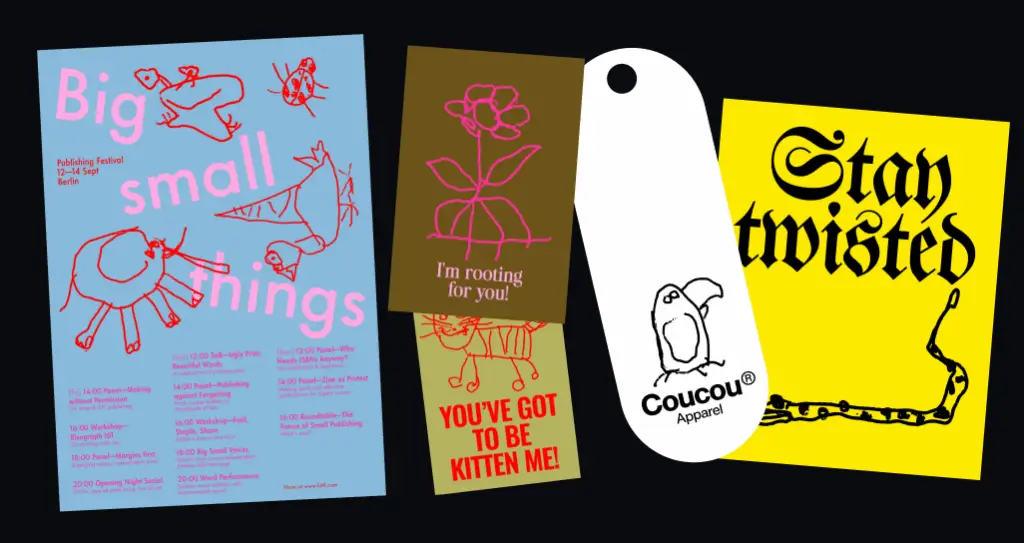
Remember those wobbly doodles in the corners of your old math notebook? Turns out, they’re back — and they’ve leveled up.
What once lived in the margins now shapes global streetwear, limited edition packaging, and the look of digital first brands. This is not nostalgia. It is a creative response to a world that feels overly polished and automated.
Welcome to Naive Design.
It is childlike, imperfect, and openly human. Think uneven shapes, shaky outlines, messy fills, and smiley faces that look like they were drawn during a phone call, not aligned to a grid. This is not about bad design. It is about honesty.
Naive Design sends a clear signal. A real person made this. After years of pixel perfect feeds and glossy brand systems, audiences are craving something genuine. Something that feels spontaneous, expressive, and alive.


What Is Naive Design?
Naive Design is not about ignoring the rules. It is about knowing them well enough to bend them on purpose. Balance, hierarchy, and readability still matter. They are just applied with restraint, not rigidity.
Imperfection becomes a creative choice, not a mistake. Slight misalignment, uneven lines, and awkward spacing add personality where technical polish often removes it. The result feels human. It feels intentional. And it reminds people that design is not only about precision. It is about character.
The origins of Naive Design
Naive Design didn’t come from the halls of art school. It started on the outside, with a French customs officer who’d never heard the “right” way to hold a brush.
Back in the late 1800s, Henri Rousseau painted wild jungles and rigid figures in his spare time — no training, no pedigree, just raw instinct. Critics? They laughed. The art world called him childish and “unskilled.” Audiences showed up just to gawk and sneer.
But Rousseau didn’t stop. He doubled down. And slowly, the tables turned. Picasso, Apollinaire, and the Paris avant-garde saw the magic in what everyone else called a mistake. Picasso even threw Rousseau a banquet, marking the moment a “naive” outsider became an underground legend. Suddenly, those slanted skies and weirdly joyful colors meant freedom, not failure.
Key Principles of Naive Design

Naive design by Kittl. Use Template

Naive design by Kittl. Use Template
- Intentional Imperfection:
Lines may wobble, shapes may drift, but each decision is deliberate. Designers bend the rules to add character, not to create chaos. - Emotional Impact:
Imperfect elements like hand-drawn shapes or off-grid lettering bring warmth, energy, and a human touch that polished digital designs often lack. - Contrast and Clarity:
Successful Naive Designs balance playfulness with clear structure. For example, bold colors and rough textures work alongside clean typography or white space, ensuring the message stays readable.
Naive Design is more than a trend. It’s a comeback for human imperfection. It says: Don’t let polish kill personality. Don’t wait for permission. Draw outside the lines and know that someone out there will get it.
What naive design looks like
You can spot Naive Design a mile away. It’s friendly, tactile, and a little unpredictable. It’s the design equivalent of a handwritten note after a decade of typed emails.
Look for these signatures:
- Uneven lines that look like they were drawn freehand with too much coffee and not enough rulers
- Wonky lettering that leans, tilts, and laughs in the face of alignment tools
- Playful colors that don’t care about gradients or shadow logic
- Flat compositions that prioritize charm over depth
- Doodles, shapes, and smiles that feel more human than vector-perfect
Or simply something like this:

You’ll find it across indie fashion brands, startup landing pages, poster art, handmade packaging, and playful portfolio sites.
It’s a style that says, “Yes, I know how to make it perfect, I just chose not to.”
And if you’re designing in Kittl, that choice is even easier. You can draw directly in the Vector Editor with uneven strokes, experiment with freehand shapes, generate your exact imagination on our AI image gen, or find some fitting childlike elements on our Content Library.
Fun fact, you can even find a collection called “Little Jimmy” handmade by the son of our very own Senior Art Director, Philipp Maus!

Along with 500,000+ other assets in our curated library!
Naive Design belongs to everyone, especially you. With Kittl, those shaky lines and doodle dreams move further, faster. Sketch it, remix it, share it. Make design feel human again.
Why it’s trending in 2026
This isn’t just an aesthetic wave. It’s a cultural response to creative fatigue.
After several years of design dominated by hyper-clean minimalism and algorithmic consistency, creatives are reaching for something warmer and more personal.
Naive Design celebrates the human touch. It blends digital precision with playful irregularity, reminding us that creativity still has fingerprints.
- It’s a rebalancing act between control and spontaneity
- It’s a sign of authenticity, where hand-drawn details make brands feel approachable and real
- It’s nostalgia-driven, tapping into Gen Z’s love for doodles, sticker culture, and the early internet
- It’s emotional, favoring honesty and warmth over flawless symmetry
Trend forecasts for 2026 point to a return of “handmade digital” aesthetics. Naive Design feels approachable in a creative world that’s getting smarter by the minute.
Plus, we’ve been seeing it rise in popularity in channels like Pinterest or Behance.
Want to see the full forecast? Check out our 2026 Design Trend Report article to find 9 more beautiful design style trends to look forward to!
How to create your own Naive Design
You don’t need to be a trained illustrator to pull off the Naive Design look. The beauty of this style is that it’s all about expression, not perfection. Here’s how to get started in Kittl.
1. Start with an idea or a template
Begin with something simple — a mood, a phrase, or a product in mind. Maybe it’s a tote bag for your art club, a playful event poster, or a hand-drawn logo for your small brand. You can build your layout from scratch or explore Kittl’s Naive Design-inspired templates for instant inspiration before adding your own twist:


2. Start with an idea or a template

This is where the fun starts. Open the Vector Editor and sketch freely. Don’t worry about symmetry! The unevenness is what gives it charm.
Draw shapes, squiggles, or characters that feel spontaneous, then pair them with bold colors or textured backgrounds to complete the look.
3. Explore hand-drawn elements in the Content Library

If freehand drawing isn’t your thing, you can still nail the Naive aesthetic. Head to the Kittl Content Library and search for doodle-style vectors, textured shapes, and playful icons. You’ll find thousands of elements that feel organic and imperfect right out of the box. Something like this:
4. Use fonts with a handmade touch
Typography plays a huge role in Naive Design. Look for fonts that feel loose, lively, and irregular. Find ones that look like they were written with a favorite pen. Try:

Each of these brings that “drawn by a real person” energy that Naive Design is all about.
Tips to create naive design
Naivety doesn’t mean chaos. The best Naive Designs aren’t random scribbles—they’re carefully unpolished. What looks effortless is often the result of real design choices.
Here’s how to get it right:
1. Let the wobble do the talking.
Draw shapes by hand. Pick rough, textured brushes. Embrace imperfect lines, but make sure your main message is crystal clear. Clarity wins, even when the outlines don’t.
2. Balance messy with clean.
One wild, playful doodle pops harder next to crisp type and generous white space. Don’t crowd the page. Let your rough edges breathe.
3. Go big with color.
Forget gradients. Use flat, bold hues that shout for attention. Simple color choices make even the wonkiest shapes feel confident.
4. Mix your media.
Digital shapes, hand-scrawled icons, a scribbled frame, a chunky font — layer them up. Think cut-and-paste energy, but on purpose.
Pro Tip
In Kittl, you can create your own “perfectly imperfect” lettering using the Vector Editor’s freehand tools, or layer fonts with Text Effects that imitate brushstrokes and pencil texture. It’s the easiest way to capture the handmade look without scanning a sketchbook.
Where to apply Naive Design
You’ve finished your Naive Design masterpiece, you created wonky lines, bold colors, and all. But where does it belong? The answer: anywhere personality, warmth, and creative energy matter most.
Naive Design isn’t just for the margins of sketchbooks. It works best when used with intention, in the right industries and contexts Since Naive Design thrives in industries where personality, emotion, and storytelling matter most, here are the sectors where Kittl thinks that this style will stand out:
1. Children’s Products and Education
- Why: The playful, childlike aesthetic is instantly relatable and trusted by parents, teachers, and kids.
- Examples: Toy packaging, children’s books, educational games, classroom decor.
2. Food and Beverage
- Why: Brands use Naive Design to communicate friendliness, craft, and authenticity.
- Examples: Organic snack packaging, artisanal coffee brands, indie bakeries, food trucks.
3. Fashion and Streetwear
- Why: Naive Design brings energy and individuality, helping brands stand out in a saturated market.
- Examples: T-shirt graphics, brand tags, lookbooks, pop-up shop installations. If you are looking for a way to apply naive design on your Shopify products, don’t miss the POD optimization to boost your organic sales.
4. Creative Agencies and Startups
- Why: Naive elements project a spirit of experimentation and approachability—attracting clients looking for fresh thinking.
- Examples: Agency branding, pitch decks, startup landing pages.
5. Arts, Events, and Festivals
- Why: Hand-drawn, spontaneous elements reflect the dynamic, creative nature of live events.
- Examples: Event posters, festival programs, gallery invitations.
6. Health and Wellness
- Examples: Yoga studios, organic skincare, wellness apps.
- Why: This style softens clinical edges, making brands feel more human and relatable.
Key takeaway: The heart of Naive Design
Naive Design means knowing the rules of good design and bending them with skill and confidence. The result is work that feels genuine, lively, and full of character, proving that “perfect” isn’t always best.
Explore Naive design more with Kittl
Naive Design is just one of the creative movements shaping the year ahead. From bold typography revivals to surreal textures and new AI-powered workflows, 2026 is a playground for designers who love to experiment. With Kittl, you can easily blend hand-drawn textures, playful type, and clean structure in one project. Make your next design feel truly alive.
If you haven’t seen it yet, check out the full Kittl 2026 Design Trend Report. It’s a collection of insights, examples, and tools to help you stay ahead of what’s next.

Kittl gives you the power of a world-class creative agency on one platform. Build product imagery, labels, packaging, and campaign assets in one place, with AI tools, a professional editor, and templates built by some of the best designers in their fields. Set your brand once, then create on brand every time.