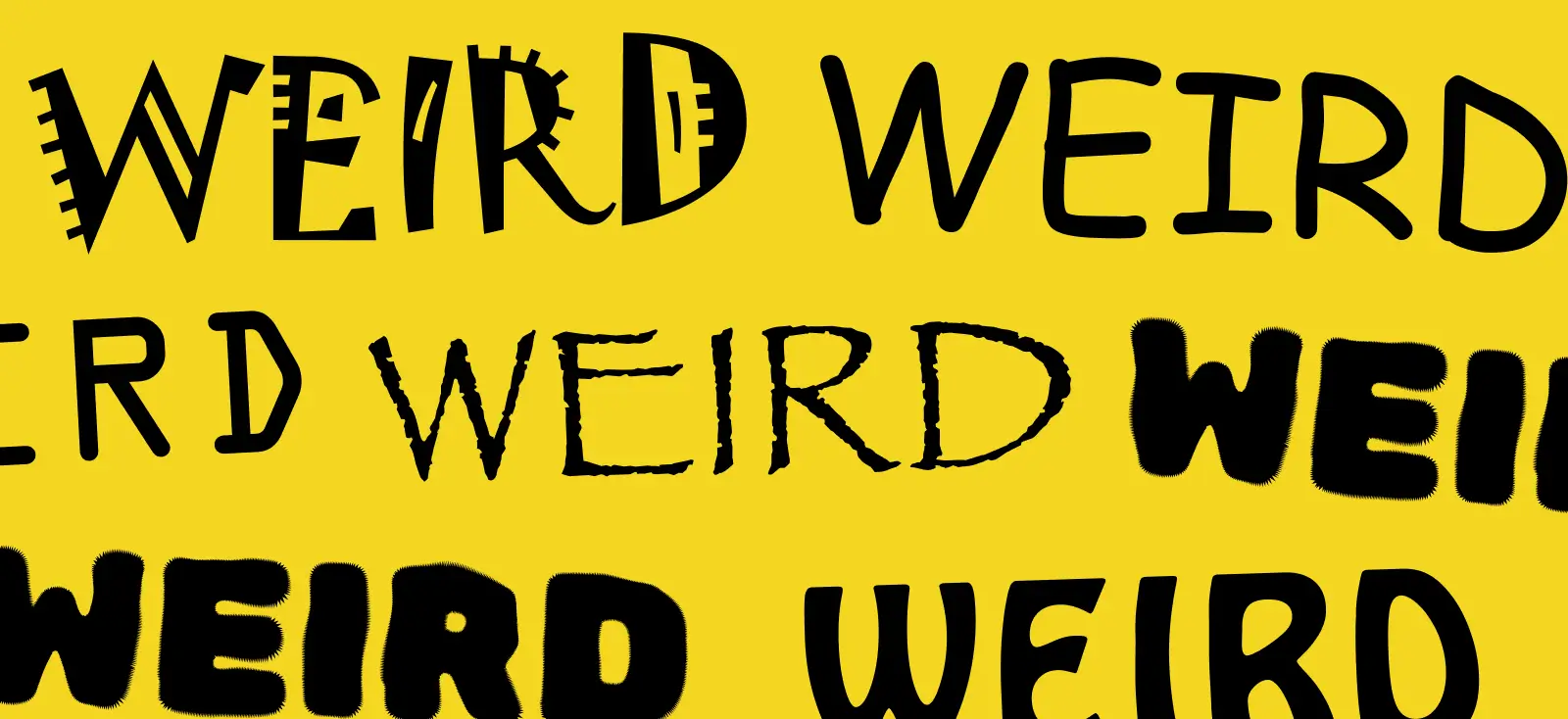
A font is never just a font. Some spark arguments, some become memes, and a few turn into legends because they look so strange you wonder how they ever made it into the world.
Think about Comic Sans. Many of us adored it as kids because it felt playful and different. Later, we discovered designers treated it like a cultural crime scene. That shift alone proves how emotional people can get about typography.
So when we talk about the weirdest fonts in history, we’re looking at the typefaces that confused people, stirred reactions, or became unforgettable for all the wrong reasons. Here are the ones that earned their place in design folklore.
What counts as a “weird font”?
Before we dive into the list, it helps to define what “weird” really means. These four qualities aren’t random.
They’re the clearest signals designers use when evaluating fonts that fall outside the norm. Typography as a field is built on legibility, consistency, and purpose.
So when a font disrupts one of those pillars, it instantly stands out.
1. Illegibility by design
Some typefaces intentionally make you work to read them. The shapes bend, stretch, or distort to the point where legibility takes a back seat to expression. It matters because readability is the core function of type. If a font is hard to read on purpose, that’s a direct challenge to traditional design values.
2. Extreme form-breaking
These fonts ignore the usual rules of typography. They toy with proportions, spacing, and structure in ways that feel unexpected or even rebellious.
Either by itself or font paired, most typefaces follow long-established structures: balance, contrast, rhythm, and spacing. When a font rejects those rules, it shifts into experimental territory.
3. Cultural controversy or backlash
A font becomes weird when it triggers strong reactions, sparks debates, or gets misused so often that it becomes a cultural punchline. Fonts show up in public spaces, branding, politics, memes, and everyday communication. If a font gets misused or sparks debate, it becomes part of cultural history.
4. A story that feels unreal
Sometimes the weirdness isn’t in the letterforms at all. An unbelievable backstory matters because typography has a surprisingly dramatic past. Feuds, accidents, rediscoveries, and strange design choices add a layer of folklore that makes a font memorable long after its release.
These four traits create our baseline. If a font hits even one of them, there’s a good chance it belongs on this list.
The 10 weirdest fonts in history
Every designer has a font that makes them pause and think, “Wait… who approved this?”
Some typefaces are odd in a charming way, others in a chaotic way, and a few are just unforgettable for reasons no one saw coming.
1. Comic Sans (1994)

Comic Sans was created by Vincent Connare at Microsoft for a casual user-interface but soon found itself everywhere… (including signage in hospitals, memorial plaques and even official documents).
Typographically, its spacing and proportion are far looser than conventional fonts: the bowls are wide, the x-height large, the kerning uneven, and the stroke endings informal, which give it a “hand-drawn” feel but also reduce rhythm and balance in body text.
However, despite its derided reputation among designers, Comic Sans is recommended by the British Dyslexia Association in some cases because its distinct letter shapes help some dyslexic readers avoid confusing “b” and “d”.
2. Papyrus (1982)

Papyrus was designed by Chris Costello, inspired by his personal study of the Bible and his curiosity about what English text might have looked like if it had been written on ancient papyrus two thousand years ago.
These organic details give it personality, but they also disrupt clean spacing and overall balance, making it harder to read at small sizes or in dense paragraphs. Its contrast is uneven, and the texture adds visual noise that can overwhelm modern layouts.
Its fame (and infamy), peaked when Avatar used it prominently, prompting a massive cultural conversation captured by The Ringer: The Enduring Mystery of SNL’s Papyrus Sketch.
3. Wingdings (1990)

Wingdings abandons traditional letter‐forms entirely and uses symbols and pictograms instead.
From a design structure standpoint, it lacks baseline alignment, consistent proportions, and uniform stroke weight. Features that make conventional fonts readable and navigable.
It gained weird-font status not just for its form, but for the bizarre cultural legends around it.
For example, claims that typing certain combinations predicted 9/11, or hid anti-Semitic messages. These are unsubstantiated, but the myths elevated Wingdings into typographic folklore.
Because Wingdings doesn’t produce readable text, some designers use it purely for decoration (or barely use it at all).
4. Grunge Fonts (1990s)

Grunge fonts emerged in the ’90s with distressed strokes, uneven spacing, and chaotic textures pulled from photocopiers, ink smudges, and scratched film.
That rough look made them deliberately hard to read but perfect for expressing rebellion and angst — which is why you see grunge-style typography in titles for Fight Club and throughout the Silent Hill games.
Eventually, traditional designers like Massimo Vignelli criticized the style for rejecting clarity and timelessness, and by the mid-2000s clean, minimal type had returned to the mainstream.
As a result, grunge fonts slipped into decline, though they still appear in streetwear, music posters, and projects aiming for a gritty, nostalgic edge.
5. OCR-A (1966)

OCR-A was created in 1966 for early optical character recognition systems, which meant every letter needed to be simple, monospaced, and unmistakable for machines to scan.
Its shapes look stiff and awkward to readers because the design prioritizes mechanical accuracy over traditional spacing, proportion, and rhythm.
Even though modern systems no longer rely on it, OCR-A still appears in places like check processing and legacy software. Its bold, raw, and utilitarian look has also found a second life in visual design.
Sites like JustCreative describe brutalist typefaces as stark, minimal, and often monospaced, which is why OCR-A fits naturally into that aesthetic.
Designers sometimes use it to evoke early computing or industrial tech, giving projects a retro-digital edge.
6. Jokerman (1995)

Jokerman is one of the most hard-to-read display fonts out there.
Its letters are over-decorated with curls, dots, and squiggles, which distract the audience from the words the text is trying to convey.
According to a design blog, “Jokerman is one of the most hated fonts for designers because of its overly stylized letters filled with dots and shapes, making it nearly unreadable.”
The font was created by British designer Andrew K. Smith in 1995, and as one researcher described, it has a low x-height with bulging curves and swaying stems, making the forms appear more like illustration than typography.
From a structural standpoint, Jokerman destroys most readability conventions: the uneven weights and unpredictable decorative elements break the rhythm of the text, kerning is inconsistent, and the ornamentation makes it impossible to use it as anything but a headline or novelty.
7. Doves Type (1900)

Doves Type is as famous for its beauty as for its dramatic disappearance.
Designed by Thomas Cobden-Sanderson and used by the Doves Press, it featured elegant, restrained forms with smooth contrast and classic proportions.
Its readability came from its balanced spacing and refined serif detailing.
The font’s legend began when Cobden-Sanderson, locked in a bitter partnership dispute, dumped the entire metal type into the River Thames to keep it out of his partner’s hands. A century later, parts of the type were recovered from the river and digitally revived, turning it into one of the most famous “lost and found” typefaces in history.
8. Hobo (1910)

Hobo is known for its curvy, line-less shapes that resemble early Art Nouveau lettering, giving it a soft, friendly look but an unusual reading rhythm.
The mystery behind its name is part of its charm. Several theories exist, but the most convincing comes from researcher Peter Zelchenko, who traced its forms to a Russian cigar poster displaying the word “ново” (“novo,” meaning “new”).
The poster’s hand-lettered shapes closely match Hobo’s rounded outlines, making this origin story the most credible.
Hobo showed up in early 2000s video games, including the Spyro series — a nostalgic surprise for anyone who grew up with The Legend of Spyro: A New Beginning and The Eternal Night!
9. Cooper Black (1922)

Cooper Black looks simple at first, but what makes it genuinely weird is how exaggerated every part of the design is.
The letters are swollen, heavy, and ultra-rounded, with soft serifs and almost cartoonish curves that ignore the typical proportions of a serif typeface.
This “maximal softness” gives it a blobby silhouette that can overwhelm spacing and readability, which is why it was always meant to be a display font rather than text for reading. Its history and structural details are documented here
The font took on an even stranger cultural life in the 1960s and 70s, when psychedelic artists embraced its oversized curves for posters, album covers and ads. One of its most iconic uses was on the cover of Pet Sounds by The Beach Boy.
The result was a font that looked cheerful and approachable, yet appeared everywhere from psychedelic rock visuals to loud advertising campaigns.
10. Vivaldi (1994)

Vivaldi is a calligraphic script designed by Friedrich Peter for Linotype, known for its dramatic curls and looping swashes that often make words harder to read.
Its official type specimen shows how tightly its strokes overlap and how the ornate terminals crowd the letterforms. The exaggerated flourishes create visual texture, but the uneven spacing and dense curves blur individual characters, especially at small sizes.
The font frequently appears on lists of difficult or impractical typefaces because the decoration overpowers the message, as noted in this roundup of hard-to-read fonts.
Vivaldi was once a go-to choice for weddings and formal invitations, but many print shops eventually discouraged it because names and dates became nearly illegible when the script’s swashes collided. Its elegance is undeniable, but its readability issues are exactly what make it one of the strangest script fonts still in circulation.
How to recreate weird typography in Kittl
Before you start bending, warping, or reshaping letters, it’s worth exploring the fonts already in Kittl’s library.
There are plenty of expressive, quirky, and intentionally unconventional typefaces baked right in — everything from bold retro oddities to decorative scripts with dramatic personality.
Sometimes the easiest way to get that “weird font energy” is simply picking one of these styles and letting it guide the rest of your design.
But if you want to push things even further, here are a few simple ways to experiment with unusual lettering using tools you already know:
1. Play with text warp, distort or curve

A subtle bend or an extreme distortion can instantly change the tone of a typeface. Stretching baselines or twisting strokes helps you mimic the off-kilter feel seen in psychedelic or experimental typography.
2. Add grit or character with decoration effects

Grunge and distressed fonts aren’t always about the letters themselves — often it’s the texture layered on top. Decoration effects let you roughen edges, add scratches, or give clean type a worn, chaotic look.
3. Flatten text and reshape it with vector editing

For full creative control, convert your text into outlines. Once flattened, you can drag anchor points, exaggerate curves, or tweak individual letters until they take on a completely new personality.
Key takeaways from the weirdest fonts in history
The deeper you look at weird fonts, the more you realize they’re not mistakes — they’re expressions of culture, personality, and the edges of design itself. Here are the big ideas to keep in mind as you wrap up this journey through typographic oddities:
- Weird fonts stick with us because they break the rules through unusual shapes, odd proportions, heavy ornamentation, or unforgettable cultural baggage.
- Every strange font has a story behind it, whether it became iconic through misuse, overuse, or a design decision that pushed past what people were used to seeing.
- Readability isn’t always the goal. Sometimes a font succeeds because it’s strange, especially in posters, album covers, social graphics, or anything meant to grab attention first and be read second.
- Kittl’s library already includes expressive, unconventional fonts, and you can take them even further with warping, texture, and vector editing to create your own experimental styles.
If there’s one thing to take away: Weird fonts prove that typography is sometimes more about attitude, storytelling, and the thrill of breaking the rules on purpose.